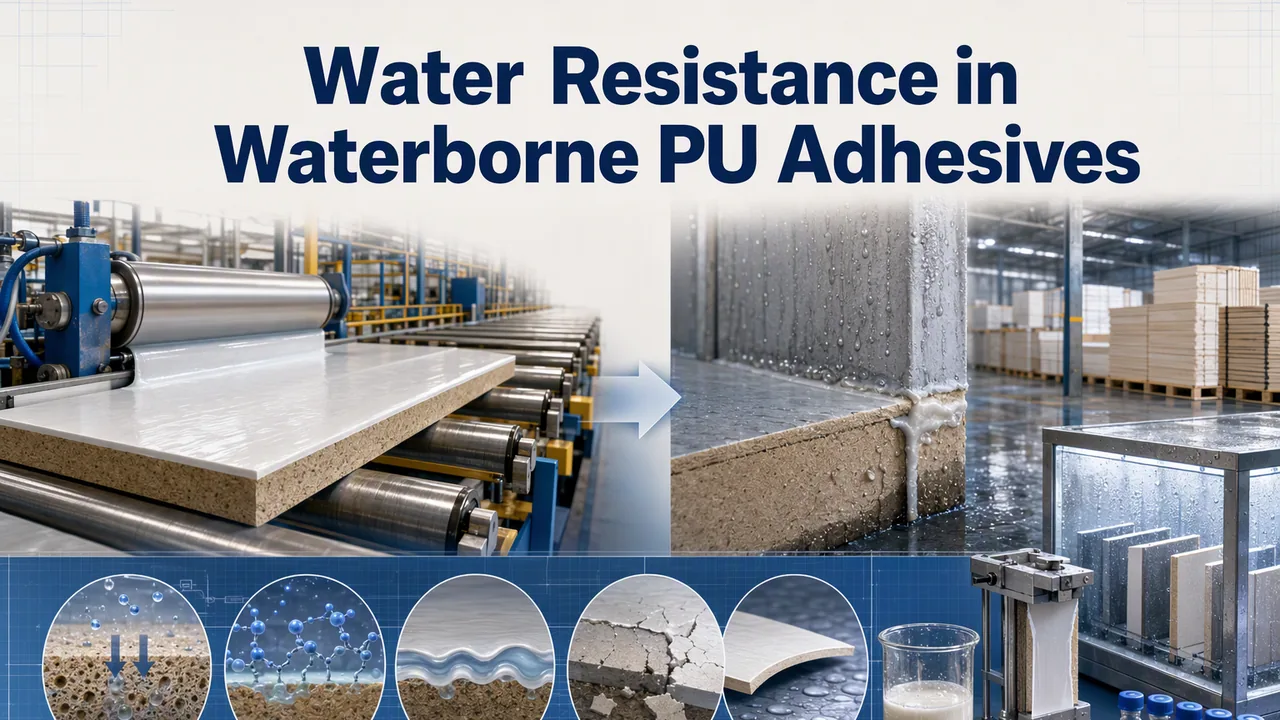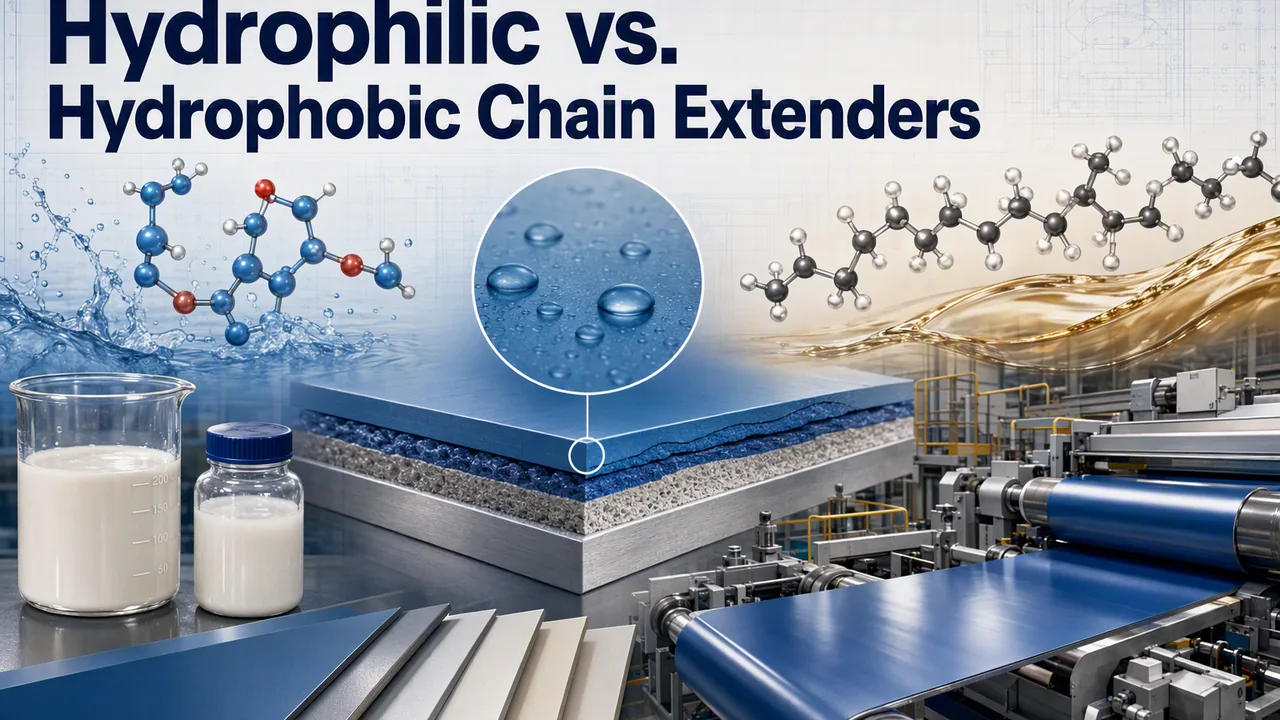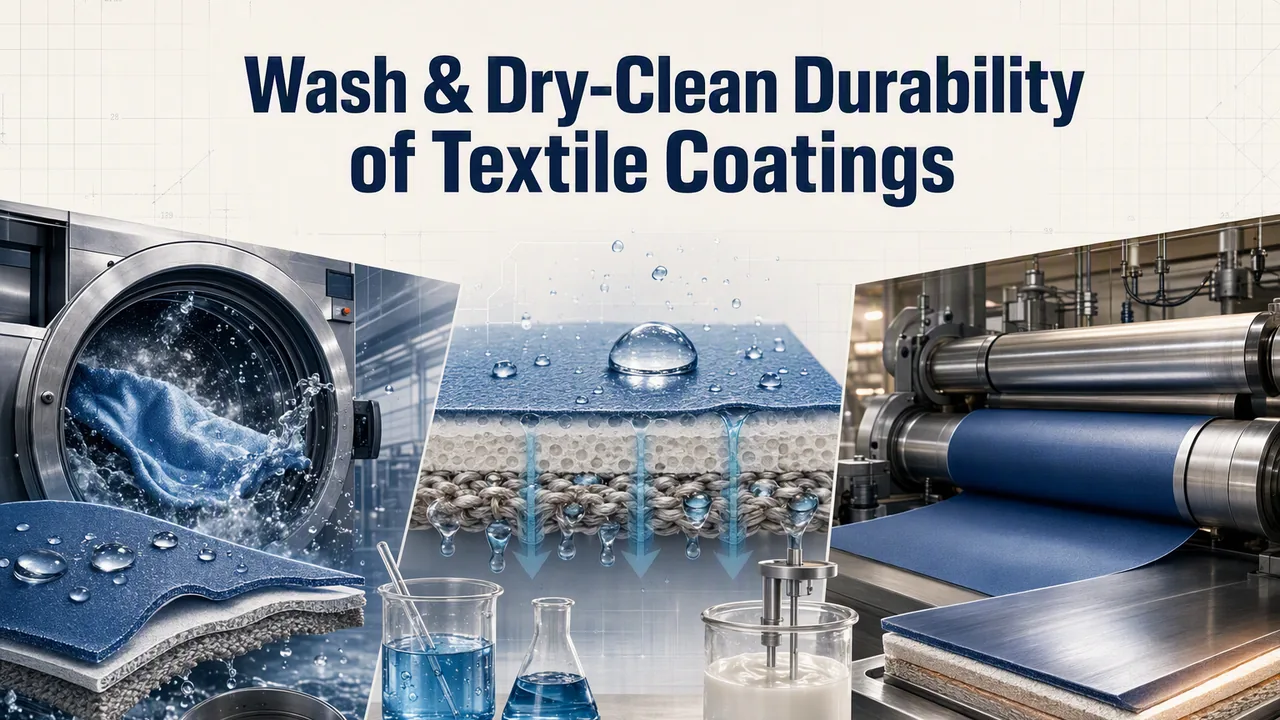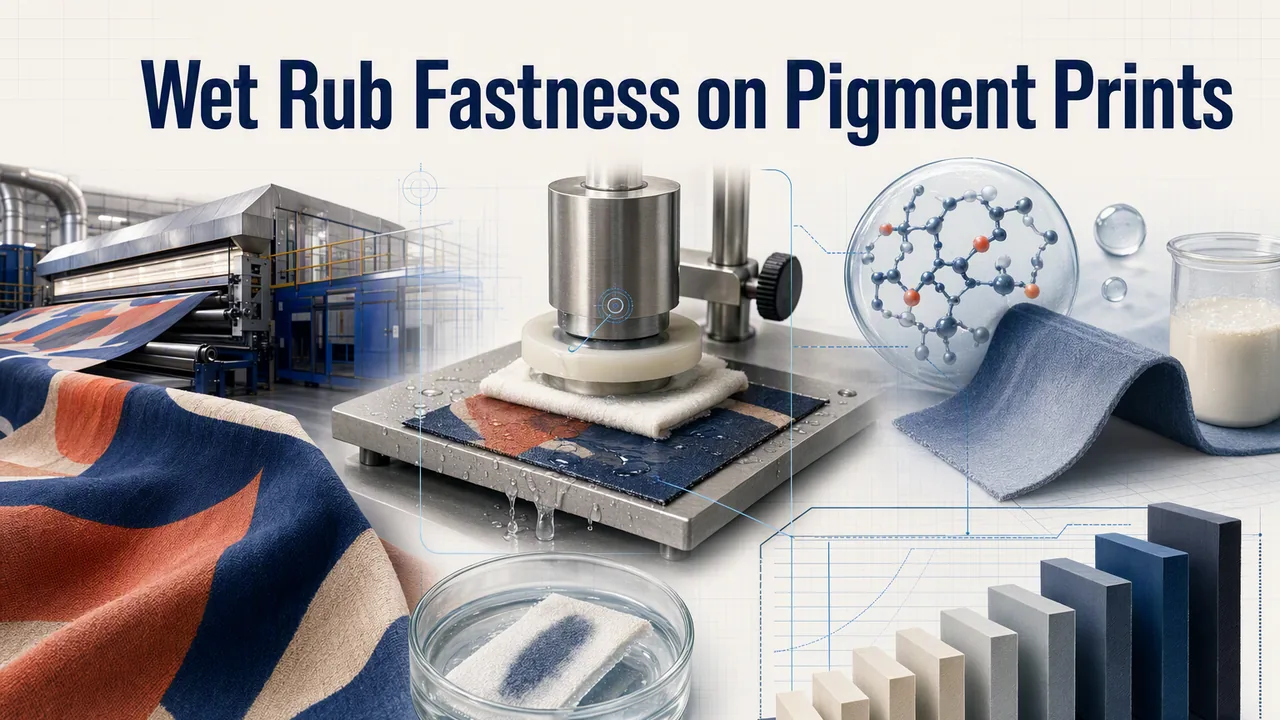
Wet rub fastness is the number that kills a pigment print approval. A 280 gsm cotton-elastane knit came back from a brand lab with dry crocking at 4–5 and wet crocking at 2, printed from one batch of paste on one screen at one squeegee setting. Nothing was wrong with the record. Those two tests do not ask the same question. And on a print that has to stay soft, the reflex fixes are exactly the ones that cost you the hand: a harder binder, more solids, another point of crosslinker.
What a wet crock test is really measuring
Under ISO 105-X12 the dry pass is ten strokes with a conditioned cotton cloth. The wet pass is ten strokes with that cloth at roughly 95% water pick-up, and the stain is read once it dries. Three things happen in the wet pass that never happen dry.
Water plasticises the binder film. A low-glass-transition film feels soft when dry, and it also takes up more water than a stiff one. The same property that buys you hand works against you here. Water then drags the soluble baggage in the paste up to the surface: residual emulsifier, neutralising amine, salts from the make-up water. And a wetted cloth is no longer an abrasive; it becomes a transfer medium.
So the wet grade reports how cohesive a swollen film is, not how hard a dry film is. That is why we look for cohesion at low modulus rather than hardness. Our standard soft pigment printing binder YT-1150 sits at 0.6 – 1.2 MPa 100% modulus, with a tensile strength of ≥ 12 MPa and elongation at break ≥ 1000%. The film stretches with the yarn instead of bridging across it, and it still holds the particle once the yarn has stretched.
Why the usual fixes stiffen the hand
Formulators reach for three moves, and each has a price we have paid on a real job.
Raising add-on puts more resin around the pigment, and it does lift the wet grade by a point. On a knit it also glues the loops together. A print that feels like print at 8% binder pickup feels like a patch at 18%. The buyer's hand panel will tell you that long before the lab reports the crocking improved.
Blending in a hard grade is the second move. The YT-6120 family we sell for PVC reverse-print inks runs 4.5 – 6.0 MPa modulus, ≥ 35 MPa tensile, with under 3% water absorption after 24 h. That film is close to waterproof and roughly five times stiffer than a soft paste binder, so on 20 denier nylon or a 4-way stretch it is the wrong tool.
Dosing a crosslinker is the third. The honest version of that trade is printed on our own TDS. For YT-206 we state that adding a crosslinker improves fastness but may affect hand-feel, and that the crosslinked paste has to be used within 24 hours. You lose pot life and gain a network that cannot yield.
The failure mode nobody expects is a crosslinked print that passes, then falls over after home laundering. A rigid covalent network resists water well and stretches badly. On elastane it micro-cracks every time the knee does, and pigment walks out through those cracks. We have read grade 4 on a flat conditioned swatch and grade 2 on the same fabric after five wash cycles on a stretcher.
The modulus ladder: reading a pigment printing binder spec sheet
Every binder in the table below is one we sell for printing paste or textile coating. Read 100% modulus as the hand. Read tensile strength as how hard you can pull before the film lets go of the pigment. Read elongation as the stretch the film can follow. Solids matter for paste economics, not for fastness.
| Grade | 100% modulus | Elongation | Tensile | Solids | Where it helps |
|---|---|---|---|---|---|
| YT-1062 | 0.5 – 1.5 MPa | 600% | ≥ 6 MPa | 40 ± 2% | Aromatic. Best pigment wrapping and colour development in the soft group |
| YT-1150 | 0.6 – 1.2 MPa | ≥ 1000% | ≥ 12 MPa | 50 ± 2% | Default soft-hand paste binder on knits and elastic substrates |
| YT-206 | 1.0 – 1.5 MPa | ≥ 1200% | 4 – 5 MPa | 30 ± 1% | Clear soft film, strong nylon adhesion for down-proof fabrics |
| YT-1155 | 1.5 MPa | ≥ 1300% | ≥ 25 MPa | 55 ± 2% | Where the print must take abrasion; thick-plate paste and high build |
| YT-1128 | 1.5 – 3 MPa | ≥ 400% | ≥ 10 MPa | 27 ± 1% | Self-crosslinking; wet-heat anti-tack ≥ Grade 3.5 with no aziridine added |
| YT-2250 | 3 MPa | - | - | 50 ± 2% | Highly filled matte recipes; tuned for inorganic powder compatibility |
| YT-6120 | 4.5 – 6.0 MPa | ≥ 500% | ≥ 35 MPa | 35 ± 1% | Where water and solvent resistance outrank hand |
Two conclusions carry over to every job. Modulus doubles between YT-1150 and YT-2250, and tensile roughly doubles with it. Hardness is therefore not what buys cohesion. The other is YT-1128, a self-crosslinking aromatic dispersion that reaches wet-heat anti-tack ≥ Grade 3.5 with nothing dosed into the paste. Built-in functionality gets the wet behaviour without a 24-hour pot life, and that is where we look first once the hand is already at its limit.
One limit stated plainly. YT-1062 gives the best colour yield per gram of binder in the soft group, and it is aromatic. On a pale ground under UV, an aromatic polyurethane discolours. The aliphatic grades on this ladder exist for that reason, and they cost more.
Check the paste room and the dryer before you blame the resin
About a third of the wet-crocking complaints we get are not formulation at all. The first thing we ask for is the process sheet.
Ionic clash is the commonest one. Most paste binders here are anionic. A cationic softener applied upstream bites the dispersion, and so does hard make-up water carrying calcium and magnesium. The film that dries is then not the film that was dispersed, so the print comes up sandy and the wet cloth lifts colour straight off it. Same paste, softened water, better grade.
Charge helps when you aim it deliberately. YT-7010 is a cationic aliphatic dispersion at 16 ± 1% solids and pH 4 – 7. We make it for pretreating pale cotton and polyester-cotton before waterborne pigment inkjet printing. It holds the pigment where it lands, so you keep definition and colour strength at a low add-on. The fastness comes from that anchoring and a soft hand, not from building a thick film.
Then look at what keeps the pigment up in the paste rather than sinking between the yarns. Rheology is a wet-crock lever before it is a print-definition lever. When a print bleeds into the fabric structure and leaves a dry, powdery surface behind, our associative thickeners are the first place we go.
And check the oven, because heat is a window rather than a ramp. The YT-7010 TDS illustrates it: pad to 65–75% wet pick-up, then dry at 100 – 105 °C for about 3 minutes. Above 110 °C, wash fastness can get worse rather than better. After printing, cure at 150 °C for 3 minutes. Too cool and the film never coalesces, so pigment rinses out the moment water finds it. Too hot and too fast, and the surface skins over a wet core that never fuses.
What to change first when wet crocking fails
- Re-read the result before you change the recipe. Condition the print for 24 hours. Assess the wet stain only after it has fully dried. Then run the crock again after one wash, because a print that is still developing scores low on day one.
- Fix the cure window. Log oven set point, fabric surface temperature and dwell. Compare them with the TDS window for the binder you are actually using. This catches more cases than a resin swap.
- Remove the ionic clash. Stop the cationic softener and check make-up water hardness. Re-test with RO water before you touch the binder.
- Take the soluble baggage out. Every point of free emulsifier and low-molecular surfactant migrates to the surface and re-opens under a wet cloth.
- Add cohesion instead of hardness. YT-G30 is a polymeric carbodiimide at 50 ± 2% in PMA, dosed at 1 – 5%. It reacts with the carboxyl groups that hold water in the film. It is slow at room temperature so your open time survives, and it crosslinks during drying. It is also non-sensitising and yellows less than a polymeric aziridine. This comparison of aziridine and isocyanate crosslinkers covers when each chemistry is the wrong choice.
- If the hand is contractual, buy anchor instead of film. Pretreat with YT-7010 and drop paste add-on, rather than pushing another binder layer onto a soft fabric.
What we cannot sell you is grade 4 wet crocking on a heavy pigment load with a sub-1 MPa binder, no crosslinker and no cure change. That combination does not exist. The binder range behind our waterborne polyurethane dispersions page covers the soft end honestly, and the textile coating and printing page lists which grade suits which process. For the modulus and pH figures above, the YT-1150 TDS (PDF) is the document to check against your own recipe.
Send us the fabric, the pigment load and the crock report. Ask our application lab and we will come back with a paste starting point rather than a brochure.
Frequently asked questions
Why does my pigment print pass dry crocking and fail wet?
Dry rubbing only removes pigment that was never anchored. Wet rubbing first swells the binder film and dissolves out the surfactant and salts left in the paste. It then transfers whatever that swollen surface releases. A film can be perfectly cohesive dry and give up colour the moment water plasticises it.
Does a softer binder always mean worse wet rub fastness?
No, and this is where most specs mislead. Hand follows 100% modulus. Wet cohesion follows tensile strength and how much free charge is left in the film. YT-1150 gives ≥ 12 MPa tensile at 0.6 – 1.2 MPa modulus with ≥ 1000% elongation. That is how a soft print still holds grade 3 to 4 wet.
How much crosslinker goes into a textile pigment paste?
For the polymeric carbodiimide YT-G30 we work from 1 – 5% on paste solids, added under stirring. Start at 1%, because carbodiimide consumes the same carboxyl groups that keep the dispersion stable. Move to 3 and 5% only if the wet grade still falls short. Two-part isocyanate systems put you on a pot-life clock instead, and a crosslinked YT-206 paste is dead inside 24 hours.