A formulator on a wood-coating line called us last month with a familiar story. His acrylic topcoat passes every wet-rub test in the lab, then fails washability on customer cabinets within a week of warm storage. The two candidates on his desk: a polyfunctional aziridine crosslinker and a water-dispersible aliphatic isocyanate. Both promise harder, tighter films. Neither data sheet tells him what happens to his pot life in a 35 °C workshop, or what his EHS team will say when they read the hazard classification. Choosing between an aziridine crosslinker and an isocyanate crosslinker for a waterborne system is a decision we help customers make almost every week, so here is the full comparison.
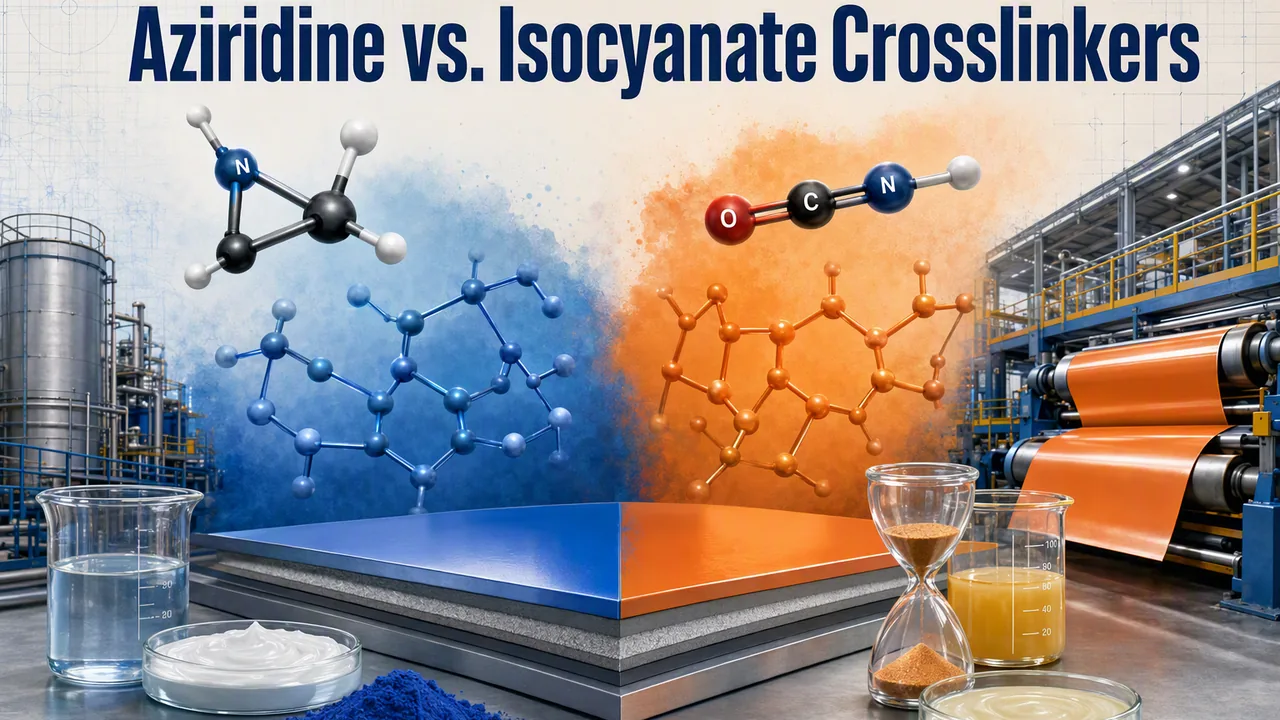
Two crosslinkers, two different reactions
Aziridine crosslinkers attack carboxyl groups. Most waterborne acrylics, and many polyurethane dispersions, carry a small fraction of carboxyl-bearing monomer neutralized with amine. A polyfunctional aziridine ring opens and reacts with those COOH sites, stitching chains together. The reaction accelerates as the film dries and the pH shifts, which is why aziridines deliver such a dramatic jump in wet-rub and blocking resistance at modest addition levels, often just 1–2% on total formulation.
Isocyanate crosslinkers play a different game. They react with hydroxyl groups, and in waterborne systems they also react with water itself. That second reaction is both a feature and a liability. It lets you crosslink even polymers with few OH groups, but every NCO group consumed by water releases CO₂, and CO₂ trapped in a drying film shows up as microfoam or pinholes, especially on wet films thicker than roughly 100 g/m². Dosage becomes a stoichiometry exercise: formulators typically run NCO:OH at 1.1–1.3 : 1 to leave margin for the water loss, because overcorrect in the other direction and the excess NCO ends up as bubbles and urea rather than crosslinks.
A third chemistry matters in this decision even though it is rarely on the first page of search results. Carbodiimides react with the same carboxyl groups as aziridines, but far more slowly at room temperature, which changes the pot-life picture entirely. Keep it in mind; we will come back to it.
Pot life: what an isocyanate crosslinker costs you in open time
On paper both chemistries are "added just before use". In practice they behave very differently in the bucket.
Aziridine carboxyl crosslinking is slow at application pH and speeds up only as the film dries. We have run aziridine-crosslinked acrylic wood lacquers that were still sprayable four to six hours after addition. The catch is silent: some viscosity creep is normal, and once you pass the working window, final hardness and water resistance quietly drop even when the paint still looks fine.
Water-dispersible polyisocyanates give you a defined but shorter window. Our anionic grade YT-6300 has an activation open time of 3–4 hours; the non-ionic YT-1102 stretches to 5–6 hours. Those are honest bench figures at standard solids, and they shrink in warm shops. A tropical line can easily cost you an hour of that window, so plan your batch sizes accordingly.
Safety: why formulators keep replacing aziridine crosslinkers
This is usually the deciding factor, so let us be direct. Polyfunctional aziridines carry a harsh hazard classification in the EU: skin sensitization plus suspected mutagenicity, and some commercial grades are classified for carcinogenicity. You can check the current entries in the ECHA classification inventory. That file drags along labeling, PPE requirements, and increasingly, raw-material questionnaires from brand owners. Several of the coating brands we supply have written aziridine crosslinkers out of their approved lists entirely. Closed industrial processes can still run them responsibly, but the trend is one-directional.
Isocyanates have their own, better-understood file: respiratory sensitization driven by free monomer. The control lever is the residual monomer figure, and it is a number you can actually specify. Both of our water-dispersible grades spec free monomer at ≤ 0.2%, a level most EU formulators accept for industrial application. Spray application of any isocyanate still demands respiratory protection and local exhaust; that is a manageable, documented risk profile rather than a structural problem.
Aziridine vs. isocyanate vs. carbodiimide: side-by-side
| Property | Polyfunctional aziridine | Water-dispersible polyisocyanate | Polymeric carbodiimide |
|---|---|---|---|
| Reacts with | Carboxyl (COOH) | Hydroxyl + water | Carboxyl (COOH) |
| Typical dosage | 1–2% on formulation | NCO:OH 1.1–1.3 : 1 | 1–5% on formulation |
| Wet-state open time | 4–6 h typical, some viscosity creep | 3–4 h (YT-6300) / 5–6 h (YT-1102) | Minimal viscosity change over a working day (YT-G30) |
| Thick-film risk | None reported | CO₂ pinholes above ~100 g/m² wet | None reported |
| Yellowing | Moderate | Excellent (aliphatic) | Better than aziridine |
| Safety file | Sensitizing, suspected mutagen | Free monomer ≤ 0.2% on both grades | Non-sensitizing |
| Best fit | 1K acrylic/PUD in closed processes | 2K wood, plastics and floor coatings | 1K aziridine replacement, baking systems |
The carbodiimide route: aziridine performance without the hazard file
When a customer wants aziridine-like performance but cannot live with the classification, we usually point them at our polymeric carbodiimide crosslinker YT-G30. It reacts with the same carboxyl sites an aziridine would, so switching rarely requires reformulating the resin itself. It is non-sensitizing, and in accelerated weathering its yellowing resistance beats aziridine chemistry. Supplied at 50 ± 2% solids in PMA with a viscosity of 80–150 cps at 25 °C, it doses cleanly at 1–5% and, unlike small-molecule aziridines, it barely moves the viscosity of the base resin during the working day. For a deep dive on the category, see our crosslinker and curing agent line.
Honest limitation: carbodiimides are slower than aziridines at ambient cure. If your process needs full property build-up within 24 hours at room temperature, an aziridine or an isocyanate will get there first. YT-G30 prefers a baking step, which suits most industrial wood and metal finishing and suits air-dry architectural work much less.
YT-1102 or YT-6300: picking the 2K grade
Both are aliphatic water-dispersible polyisocyanates, both deliver hardness, water and chemical resistance on most neutral waterborne polymers, and we use them interchangeably on paper more often than we should. The practical differences:
YT-1102 is the non-ionic grade, 99–100% solids with an NCO content of 19–21%. Non-ionic dispersibility makes it the safer choice in formulations loaded with non-ionic thickeners or electrolyte-sensitive additives, and its 5–6 hour open time is the longest we offer in a 2K package.
YT-6300 is the anionic grade at 100% solids, NCO 20.5–21.5%. It disperses into water with hand stirring alone, needs little or no thinning solvent, and its higher NCO content means lower dosage than a conventional curing agent. On low-VOC projects, that solvent reduction is often what decides it. If you are still weighing the binder side of the same formulation, our earlier comparison of waterborne PU vs. acrylic dispersion picks up where this leaves off.
Both grades earn their keep in waterborne wood coating, plastics finishing and floor seals, wherever a several-hour pot life and overnight property build-up fit the line.
A one-afternoon bench protocol before you commit
- Pot-life series. Draw down at 0, 2, 4 and 6 hours after mixing. Measure Konig or pencil hardness daily for a week. The curve, not the viscosity reading, tells you when the crosslinker stopped working.
- Thick-film check for isocyanates. One 150 µm wet drawdown, inspected under raking light for pinholes. If CO₂ shows up, cut film build or raise the NCO margin slightly.
- Water uptake. 24-hour cold-water soak, weigh before and after. Crosslinked films should gain far less than the uncrosslinked control.
- Cure schedule for carbodiimide. Run YT-G30 at 60 °C/30 min against an ambient-cured panel so you know exactly what the bake is buying you.
Frequently asked questions
Can I replace an aziridine crosslinker with a carbodiimide one-to-one?
Chemically yes, since both target carboxyl groups, and most resins need no reformulation. Kinetically no: expect slower ambient cure and add a bake step or extend dry time. Typical dosage rises from 1–2% for aziridine to 1–5% for YT-G30.
How long is the pot life of a 2K waterborne system with YT-1102 or YT-6300?
Bench figures at standard solids: 5–6 hours for YT-1102 and 3–4 hours for YT-6300. Both windows shorten in warm shops, so verify with the drawdown series above on your own line conditions.
Are polyfunctional aziridine crosslinkers banned in the EU?
Not banned outright, but their classification for skin sensitization and suspected mutagenicity under CLP triggers labeling and PPE duties, and many brand owners have removed them from approved raw-material lists. Current classifications are published in the ECHA inventory.
If you want a second opinion on your specific resin system, Ask our application lab. You can also pull the technical data directly: YT-G30 TDS (PDF), YT-1102 TDS (PDF) and YT-6300 TDS (PDF).