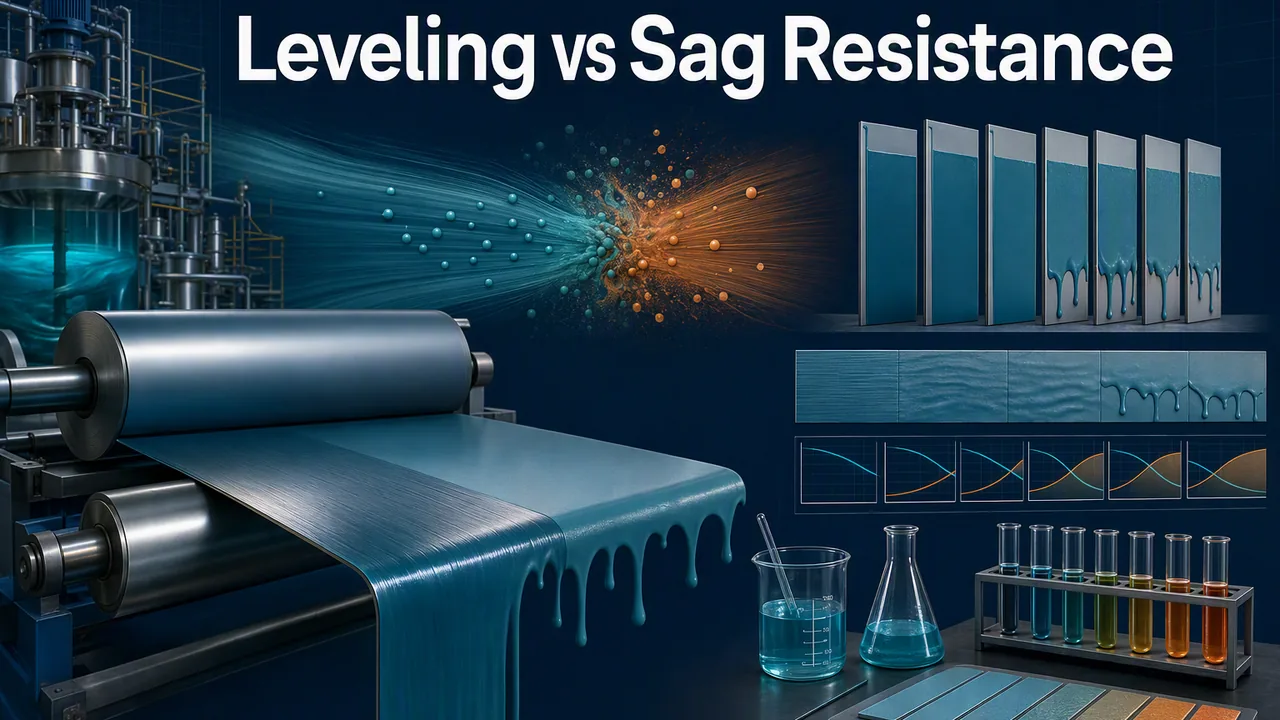
The message usually opens the same way. A waterborne clearcoat sags about 40 mm below the spray edge on a vertical panel at 180 µm wet film, so the formulator lifts the thickener by 0.3%, the sag stops, and the brush marks from the previous station are still sitting there eight minutes later. The instinct was right. It was pointed at the wrong number.
Sag and leveling are not opposites across the whole rheology curve. They fight inside one narrow band of it, and that is why the obvious fix keeps making one of them worse.
Why anti-sag and brush-mark leveling fight over the same viscosity
Both are slow-flow defects. A film on a vertical surface creeps at shear rates well below 1 s−1, and only the two to five minutes between application and the onset of drying decide whether it walks. Flow-out of a 15 µm brush groove is surface-tension driven, in the same low-shear window, over the same minutes, in the same film. Anything you do at 0.1 s−1 moves both. Gravity is not negotiating.
The variable worth arguing about is therefore not the height of the curve but the rate at which structure returns. A pseudoplastic network that collapses under the bristles and rebuilds inside a minute holds a vertical film and still lets a groove close. One that needs four minutes levels like glass and then slides down the panel. That time constant is set by hydrophobe level and molecular weight, which is why two associative grades at the same solids can behave like different products on the same panel.
We also meet the reverse case, and it is harder to fix: a coating whose low-shear structure never fully breaks down under the applicator. Viscosity looks healthy in the can, the panel does not sag, and the brush marks stay visible until the film is sanded. Over-built structure is a real failure mode, not a safe default.
Which shear rate owns which defect
Before changing anything, put a number on the complaint. Four bands cover almost everything we are asked about, and each one is read on a different instrument. This is why a KU reading can sit dead on target while the panel runs.
| Shear band | What it decides | How we read it | Defect when it is wrong |
|---|---|---|---|
| Below 0.1 s−1 | Sag on verticals, pigment settling | Anti-sag blade, creep | Sags under the spray edge, hard sediment |
| 1–10 s−1 | Flow-out of brush and roller marks | Leveling drawdown | Marks that never close, orange-peel texture |
| 100–1,000 s−1 | In-can body, pumping, film build | Stormer KU, spindle at 6 / 12 / 60 rpm | Watery handling, starved film thickness |
| About 10,000 s−1 | Brush drag, roller spatter, atomisation | ICI cone and plate | Spatter, poor atomisation, brush drag |
QC labs spend their time in the middle two bands because that is where the instruments sit. The defects live in the outer two, and the bottom band is the one that decides sag.
A ladder study that answers the question in a day
Run the panel first and the viscometer second. That order sounds obvious and is regularly reversed, which is how a batch gets signed off on a KU number and fails at the customer. The full ladder costs an afternoon and about two litres of sample.
- Fix the film before you touch the rheology. Draw down at 150, 200 and 250 µm wet on a vertical panel. If 250 µm runs whatever you do, the answer is film build, not thickener.
- Run the sag panel with a multinotch applicator held vertical at 23 °C, the way ASTM D4400 describes it, and note the first notch that fails rather than pass / fail.
- Run the leveling drawdown on the same sample at the same wet film, following ASTM D4062, and score it against your own reference panel rather than a photograph from a catalogue.
- Only then read the viscometer, all at 23 °C after 24 hours of rest: KU, 6 / 12 / 60 rpm on a disc spindle, and ICI cone and plate. The 6 rpm figure is the one that tracks the sag notch.
- Step the thickener in 0.2% increments on total formulation and repeat the two panels. Two or three steps are normally enough to find the knee of the curve.
One variable per ladder. Formulators who change thickener type and dosage at the same time usually end up with two panels that disagree and no way to read them. Our house rule is a single 0.2% step, panels before numbers, and a written target for both defects before the first drawdown is made.
Blending two grades instead of over-dosing one
Once the panel says which end is wrong, the fix is usually a blend rather than a bigger dose. Raising a single low-shear builder buys sag resistance with leveling, because the two compete in the same measurement window. Splitting the job between a low-shear builder and a high-shear leveling type buys both, because the two act in different windows.
This is the shortlist we put on trial cards, with the numbers copied off the data sheets rather than written for an article.
| Grade | Shear band | Why you would pick it | Solids | Viscosity as supplied | Dosage window |
|---|---|---|---|---|---|
| YT-255E | Low shear, strongly thixotropic | Sag and settling control with good pigment wetting; drop-in for 12W and 299 | 40 ± 2% | 5,000–8,000 mPa·s | — |
| YT-255A | Low shear | Low-shear body with mild leveling, pH-independent, drop-in for 105A | 40% / 50% | ≤ 30,000 mPa·s | 0.5–2.0% of formula |
| YT-155A | Low shear, pH 7–9 | Pseudoplastic body with spatter-free rolling and resistance to biodegradation | 30% / 40% / 50% | ≤ 30,000 mPa·s | 0.5–20% of formulation |
| YT-255B | Medium shear | Leveling with medium-shear build, solvent-free, drop-in for 8W | 40% | ≤ 25,000 mPa·s | 0.5–2.0% of formula |
| YT-255C | High shear | Leveling and high-shear viscosity build together, drop-in for PS166 | 20% / 40% | ≤ 30,000 mPa·s | 0.5–2.0% of formula |
| YT-330B | Mid-to-high associative | Leveling plus anti-settling and anti-float from one drum; free of organic tin and APEO | 30 ± 1% | 20,000–30,000 mPa·s at 25 °C | — |
Two pairings cover most of what we see. On a vertical-panel line with a pigmented topcoat, the low-shear builder carries the sag and the high-shear type carries the flow-out: YT-255E or YT-255A in the first role, YT-255C in the second. On a shop that wants one drum and the shortest bill of materials, a mid-to-high associative grade such as YT-330B is documented as building high viscosity under high shear with outstanding flow and leveling, plus anti-settling and anti-float, and it contains no organic tin or APEO. We reach for it first when the customer has a single let-down tank and no appetite for a second component.
Where the data sheet does not quote a dosage window, treat the ladder study as the only source of truth. That applies to the thixotropic grades in particular. YT-255E arrives at 5,000–8,000 mPa·s, which is deliberately low so it pours off a metering cup without a solvent rinse, and it also means a cup drawn straight after dispersion reads badly against a can that has rested. Rest the cup half an hour before you judge it.
Sequencing decides as much as the ratio. Add the low-shear builder during let-down with the pigment paste so the structure has time to develop, and add the high-shear leveling grade last, after the pH adjustment, with the mixer at low speed. Both are non-ionic and pH-independent, so neither needs neutralisation and neither drifts when let-down water hardness changes. Start at the bottom of the documented window, read the panel, then step. The YT-255E technical data sheet gives the storage range as 5–30 °C and a 12-month shelf life, and the same applies across the 255 range.
If the parts are furniture or cabinet components coated on a vertical line, our wood coating application guide lists the resins we pair with these rheology grades, stage by stage. For in-can or storage behaviour rather than application behaviour, the sibling failure we see most often is viscosity loss during storage, and it needs a different diagnosis entirely. The rest of the range, including a solvent-free medium-shear grade, sits on the PU rheology additives page.
What no blend will fix
Three limits, because they arrive with every second inquiry and the honest answer is cheaper than a trial batch.
Thick films on vertical surfaces. No associative thickener holds 350 µm wet on a vertical panel. If that is the specification, the film build comes down or a genuine sag control additive goes in. Asking a HEUR to do that job is how a formulator ends up at 3% thickener with a coating that no longer flows or dries evenly.
Atomisation and orange peel from a spray gun. That is a shear and solvent-release story at the nozzle, and gun setup, tip size, viscosity at the gun and flash-off all outrank the thickener. We have watched a coating get reformulated twice for a defect that was a 1.4 mm tip on a primer.
Cost and collateral effects. Per kilo of viscosity delivered, a cellulosic ether is still cheaper than any associative polyurethane, ours included. Past roughly 2% on formula you are buying sag resistance with leveling, water resistance and money. Our non-ionic grades are documented as having no adverse effect on the gloss of the formulated product, and that still leaves the drying rate and the open time to watch.
One more thing worth saying out loud. In a tinting base with a heavy pigment paste, we often keep a cellulosic backbone for pigment float and use the HEUR for sag, leveling and application feel. A partial replacement is a normal outcome and not a compromise.
Questions we get on this trade-off
Can a single associative thickener give both leveling and sag resistance?
Partly, and mid-to-high associative grades get closest. But when a panel fails below 0.1 s−1 while the leveling drawdown is already marginal, two grades at lower total dose beat one grade pushed higher. In practice most of the formulations we help with end up with two.
How do I know which one my complaint actually is?
The panel tells you, not the viscometer. Draw both panels on the same sample at the same wet film. If the film moves on the vertical panel, that is the low-shear end and it outranks the leveling question. If it stays put and the marks do not close, you are looking at recovery rate rather than viscosity, and the fix is a different grade rather than more of the same one.
Does a higher KU guarantee better sag resistance?
No. KU sits in the mid-shear band, and sag is decided below 1 s−1. A specification with one viscosity number cannot describe both ends of the curve, which is why we write KU, a 6 rpm disc reading and a pass / fail on the sag panel into the specifications we hand customers.
If a panel is sagging and the leveling has gone with it, send us the formulation, the two drawdowns and the wet film you are running. We will tell you which end of the curve to move, and the lab can run the ladder on your sample first. Ask our application lab.