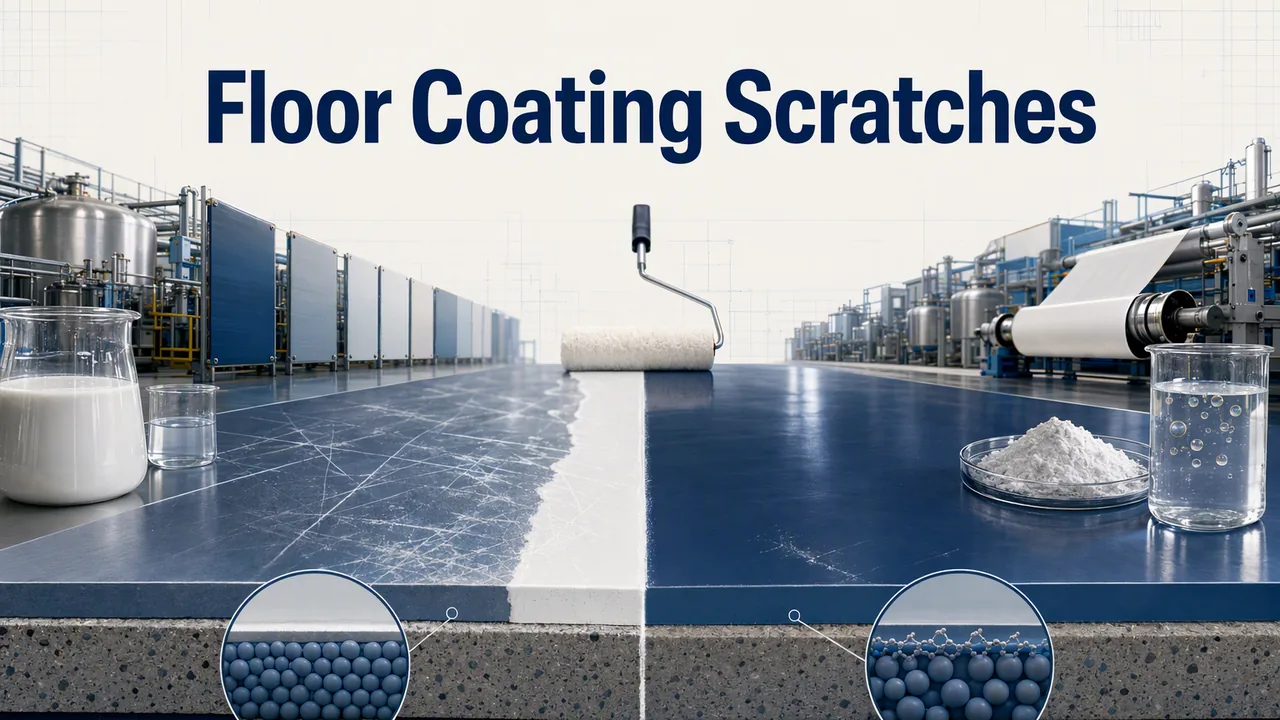
A flooring plant in Zhejiang called us about a white haze that appeared three months after delivery. Not on the display boards. On the walkway in front of the sales counter, where customers stop in hard-soled shoes. The topcoat was a 2H pencil-hardness waterborne PU that had passed every outgoing test we could point at. The whitening was not a defect in that film. It was a consequence of how hard it was.
Scratched waterborne floor coatings and the white marks that follow them get sold as one problem. They are two. Fixing one with the tool built for the other is how a floor goes from clear to chalky in a quarter.
Two failures, one coat of white
A scratch is material displaced. Something harder than the film rides over it and pushes a groove. You see it as a line, and you feel it with a fingernail.
Stress whitening is different. It is light scattering. When the film is stretched and crazed at a microscopic scale, air enters the voids, and every void wall bends light out of the beam that was showing you the wood. The mark looks white because it is full of air. Compress the same spot with a hot needle and the white often disappears: you have closed the voids.
The mechanism matters for selection because whitening needs two things at once. Stress has to reach the film, and the film has to be unable to absorb it without crazing. A hard, dense, low-elongation film satisfies the second condition beautifully. That is why the toughest floor in the shop is frequently the one that shows white first.
Route one: pack the film tighter
The denser-film logic is straightforward. Higher hardness resists penetration, so the groove never forms. YT-6058 is our specialty grade for this: 40 ± 2% solids, semi-transparent, pencil hardness 1H–2H, at 50–200 mPa·s so it still flows off a roller. Where water and cleaning chemicals are part of the service life, YT-6070 is the pick, also 40 ± 2% solids with the water resistance carried by film cohesion rather than by wax.
A dense topcoat is only half of it. Whitening on wood often starts at the interface, where a thin first coat bridges open grain and then cracks with the substrate. A penetrating sealer kills that. YT-6035 is built for it: 35 ± 2% solids, low viscosity, sand-binding, hard modulus, so the grain is locked before the build coat arrives. On a mid coat that has to be sanded between layers, YT-6059 holds H–2H and sands clean.
The honest limit of this route: hardness is bought with elongation. A 2H film on a floor that moves with seasonal humidity will craze under footfall, and crazing is the whitening mechanism. We have watched customers raise pencil hardness and make the white marks worse.
Route two: lower the friction at the surface
The slip route stops the stress from arriving. A wax micro-dispersion raises the force needed to initiate a groove and, more usefully, lets a shoe sole slide instead of grabbing and dragging. YT-6359 is a large-particle waterborne micro-dispersion of the matte wax-paste type. It takes water at any ratio and stays stable after dilution, which is what makes it usable in a floor shop that thins by eye.
Its datasheet numbers are the reason we treat it as a trade, not a free win. At 5% addition, 60° gloss drops by about 20 units. Good abrasion resistance with a visible matting effect lands in the 5–10% band. If the customer wants a clear high-gloss floor and no slip, you cannot have both from this additive.
Two other costs. Wax at the surface is a recoat liability: intercoat adhesion on a wax-loaded floor is a real question, and the same overdose that gives you a silky hand gives you craters in the next coat, which we covered in our fish-eye troubleshooting article. And YT-6359 flocculates with C16 alcohol-ester raw materials, so a tint or a co-solvent package built on those esters will spoil the dispersion before it reaches the floor.
If the goal is a matt floor anyway, the matting question is a separate one, and we would rather you read our self-matting versus silica blooming article before reaching for a wax paste to knock back gloss.
What each route actually buys you
| Move | Fixes | Costs you | Grades |
|---|---|---|---|
| Denser, harder topcoat | Penetration scratches, chemical and water attack | Elongation; crazing and white marks under flex | YT-6058, YT-6070 |
| Sealed grain underneath | Interface whitening at open grain | One extra pass and a sanding step | YT-6035, YT-6059 |
| Slip and anti-scratch additive | Drag marks, burnish, heel scuff | About 20 gloss units at 5%; recoat risk; ester incompatibility | YT-6359 |
How we choose on a real floor line
We run the same short sequence on wood floor and parquet systems in our specialty additives trials, in this order, because the first two answer the question the customer asked and the rest answer the question they did not.
- Reproduce the mark. A hard-soled shoe and a chair leg on a tiled panel, ten passes each, before any instrument.
- Decide which failure you are looking at. Press the white area with a warm fingertip. If it fades, air is in the film and you have crazing, not removal.
- Read gloss before and after burnishing with 0000 steel wool. A film that loses more than a few gloss units is burnishing, and hardness will not save it.
- Pull the recoat adhesion on the additive-loaded panel at the top of the dosing range, not the bottom.
- Only then run the abrasion wheel and compare weight loss between the two routes.
What this sequence cannot tell you: how the floor behaves in month fourteen with a humid winter behind it. For that we rely on the panel kept by the window, and on customer reports, and both have surprised us.
Questions we get on floor coatings
Is a harder floor always more scratch-resistant?
Against penetration, usually yes. Against whitening, often no. Hardness without elongation concentrates the stress in a narrow band under the contact point, and that is exactly where crazing starts. We would rather have 1H with the grain sealed underneath than 2H bridging open grain.
How much anti-scratch additive should a floor topcoat carry?
Start at 3% on total formulation and work up. The useful band for YT-6359 is 5% to 10%, and above that the gloss cost and the recoat risk grow faster than the scratch benefit. Confirm with your own burnish panel, and check any ester-containing tint base first.
Can I fix a floor that already whitens?
On installed boards, mostly no, because the crazing is inside a cured film. A light abrasion and a fresh coat carrying the slip route over a sealed base is the reliable fix. On the shop floor, before it ships, you change the topcoat and re-run the panel.
If you want a second read on your own floor system, send us a coated panel and the mark you are chasing. We will tell you whether the answer is a denser film, an additive at a specific dose, or a sealed first pass, and what it will cost you in gloss. Start with our application team, or download the YT-6058 and YT-6359 datasheets.