A container of protected glass panels sat on a dock in Guangdong for six weeks in July. The film had come off in one piece at the end of the line. On the dock it split into strips halfway across each panel. The half that stayed behind came off by hand, one panel at a time, in front of the customer. The buyer's conclusion was that peelable coatings do not work. Ours was that somebody had asked a temporary coating to do a permanent one's job.
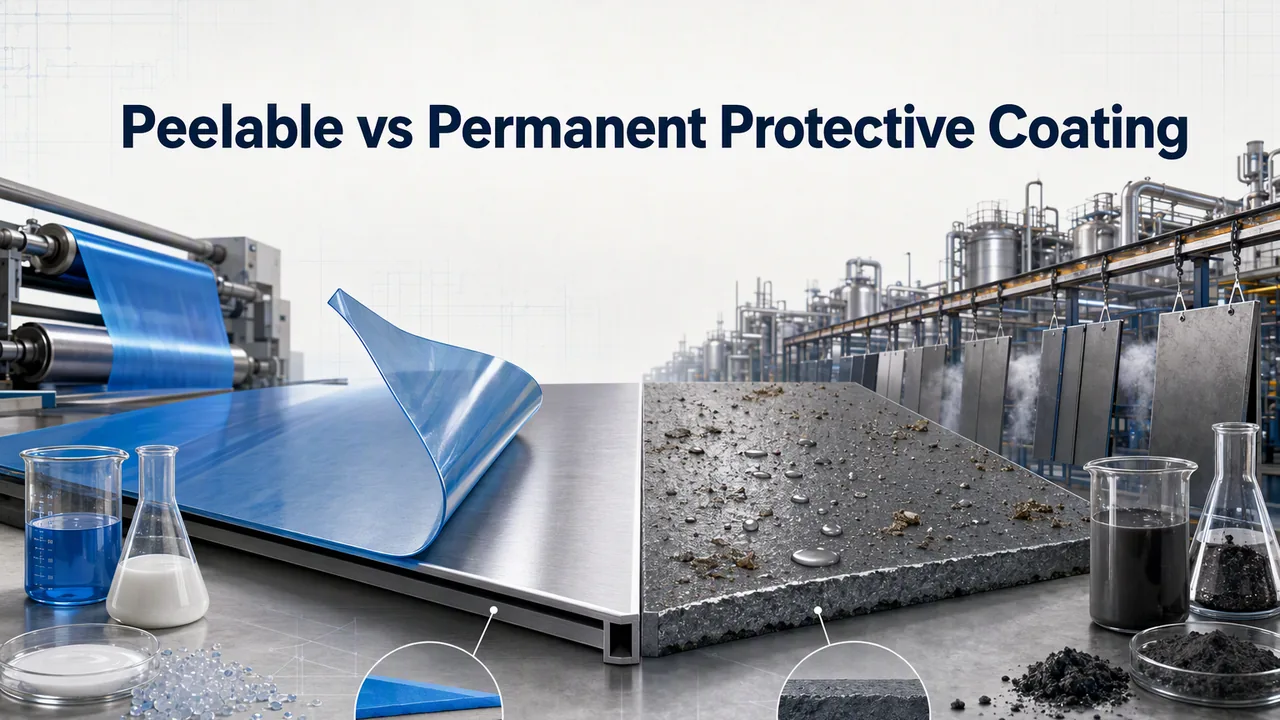
Peelable and permanent protective coatings get compared on toughness. That is the wrong axis. They differ on where the protection ends, and on who pays for the ending.
The question is where the protection stops
Every protective coating has a service window. A temporary one exists until the next station. The panel is cut, drilled, shipped, unboxed, and the film goes in the waste stream. A permanent one exists for the life of the part. It has to survive cure, storage, UV, cleaning agents and the first scratch. It can never be taken back.
That difference moves the cost: with a peelable film you pay for removal twice. Once in labor and disposal at the downstream plant, and once in the risk that removal takes something with it. With a permanent coating you pay for the guarantee instead. You pay it in solids and in cure conditions, and in the fact that a defect is now a rework rather than a sheet you throw away.
What a peelable film gives up to stay removable
Removability is a balance, not a property. The film has to hold itself together well enough to come off in one piece. It has to stick to the substrate well enough not to blow off in transit. Neither of those is allowed to turn into anchoring. YT-8083 sits on the soft side of that balance on purpose. The cured film is translucent, with high elongation and stretch. It runs at pH 7 to 9 and 200 to 1000 mPa·s, so it takes a roller or a spray without help.
The thickness rule is where the money hides, and for clean peel we ask for a dry film of at least 50 μm. At 35 ± 2% solids that is roughly 145 μm wet, or about 150 g/m² of material going up the wall. A permanent protective coat at the same line speed and 30 μm dry lands near 100 μm wet. Per square meter you put down two-thirds more resin solids to buy a coating you intend to throw away. That is the correct trade when the alternative is a scratched finished part.
Process is the other half of it. YT-8083 wants ten minutes to stand after application before it goes into 60–80 °C drying. That pause is what lets it level. Skip it and you get an orange-peel surface. Pull orange peel and it tears at the edge, so you get a film in fragments. We let the panel sit for the ten minutes, and we tell customers the flash is not optional.
What we cannot tell you is how long the film survives heat in a closed container. In our lab we test 24 hours and two weeks, and beyond that we are extrapolating. and the dock in July is not in our test data.
What a permanent coating has to survive
The permanent route asks the film to be the product's skin. YT-6153 is our workhorse there. It is an anionic aliphatic dispersion at 31 ± 1% solids and under 300 mPa·s. The film reaches HB pencil hardness and absorbs 4 to 5% water after 24 hours at 25 °C. It is smooth, scratch and abrasion resistant, and it carries no formaldehyde, nonylphenol, heavy metals, PAHs or DMF.
Where the part sees water and cleaner, we move it up with a crosslinker rather than changing resin. YT-G30 is a polymeric carbodiimide at 50 ± 2% solids in PMA, dosed at 1 to 5%, added under stirring. It reacts slowly at room temperature, so the coated part keeps a workable open time. Then it speeds up as the film dries and the temperature rises. In a cold shop it thickens; pre-heat it above 15 °C or dilute with PMA before dosing.
Two rules come with the permanent route. First, do not blend it with adhesives of a different nature. If you want to cut cost by mixing grades, stay inside the anionic family. Our compatibility article covers what happens when you do not. If HB is not enough for the job, YT-615 is the stiffer aliphatic option. It runs at 35 ± 1% solids with a modulus of 8.0 to 9.0 MPa and tensile strength of 20 to 30 MPa, and it brings the gloss and light fastness that go with that. The trade is a six-month shelf life against the twelve you get elsewhere.
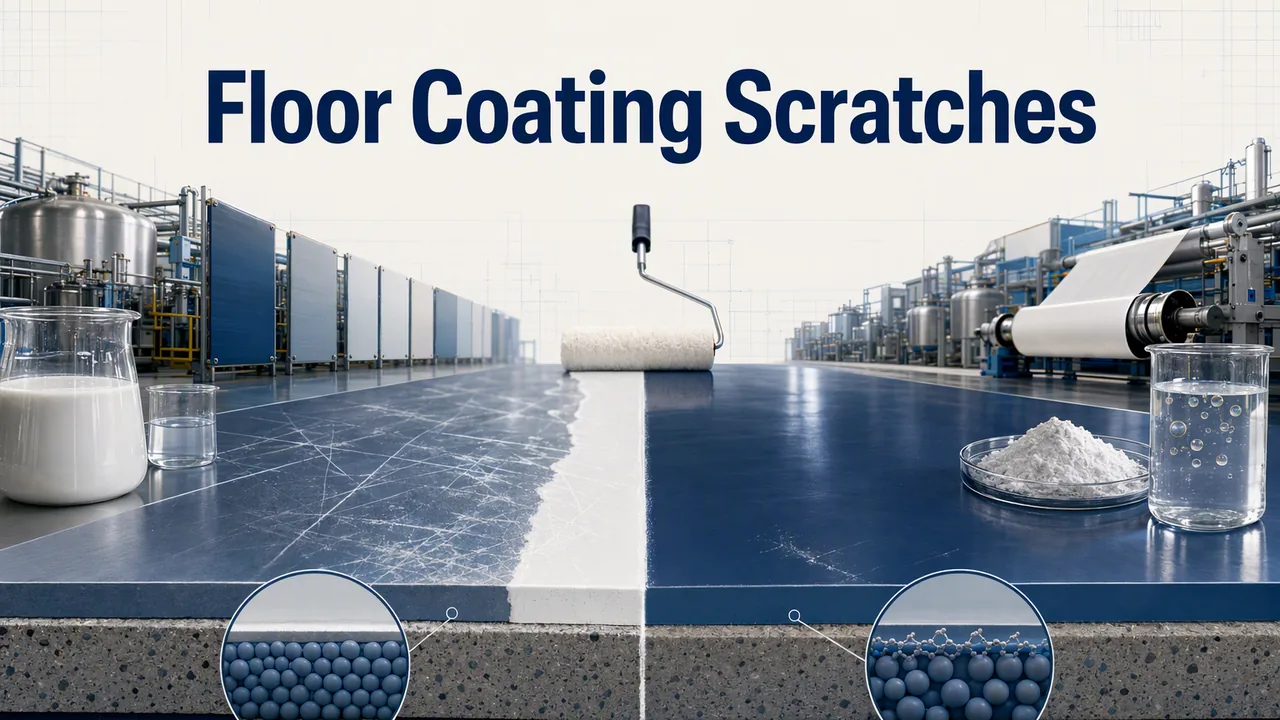
Once a coating is permanent, a scratch is no longer a peeled strip of film. It is a defect on a finished part. The mechanism behind it is the one we laid out in our article on scratches and stress whitening.
Where each route breaks
| Route | Works when | Breaks when | Grades |
|---|---|---|---|
| Peelable temporary film | Multiple handling steps, short dwell, removal at a known station | Long heat exposure, sharp edges, film pulled below 50 μm | YT-8083 |
| Permanent protective coat | The coating is the finish and has to last with the part | Substrate moves, cure is rushed, or a scratch becomes a claim | YT-6153, YT-615 |
| Permanent coat plus crosslinker | Water, cleaner and heat are part of the service life | Open time is short, dosing is sloppy, or the shop runs cold | YT-G30 |
How we choose on a line
We run five checks before recommending one route over the other. They are on the plastic and coated parts panels in our waterborne polyurethane range, in this order.
- Write down the dwell time between coating and removal, in weeks, including the worst container and the worst month.
- Measure the dry film on the panel, not the wet film on the gauge. Anything under 50 μm will not peel clean, whatever the datasheet says.
- Pull one panel at 24 hours and one after two weeks in a 50 °C oven. Note whether the film comes off whole or in pieces.
- Cost the removal step honestly: seconds per panel, a disposal stream, and the rework rate when the film leaves residue.
- Only then compare against the permanent route, where that same money buys cure, crosslinker and a scratch test you have to pass.
Check three is the one that decides most jobs. A film that peels whole at 24 hours and shreds after two weeks of heat is not a bad product. It is a temporary product that was given a permanent schedule.
Questions we get on protective coatings
Can a peelable coating be left on outdoors?
Not as a protection layer. YT-8083 resists yellowing, which is why it survives a bright warehouse. Beyond that it is still a soft, high-elongation film meant to be pulled. It will pick up dust, soften in sun and tear at the edges. If nobody is going to peel it, specify a permanent coat instead.
Why does my peel film leave residue?
Usually it is one of three things. The film went on under 50 μm and broke apart instead of peeling. The flash time was skipped and the surface never leveled. Or the part was stacked while the film was still warm. We check the thickness first because it is the cheapest to measure and the most common to get wrong.
Is a crosslinked permanent coat harder to get right?
It is harder to walk back. YT-G30 at 1 to 5% gives you the water resistance. Carbodiimide reacts with the carboxyl groups in the resin whether or not you wanted it to, so mixed material has to be used. Get the open time and the dosing right on a small batch before it goes on a truck.
If you are deciding between the two routes for a specific part, send us the panel with the film still on it. Tell us how long it has to survive. We will tell you whether removal is cheaper than resistance, and what the film should weigh per square meter. Start with our application lab, or download the YT-8083 and YT-6153 datasheets.