We burned a week of lab time on a "bad batch" that was entirely our own doing. A customer wanted our cationic ink binder in the same tank as an anionic PU basecoat. We blended the two 1:1 in a beaker. It turned pasty in under a minute. We kept going anyway, because the viscosity still looked workable. Twenty-four hours later the jar held clear water and a layer of grit at the bottom. Neither dispersion was off-spec. Their ionic types were.
PUD compatibility is a charge story before it is a hardness or gloss story. Here is how we decide whether two waterborne polyurethane dispersions can share a tank. It comes down to what each ionic type needs to stay stable, plus one short test before anyone touches a 1,000-litre batch.
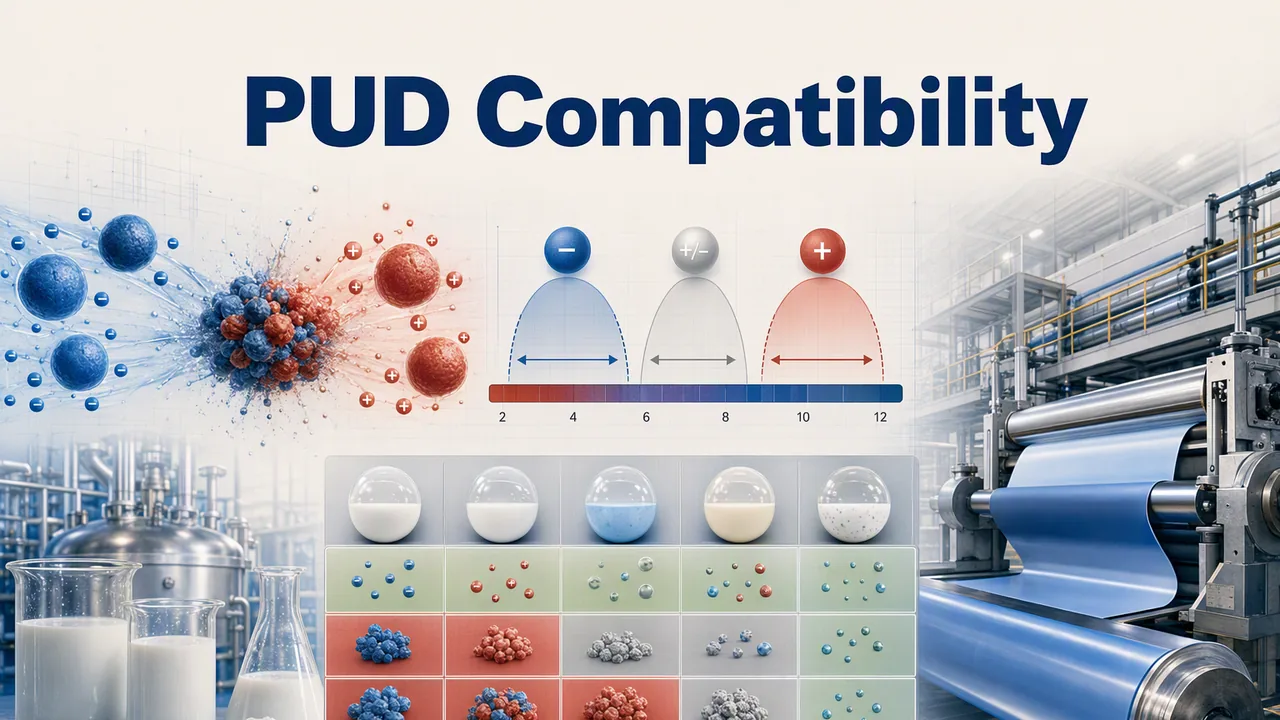
Why opposite charges flocculate on contact
An anionic PUD carries its charge in fixed acid groups, usually carboxyl or sulfonate. An amine neutralizer holds those groups on the polymer chain. Those ion pairs sit at the particle surface. Repulsion between like-charged particles is what keeps the dispersion pourable at 30% solids. A cationic PUD does the same job with protonated amine groups and an acid neutralizer, so the surface charge flips sign.
Mix the two and the charges cancel at the surface. You don't get a slow drift. You get strings, grit, or a shear-thickened mess that plugs a 100-mesh filter. In our experience that flocculation is not recoverable by stirring, by thinning with water, or by raising shear. It is chemistry, not a mixing problem.
So we rule out cationic-plus-anionic blends unless flocculation is the point. Cationic fixation of pigment on textile works on exactly that mechanism, which is what our pigment inkjet pretreatment article covers.
The pH window each ionic type needs
Ionic type also sets the pH band a dispersion can live in. This is where most "mystery" incompatibilities come from: two resins of the same charge sign that still fail, because their pH bands never overlap. Every grade on our waterborne polyurethane resin page ships with a measured pH range. We treat that range as a hard boundary, not a suggestion.
Anionic grades sit alkaline. YT-5130 runs pH 7–9 at 32% solids, and YT-614 is the same 7–9 band at 35 ± 1% solids. Drop an anionic dispersion below about pH 6 and the carboxylate protonates. The charge that was holding the particles apart simply stops existing, and the viscosity collapses from one reading to the next.
Cationic grades sit acid. YT-7011 and YT-7012 are both pH 2–6 at 30 ± 2% solids, thin at 50–200 mPa·s. Neutralize a cationic dispersion upward and you deprotonate the amine, which is the mirror image of the same failure. The practical limit is that you cannot buffer a cationic ink to run neutral alongside a neutral anionic topcoat.
Nonionic grades are the peacemakers, and we lean on them more than on either charged type. YT-101 is pH 5.0–7.0 and fully water-soluble; YT-102 covers the same band and is odourless; YT-103 runs pH 6–8. With no ionic stabilizer to lose, they tolerate pH drift in both directions. That is why they are the default in textile and fabric finishing baths that get topped up overnight.
The honest trade-off: nonionic stability is bought with hydrophilic soft-segment content rather than charge. A nonionic film therefore takes up more water than a comparable anionic one. YT-5130 shows no whitening after one hour immersed at 60 °C. We would not make that claim for a nonionic grade without testing it, and we tell customers so.
Grade-by-grade: what we blend and what we don't
| Ionic type | Where it stays stable | What breaks it first | Grades in our range |
|---|---|---|---|
| Anionic (carboxylate) | pH 7–9; YT-612 tolerates pH 6.0–8.0 | pH below about 6; hardness and calcium ions; any cationic partner | YT-5130, YT-614, YT-612 |
| Nonionic | pH 5.0–8.0; no neutralizer to lose | Under-neutralized hydrophilic balance; high electrolyte loads | YT-101, YT-102, YT-103 |
| Cationic (ammonium) | pH 2–6; YT-7010 reaches pH 4–7 | pH above about 7; anionic dispersants and surfactants; any anionic partner | YT-7011, YT-7012, YT-7010 |
Two notes on reading that table. First, YT-7013 behaves like YT-7011 but films harder, at an HB 100% modulus, so we use it where a cationic ink needs bite. Second, "stable" here means the dispersion stays smooth in the jar. It says nothing about whether the blend passes your rub or wash test. That is a separate question, answered on the substrate.
A 24-hour check before the tank
We keep this in our application lab as a written procedure, mostly because engineers argue about compatibility and never about data.
- Mix at the intended ratio, then again at 1:4 in both directions. 200 g total is enough to see everything.
- Adjust to the pH the line will actually run at, after mixing. Some blends look fine at the drum's native pH and fail at the application value.
- Hold 24 hours at 25 °C, and one week at 50 °C. Stir once on day three and note what you see.
- Filter through 100 mesh and weigh the residue. If you can see grit with the naked eye, the blend is already rejected.
- Pull films on the real substrate and check intercoat adhesion, not just appearance.
What this test does not catch: a slow charge drift across six months of storage, or hydrolysis that only shows after hot-humid ageing. For anything we intend to sell pre-blended, the 50 °C week is mandatory. We extend it to twelve weeks before quoting.
Crosslinkers and additives follow the same rules
Ionic type decides which crosslinker chemistry has anything to react with. An anionic resin is carboxylated by design, so YT-G30 has targets. It is a polymeric carbodiimide at 50 ± 2% solids in PMA, used at 1–5%, slow at room temperature and fast as the film dries. Dose the same additive into a nonionic grade with no free carboxyl and most of the spend does nothing.
For two-component work we match the hardener's own charge to the resin. YT-6300 is an anionic, water-dispersible aliphatic hardener at 20.5–21.5% NCO, and it disperses with hand stirring in a 3–4 hour open time. YT-1102 is non-ionic at 19–21% NCO, with a 5–6 hour window. That is the one we reach for in cationic and nonionic systems, where adding charge would destabilize the bath. They are not interchangeable on a line. The extra two hours changes dwell and rework behaviour, so we re-time the station rather than swap the drum.
Rheology has the same dependency in a milder form. If a blend forces you to move pH, a pH-insensitive associative thickener saves the day. YT-155A runs at 0.5–20% of the total formulation and holds its profile across the band. We still measure before and after adjustment, because "insensitive" is a claim and a viscometer is a fact.
Questions we get before a blend trial
Can I blend an anionic and a cationic PUD if I add them slowly?
Slow addition changes the particle size of the floc, not the outcome. You get a softer, finer precipitate that still settles and still blocks filters. We have never made that blend stable for longer than a shift.
Does a nonionic PUD make any combination safe?
It removes the charge-neutralization failure mode, which is the loudest one. It does not remove pH, solvent, electrolyte or hardness effects, and it can weaken water resistance in the blend. Test the film, not just the jar.
How do I check the ionic type of a resin I already own?
Dilute to 1% and split the sample. Add a dilute anionic surfactant solution to one and a cationic one to the other. The tube that flocculates tells you the sign. It is a crude test, and it takes ten minutes, which is cheaper than a tank.
If you are weighing a blend against two separate coats, send us both dispersions and the pH you run at. We will report the jar results, the TDS for each grade, and whether the blend is worth the risk. Start with our application team or download the YT-5130 and YT-7011 datasheets.