A European ink house asked us last spring to put "50% bio-based" on the sheet. They had a tender to win, and a competitor who had already promised the number. We sent back the YT-3300 datasheet with the adhesion, flexibility and abrasion lines filled in. The content line stayed empty, and they were annoyed. Then their lab reported that the other resin had lost a grade of cross-cut adhesion, and the competitor had quietly dropped its own claim.
Bio-based content is the easiest number in this industry to say and the hardest to sign. What decides whether a claim survives a production run is what the film still does.
A bio-based claim is really two numbers
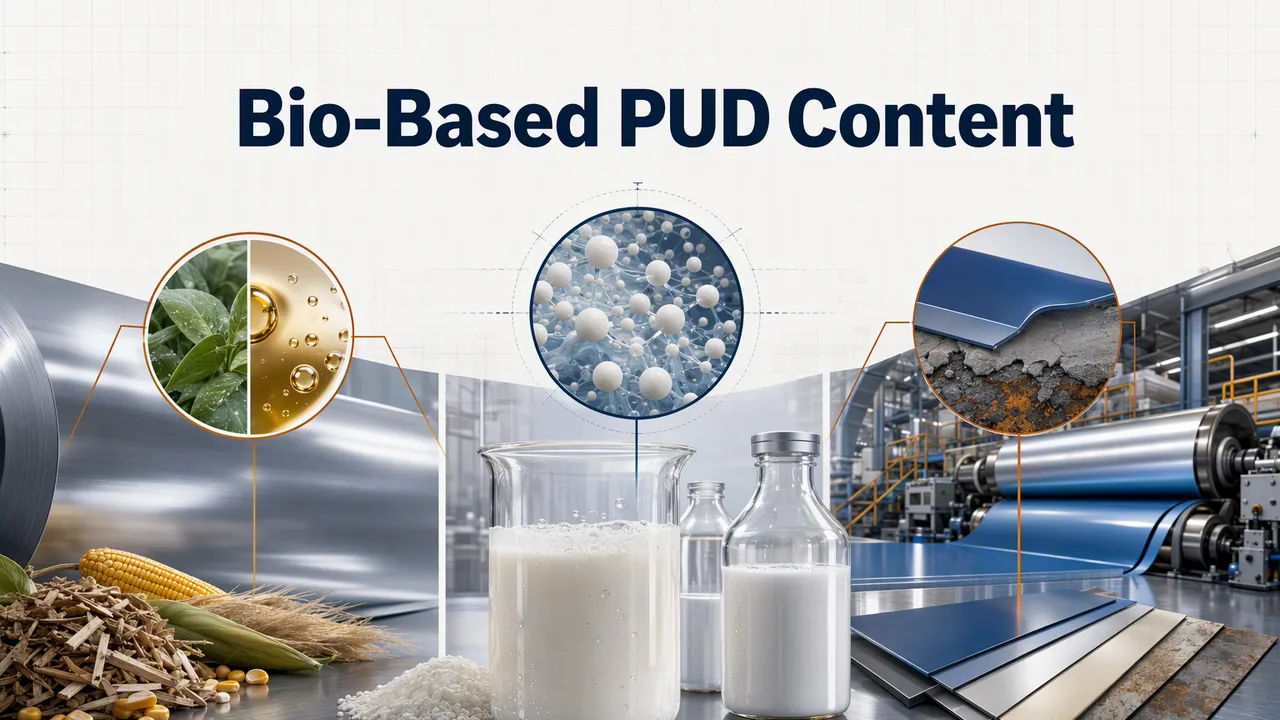
The first number is feedstock: how much of the carbon in the resin came from a plant. The second is performance retention: what the coating still passes after you swap the binder. Purchasing departments hear the first number; quality departments live with the second.
We publish the second one, because it is the one we measure on the same panels we ship. Our sustainability page says the platform uses renewable feedstocks and stops there. It quotes no percentage, and neither will this article. A percentage without a test method behind it is a marketing figure your customer's lab can take apart in an afternoon.
What the bio-based resin actually holds
YT-3300 is our bio-based waterborne polyurethane resin, and it is not a general-purpose binder. It was built for specialty top-coats, and the sheet carries the numbers that job needs. Cross-cut adhesion comes in at Grade 3 or better. Flexibility is 0.5 mm or tighter, and abrasion loss is 0.01 or less. Wet and dry rub, cut, solvent and scratch resistance all come out of that same combination of sticking and bending.
It runs at 30% solids and pH 7 to 9, and it dries to a clear, tough film. That is why it sits in high-performance inks and high-strength coating systems. It also covers the non-peel nail polish work we do, where the film has to flex with the substrate and stay stuck to it.
Where the bio-based film gives ground
Three places, and they are all in the datasheet if you read the small lines.
There is no pencil hardness on the YT-3300 sheet. That is not an omission; it is an adhesion-and-flexibility resin. If your specification is written around 1H to 2H, you are buying the wrong tool. YT-616 is the conventional anionic aliphatic we point at instead. It runs at 35 ± 1% solids and pH 6.0 to 8.0, reaches 1 to 2H pencil hardness, and absorbs under 3% water in 24 hours.
The storage window is tighter than the rest of the range. YT-3300 wants 2 to 25 °C. Most of our dispersions sit happily at 5 to 30 °C. Twenty-five is not a generous ceiling for a drum standing on a dock. We have seen bio-based stock cooked in a summer container by people who read the lower number and ignored the upper one.
And the line that matters most: do not let it contact curing agents directly. The crosslinker route we use elsewhere to claw back water resistance and hardness is closed on this resin. Whatever the film does out of the drum is close to what it will do forever.
Three ways to buy the claim
The first is a straight swap. Use it where the job is adhesion and flex, and where the current binder is an anionic aliphatic at similar solids and pH. YT-618 and YT-3300 sit in that window: both around 30% solids, both pH 7 to 9. YT-618 brings 1H to 2H and 50 to 200 mPa·s, so the swap is a trade rather than a downgrade.
The second is a blend, and it is the one we recommend when the specification has a hardness clause. Run YT-3300 as the adhesion and flexibility carrier, and let YT-616 carry the pencil hardness. Do the ion-type homework first, because YT-7013 is cationic at pH 2 to 6. It will not coexist with an anionic dispersion in the same letdown. Our compatibility rules article covers that failure.
The third is to keep the fossil binder where it is load-bearing and put the bio-based resin where the claim is cheap. One flexible overprint in a stack of six layers moves the renewable share of the ink package. It touches no specification on the way down either.
| Move | What you gain | What you pay | Grades |
|---|---|---|---|
| Straight swap to the bio-based binder | Renewable feedstock in the main film former, adhesion and flex retained | No hardness claim, 2 to 25 °C storage, no curing agent contact | YT-3300 |
| Blend for hardness | Pencil hardness back on the sheet, same pH family | 17% more wet weight per square meter at 30% against 35% solids | YT-3300, YT-616 |
| Move the claim to one non-critical layer | Package-level renewable share without touching a spec | Smaller claim, and one more resin to hold in stock | YT-3300, YT-618 |
How we test before you sign anything
Five steps, on the waterborne ink and polyurethane dispersion panels we keep for this work.
- Pull the current binder's adhesion, flexibility and abrasion numbers out of your own incoming-inspection records, not from our sheet.
- Run YT-3300 at the same solids and pH in a one-to-one letdown and read the same three tests.
- Hold a drum at 30 °C for four weeks and re-run them. Anything that cannot survive a warm store is not a candidate. The feedstock does not get a vote.
- Check every additive in the package against the no-curing-agent rule. That includes anyone's habit of adding a little crosslinker for block resistance.
- Only then work out how much of the fossil binder you can actually displace. Write the claim to match that number.
Step three fails more often than people expect. A resin can hold adhesion at 25 °C and lose it at 30 °C. No supplier owes you a claim that survives a container in July.
Questions we get on bio-based binders
Can you put a bio-content percentage on the datasheet?
Not from our lab. We can give you the formulation's renewable share as a supplier statement for internal reporting. The test methods that turn that into an audited number belong to a third party. We will not print a figure we have not measured ourselves.
Will a crosslinker bring the hardness back?
Not on YT-3300. Its storage note says to avoid direct contact with curing-agent products, and we have not found a way to argue with that. If hardness is the goal, blend with YT-616 and accept the solids penalty.
Is the bio-based resin more expensive per square meter?
Usually, and the solids gap makes it worse before the price does. At 30% against 35% you lay down about 17% more wet material for the same dry film. Quote the job on dry pick-up, not on the kilogram price of the drum.
If a buyer is pushing you for a number, send us the specification you are being held to and the panel you are failing. We will tell you which of the three moves above survives your own incoming tests. We will also tell you what the claim is allowed to say. Start with our application lab, or download the YT-3300 and YT-616 datasheets.