A coating plant outside Wenzhou ran a two-component waterborne topcoat on bag leather. Every Monday the line started with a fresh tank. Every Friday the leftover went into a waste drum, already gelled. The 3–4 hour open time had killed it twice over by Thursday. They switched to a self-crosslinked single-pack grade and kept the same oven. Scrap dropped, and the hardness numbers went slightly the wrong way. That trade is the whole decision, and most data sheets present it upside down.
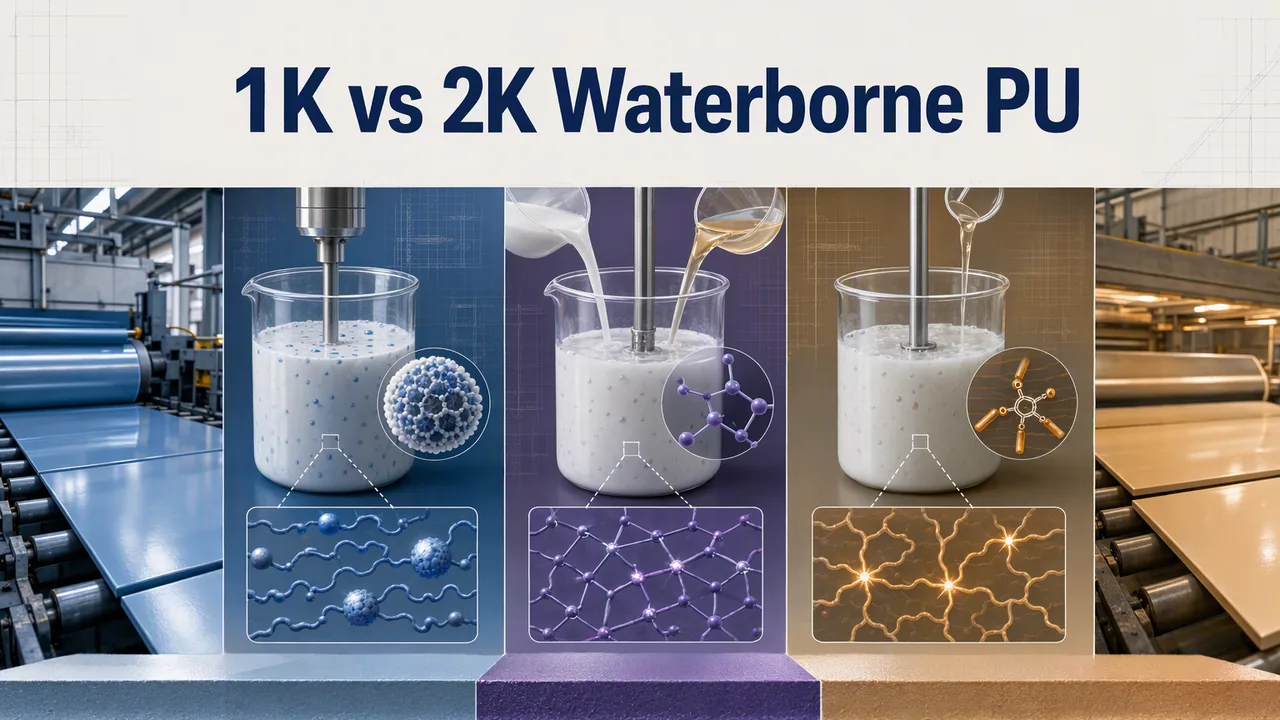
1K vs 2K waterborne PU is not a contest about which film is tougher. It is a question about pot life, metering labor, and what a mixed tank costs you when the shift ends early. Here is how we work it out.
What actually sets in a two-pack mix
A 2K waterborne system cures because you bring two reactants together at the moment of application. The hardener is a waterborne polyisocyanate, and it hunts for hydroxyl groups in the resin. YT-6300 runs 20.5–21.5% NCO at 100% solids, and YT-1102 sits at 19–21% NCO. Both are aliphatic-monomer grades, so they do not drag yellowing into a light-fast topcoat.
Water is the competing reactant. Any NCO that misses a hydroxyl meets water instead and releases CO2. That is why a mixed tank left overnight does not just thicken. It foams, and the film pulled off it next morning has pinholes you cannot sand out.
Pot life is therefore a countdown, not a suggestion. YT-6300 gives 3–4 hours from mixing, while YT-1102 gives 5–6. That is why we quote the second for long knife-coating runs and for shops that mix one tank for a whole day. Neither number survives a hot plant room, and both assume you metered correctly.
What a self-crosslinked resin does instead
A self-crosslinked PUD carries the crosslinking function inside the polymer, so nothing is added at the tank. The film develops as water leaves and the coating gets warm. Your dryer and your dwell drive the cure, not a clock that started when somebody opened a drum.
YT-1128 is our aromatic example. It runs 27 ± 1% solids at pH 6–8, with 1.5–3 MPa modulus and tensile above 10 MPa. On synthetic leather it reaches wet-heat anti-tack of grade 3.5 or better with no aziridine crosslinker added at all. That is the practical payoff: one tank, no scale, and no gelled waste drum on Friday.
The honest limit: you cannot tune a 1K film after purchase. Crosslink density is fixed by what we put into the polymer. A job that genuinely needs 2K chemical resistance will not get there by drying harder. We tell customers this before they build a recipe around it.
Carbodiimide, which behaves like neither
YT-G30 is a polymeric carbodiimide at 50 ± 2% solids in PMA, thin at 80–150 cps. It reacts with the carboxyl groups already on an anionic resin. So it needs a partner that carries charge by design. It is slow at room temperature and fast as the film dries. That combination is the whole trick: a workable open time in the tank with no stoichiometric countdown, and crosslinking that arrives once the coating is on the substrate.
It also replaces polymeric aziridine without the sensitization flag, and it yellows less. We covered that comparison in our aziridine versus isocyanate crosslinker article. Dosage is 1–5% on the formula, added under stirring. In a cold plant its viscosity climbs, so we pre-heat above 15 °C or pre-dilute with PMA.
The catch is real: no carboxyl, no reaction. Dose it into a nonionic grade with no free acid and most of the spend does nothing. This is the same ionic-type logic we laid out in our PUD compatibility rules, arriving from a different direction.
Three routes side by side
| Route | What you meter at the tank | Open time | Where it wins | Grades |
|---|---|---|---|---|
| 1K self-crosslinked | Nothing | Days, in a sealed drum | Leather finishing, print paste, shops that cannot hold a ratio | YT-1128 |
| 2K polyisocyanate | Hardener by NCO to OH | 3–4 h or 5–6 h | Hardness plus chemical and water resistance | YT-6300, YT-1102 |
| Additive carbodiimide | 1–5% on formula | Long at room temperature | Cohesion and hydrolysis resistance on carboxylated resin | YT-G30 |
Counting the cost we can actually measure
We price these routes on five line items, because the resin kilogram is rarely the largest one.
- Mixed-tank scrap. Take your open time, divide by shift length, and round up. A 3–4 hour hardener in a nine-hour plant is two mixes, and the second one is half used. That fraction is what goes in the waste drum.
- Metering and verification. A 2K line needs a scale, a written ratio, and someone who checks it. A 1K line needs a drum opener.
- Clean-down. Polyisocyanate chemistry gels in the pipework. Our synthetic leather finishing customers on 2K schedule a flush per stop; on 1K they rinse at the end of the week.
- Drum size versus usage rate. YT-1102 ships in 200 kg. Open it in a shop that uses 40 kg a month and head-space moisture spends your NCO before the drum is empty. YT-6300 in 50 kg exists for that reason.
- Rework. The one place 2K pays for itself. If a 1K film fails a solvent-wipe or a hot-humid test, the recoat costs more than every gram of hardener you saved.
Two of these we cannot give you as a number: your scrap rate and your oven. Everything above we can, from the datasheets and from what we see on customer lines.
Questions we get before choosing
Does a self-crosslinked 1K resin still need heat?
It needs drying, and it needs enough dwell for the function to develop. A cold, damp line will under-cure a 1K film the same way a rushed mix under-cures a 2K one. On YT-1128 we set the knife coater at 10–13 s flow time and 100–150 g/m². Then judge anti-tack on your own oven profile.
Can I add hardener to a 1K grade to get the best of both?
You can, and you will have bought a 2K system with extra steps. The self-crosslinked resin still competes with water for NCO, so the extra crosslink density is smaller than the label suggests. And you have taken on the pot life you were trying to avoid. If you need a real step up, run the carbodiimide route on a carboxylated resin instead.
How do I check pot life on the line without a lab?
Take two samples at hour one and at the stated open time. Read viscosity on both, then pull a small film and time when it stops feeling tacky. If the second sample moves more than a few hundred mPa·s, the tank is reacting faster than the data sheet claims. Cool the room or mix smaller.
If you want the arithmetic run on your own shift pattern, send us your coating weight, tank size and oven length. We will tell you whether 1K or 2K waterborne PU fits your line, which of our crosslinker grades to use, and when the cheaper answer is a single-pack resin. Start with our application team, or download the YT-1128 and YT-G30 datasheets.