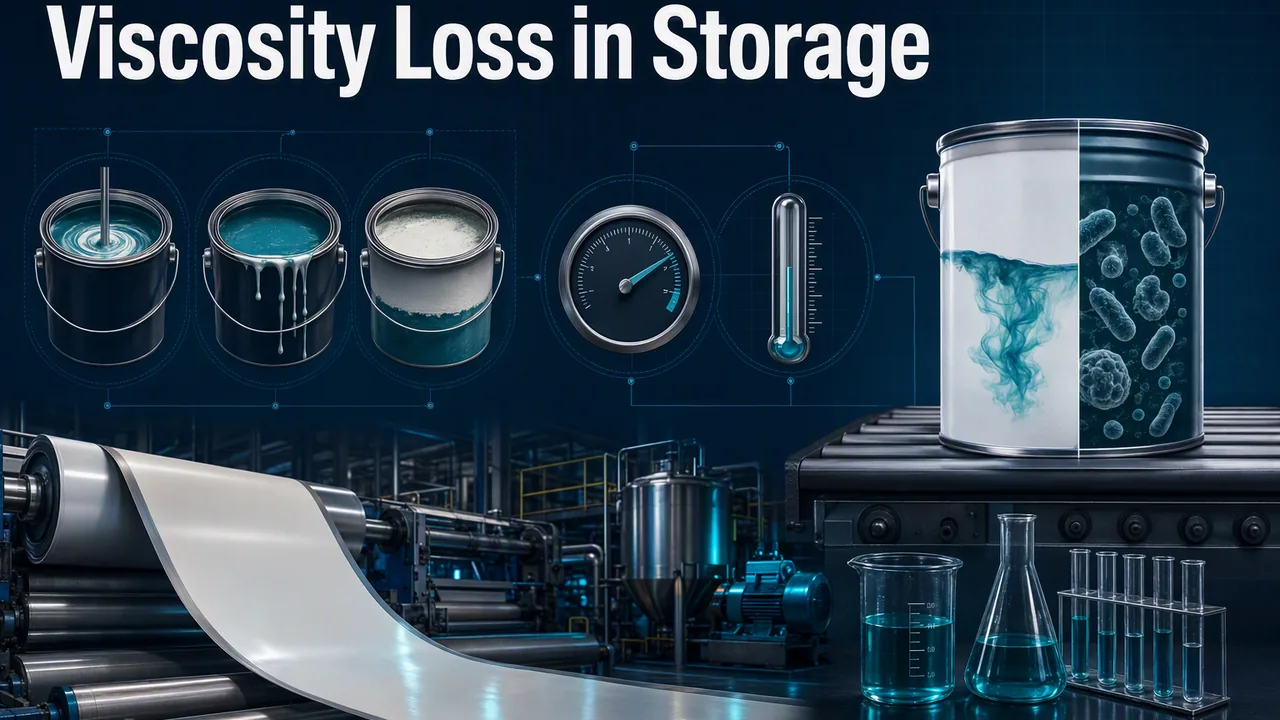
A 1,000-litre let-down tank of waterborne clearcoat reads 96 KU at filtration on Monday and 63 KU when the canning line opens on Friday. Same resin lot, same pigment paste, same operator, same cup. We meet this failure in customer labs about once a month, and the reflex never changes: dose more thickener and hope. That reflex is what turns a two-hour diagnosis into a rejected batch. Viscosity loss during storage has three separate mechanisms behind it, and each one has a different fix at a different cost. The network holding a waterborne coating's viscosity together can relax, be deactivated, or be destroyed. Spend twenty minutes proving which one you have before you open the drum.
Three ways viscosity loss shows up in a stored can
Associative polyurethane thickeners thicken by bridging. Short hydrophobic end groups pull out of the water and hook onto latex particles, onto pigment surfaces and onto each other, building a loose, reversible network. What the viscometer reads is simply how much of that network exists at the moment the spindle enters the can. Three things can reduce it.
It relaxes. Association is a temperature-driven equilibrium that also needs time to rebuild. Our own data sheet for YT-330B states it flatly: viscosity runs higher cold and lower hot, and the formulator has to design around that window. A can that spent nine days in a 38°C yard will not read like the same can pulled out of a 10°C store. Shear history sits in this bucket too. Disperse at 1,500 rpm, measure straight away, and a healthy batch looks like a failure.
It gets deactivated. The bridges need the polymer hydrated and unshadowed. pH drift is the classic route in any formula that leans on alkaline-swollen acrylic thickener, which only carries a charge above roughly pH 7.5: ammonia or AMP neutralizer escaping through a loose lid or a vented IBC quietly removes part of your thickener package. Ions do the same job without any gas involved, and hard let-down water or a salty pigment paste is enough to do it. This is where a pH-insensitive grade earns its price, and why YT-155A is specified as unaffected by system pH.
It gets destroyed. Cellulosic ethers are enzyme food. Hydrolytic loss takes months. A freeze-coalesced gel takes one bad night in a container. Both are permanent, and no redose brings them back.
The two numbers that explain most viscosity loss in storage
Retain logs almost always carry a viscosity figure and almost never carry the two numbers that explain it: pH and storage temperature. We ask for both before we look at anything else, and roughly a third of the cases are closed at that point.
Our own QC sheet for a retain sample reads day 0, 7, 14 and 28 at 23 ± 0.5°C, Stormer KU plus three spindle speeds (6, 12 and 60 rpm on a disc instrument, the way ISO 2884-2 describes it), and pH to one decimal. The three speeds matter more than the KU. A single high-shear number hides a low-shear collapse, and low shear is the first thing to leave when an associative network thins.
A cabinet clearcoat we worked on in 2025 held 92 KU for six weeks and still started sagging at the flat-up station. The 6 rpm reading had fallen by about 40% in week three. Nobody had looked at 6 rpm. Sag on a vertical surface is a low-shear symptom wearing a high-shear number. If you are dialling a topcoat for a flat-up or roll-coating line, our wood coating application guide lists the grades we put on the trial card first.
Is it the thickener or the biocide package?
When viscosity goes over days rather than weeks, stop reading rheology and start reading tank hygiene. Microbial attack on a cellulosic thickener is quick, and the smell usually arrives before the viscosity does. A sour note in the can with no foam head tells you more than another viscometer run.
The test is a split. Filter half the sample through 0.45 µm, leave the other half as received, hold both at 30°C and measure on day 3 and day 7. A filtered half that holds while the unfiltered half drops is biology, not chemistry. Dosing fresh isothiazolinone biocide into the falling half confirms it inside two days. The source is usually not a raw material but the water: a rinsed-but-not-sanitized let-down tank, recycled wash water, or a return line shared with another product.
Where the mechanism really is enzymatic, polyurethane thickeners have an advantage that sits on the data sheet rather than in the brochure. YT-255A is listed with strong resistance to biodegradation and fast dissolution; YT-155A with resistance to biological degradation. Say it straight, though: swapping HEC for HEUR removes the food, not the contamination. If your let-down water carries a load, the new thickener only buys time until the next batch. Clean and sanitize first, reformulate second.
A four-can protocol that names the cause in two weeks
This is the protocol we run in-house and hand to customers. It costs four litres of sample and one viscometer.
- Split the day-0 batch into four 1 L sealed cans. Measure all four at 23°C on day 0: KU, three spindle speeds, pH. Write it down.
- Hold can A at 5°C, can B at 23°C as the control, can C at 50°C, can D at 40°C with the lid just resting on top.
- Measure B on days 7 and 14. Measure A, C and D on day 14 after 24 h of conditioning at 23°C, lid closed, no stirring before the cup goes in.
- Read can C twice, once warm and once conditioned. If it comes back, you had a storage temperature problem and not a viscosity problem.
- Take 500 g of the worst can, add 0.1% on total formulation of the same thickener, rest it 12 h and measure. A network that rebuilds was relaxed or depleted. A network that ignores the addition is contaminated, coalesced or ion-blocked, and more thickener is money poured down the drain.
Report every result as a percentage of that can's own day-0 value. Our internal acceptance line is 90% retention on can B at day 14; that is a house rule and not a standard, and the honest version of this advice is that you need a line of your own written into the specification you send customers. A sample that only fails in can C or can D is a handling problem, and a conversation in the warehouse ends it.
Which associative thickener holds its curve in storage
Once the mechanism has a name, grade selection is short. These are the five we reach for when the retain curve is the complaint, and every number below is copied off a data sheet rather than written for an article.
| Grade | Where it helps | Solids | Viscosity, as supplied | Storage / shelf life |
|---|---|---|---|---|
| YT-255A | Low-shear builder, pH-independent, fast dissolving; drop-in for 105A | 40% / 50% | ≤ 30,000 mPa·s | 5–30°C, 12 months |
| YT-155A | pH-insensitive let-down grade, strongly pseudoplastic, spatter-free | 30% / 40% / 50% | ≤ 30,000 mPa·s | 5–30°C, 12 months |
| YT-330B | Mid-to-high associative build with leveling, free of organic tin and APEO | 30 ± 1% | 20,000–30,000 mPa·s at 25°C | 15–35°C, 12 months |
| YT-255C | High-shear viscosity plus leveling; drop-in for PS166 | 20% / 40% | ≤ 30,000 mPa·s | 5–30°C, 12 months |
| YT-255E | Anti-settling and pigment wetting; drop-in for 12W and 299 | 40 ± 2% | 5,000–8,000 mPa·s | 5–30°C, 12 months |
YT-255E is the one we try first when settling is the actual complaint. It builds hard at low shear and arrives at 5,000–8,000 mPa·s, so it still pours off a metering cup into a let-down tank instead of needing a solvent rinse. One caveat we hit on customer lines every year: that thixotropy makes a cup read far worse straight after high-speed dispersion than the can actually is. Rest the cup half an hour.
For shops that do not control pH, a tinting base house accepting third-party pastes is the usual one, both pH-insensitive grades are worth a ladder study. The recommended window on YT-255A is 0.5–2.0% of formula (see the YT-255A technical data sheet); we normally start at 0.8% and read the curve at all three speeds before touching it again.
The rest of the range, including a solvent-free grade and a leveling agent aimed at textile systems, is on the PU rheology additives page. Which shear rate is worth arguing about depends on your applicator, and that is the subject of our earlier piece on selecting an associative thickener.
What we are not going to claim
Per kilogram of viscosity delivered, a cellulosic ether is still cheaper than any associative polyurethane thickener, ours included. You buy PU thickener for the retain curve, the leveling and the sag balance. You do not buy it for the price per kilo.
No thickener recovers a freeze-coalesced can either. If it came off a winter container looking like cottage cheese, that is a disposal decision, not a formulation one. And associative viscosity will keep moving with temperature for as long as chemistry is chemistry: we can shift that drift by a few percent with hydrophobe balance and by how much of the package is associative, and we cannot delete it.
One more limit worth saying out loud. A heavy pigment paste in a tinting base usually still wants a cellulosic backbone to hold pigment float, so our recommendation is often a partial replacement and not a full swap. If a supplier tells you a single grade solves storage stability, sag and float in one dose, buy their competitor's product instead.
If viscosity loss in your retain samples is eating margin, send us two litres: one fresh off the tank and one from the retain that failed. We run the four-can protocol and send the table back with your numbers in it. Ask our application lab and we will tell you what to include with the sample.