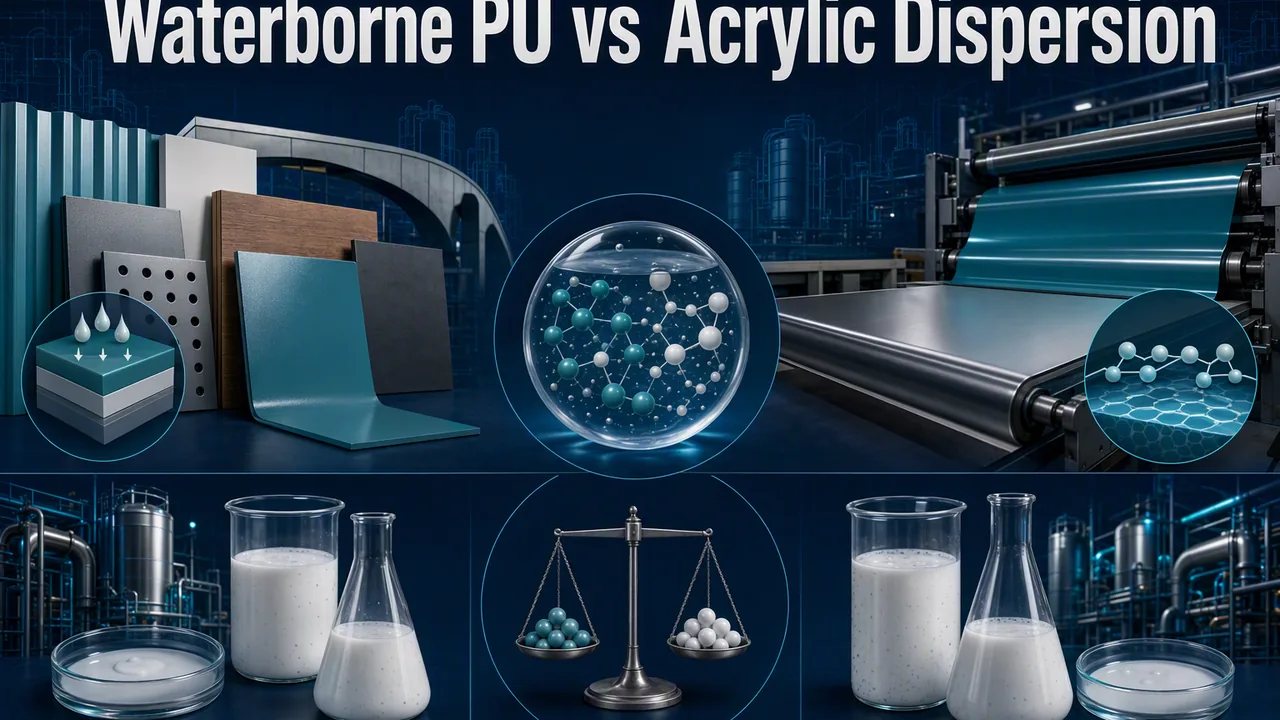
The meeting usually goes the same way. A customer wants to move a wood clearcoat, a paper ink or a textile paste to waterborne, and the first spreadsheet row is the binder. Someone quotes an acrylic dispersion, someone quotes a waterborne PUD, and the PUD number is high enough to end the conversation early. That comparison is honest about price and vague about everything else, because the two chemistries fail in different places. Once you know where your film will actually be stressed, the choice mostly makes itself.
We ship both and keep both in our trial store, so this is not a pitch for one side. It is the decision path we walk customers through, and the grades we would start the ladder with.
Where an Acrylic Dispersion Binder Wins
Pure acrylic dispersions build hardness from a high-Tg backbone, so they deliver a hard, clear film without any crosslinker, at a fraction of PUD pricing. Pigment work is where they are hardest to beat. YT-1706, our pure acrylic copolymer emulsion, carries 45 ± 2% solids at a viscosity of only 50–500 mPa·s (25 °C), and in waterborne ink systems we grind red pigments straight into it with no dispersant. Reds are the ones that flood and float first, and this is the grade that finally settled that argument on a customer’s flexo line. If foam control on that same line is your next headache, we wrote a separate piece on foaming in waterborne flexo inks.
- Cost per kilogram of binder solids stays low, which matters on commodity coatings.
- Monomer choice lets you place the Tg where you want it. YT-1706 sits at 35 °C, and hardness, DOI and alcohol compatibility can be tuned almost independently.
- Pigment compatibility is excellent, which is why acrylics remain the default grinding vehicle for waterborne color work.
In the shop, acrylics stay our default answer for three kinds of jobs. Overprint varnishes on paper and board, where the film is thin, fast and disposable. Primers that will be buried under a topcoat anyway, because nobody sees the scratch resistance of a layer nobody sees. And any clearcoat that is quoted and rebid on price every six months, because the formulation that wins the tender is rarely the one with the best laboratory data. If your spec sheet stops at gloss, adhesion and block resistance, an acrylic takes you across the finish line, and there is no shame in stopping there.
The limit shows up when the film has to survive rather than look good. A high-Tg acrylic is hard but brittle; it cracks over flexible substrates, and without a hydrogen-bond network to fall back on, its abrasion resistance and low-temperature film formation depend on coalescent and external crosslinkers. Those problems are solvable, but every fix adds cost back into the formula you were trying to save money on.
What a Waterborne PUD Adds to the Film
A waterborne PUD earns its premium exactly where acrylics are weakest. The backbone separates into soft and hard segments, and the hard segments hydrogen-bond into physical crosslinks. The film therefore stretches before it fails, stays flexible at low temperature, and coalesces without solvent where an acrylic of equal hardness would crack. On waterborne wood coatings, this is the difference between a clearcoat that passes and one that comes back on a complaint.
Two grades bracket the range. YT-617 is a polycarbonate-based PUD for wood, metal and glass substrates: film pencil hardness 2H, water absorption below 3% after 24 hours at 25 °C, and no crosslinker in the formulation. For ink and paper work, YT-618 reaches 1H–2H at 30 ± 2% solids and films out with a slight blue tint that reads as extra transparency on white stock. Both are anionic aliphatic dispersions, so they tolerate most acrylic letdown conditions.
One number worth checking before the price discussion is the minimum film formation temperature. A hard acrylic drives its MFFT up along with its Tg, so the same grade that gives you block resistance in summer will crack in a cold workshop in January, and the usual rescue is more coalescent, more smell, more VOC on the label. A PUD separates the two properties: the hard segments carry hardness while the soft segments keep forming a film at temperatures that stop an acrylic dead. That single mechanism is why so many waterborne floor and furniture reformulations start with a PUD even when the quotation against it looks painful.
The honest side of the ledger: at equal solids a PUD costs more, and softer grades can read slightly water-sensitive during the first days of cure. On a rigid indoor part where nothing rubs, flexes or freezes, a PUD is paying for properties you will never test.
PUD vs Acrylic Dispersion: A Side-by-Side Comparison
The table below condenses what we check before quoting either chemistry.
| Property | Acrylic dispersion (e.g. YT-1706) | Waterborne PUD (e.g. YT-617) |
|---|---|---|
| Hardness source | High-Tg backbone | Hard-segment hydrogen bonding |
| Hardness plus flexibility | Usually one or the other | Both at once |
| Abrasion resistance | Moderate, typically needs a crosslinker | High as-built |
| Low-temperature film formation | Coalescent or soft Tg required | No coalescent on polycarbonate grades |
| Water absorption (24 h, 25 °C) | Higher without crosslinking | Below 3% (YT-617) |
| Pigment grinding | Excellent; dispersant-free possible (YT-1706) | Possible but not its strength |
| Relative cost at equal solids | Lower | Higher |
Read that table against your own spec sheet rather than as a general ranking. A row only matters if your application stresses it, and most applications stress three rows at most. The formulators who overpay are usually the ones who priced the whole table instead of the rows their customer can actually feel.
Blends and Hybrids: When You Do Not Have to Choose
A lot of real formulations land between the poles. Textile pastes are the classic case: an acrylic delivers build and hand feel, and a PUD fraction buys wash and abrasion durability in textile printing pastes and fabric coatings. YT-614 sits exactly there, with 35 ± 1% solids built for that job. Where the system runs acidic or alkaline, or ionic strength drifts during the run, the nonionic grade YT-101 stays stable in conditions that would crash an anionic blend.
On a printing paste, that split often lands somewhere around four parts acrylic binder to one part PUD, added late in the letdown so the PUD arrives as a durability top-up rather than the cost driver. The exact ratio is a ladder test, not a rule, but starting low keeps the hand feel that made the acrylic attractive in the first place.
Compatibility between anionic PUDs and anionic acrylics is usually good, but judge it after storage, not at the mixing jar. We once watched a blend look perfect on day zero and phase-separate after two weeks at 50 °C. One hot-storage test costs an afternoon and can save a whole batch.
A Five-Step Checklist Before You Commit
- List the two properties the film must never fail on, whether that is abrasion, flexibility, hardness or water resistance, and price the binder against those, not against the drum.
- Run hardness and elongation checks on free films at 23 °C and again at 5 °C before anyone argues about money.
- Score adhesion on the real substrate with the ASTM D3359 cross-hatch method; clean lab panels flatter both chemistries.
- If cost forces acrylic, add durability back with a small PUD fraction and a crosslinker instead of pushing the acrylic Tg up until the film cracks.
- Storage-test the final blend for two weeks at 50 °C before scaling up.
Which Waterborne PU Dispersion Fits Your Formulation?
If your formulation lives on pigment loading, gloss and cost, as inks, grinding bases and commodity paper coatings do, start with an acrylic dispersion and reach further only when a failure forces you to. If it lives on abrasion, flexibility or cold film formation, as furniture and floor coatings and premium textile finishes do, start with a waterborne PUD such as YT-617 or YT-618 and tune down from there. Both directions are catalogued in our waterborne PUD product line and our acrylic dispersion range.
Most formulations we review end up needing less PUD than the first quotation suggested, not more. For the full parameter tables, download the YT-617 TDS, or ask our application lab to run the ladder for you.