A clear wood topcoat came back from a customer last month with a failure pattern we meet several times a year. It sprayed well, dried fast, hit gloss and pencil hardness on the target sheet, then whitened within minutes under a damp cloth. A week in a humid container and the film lifted off in one piece at the cross-cut. The dispersion had already passed our release protocol, four weeks at 50 °C in a sealed bottle, so every number on the quality report was green.
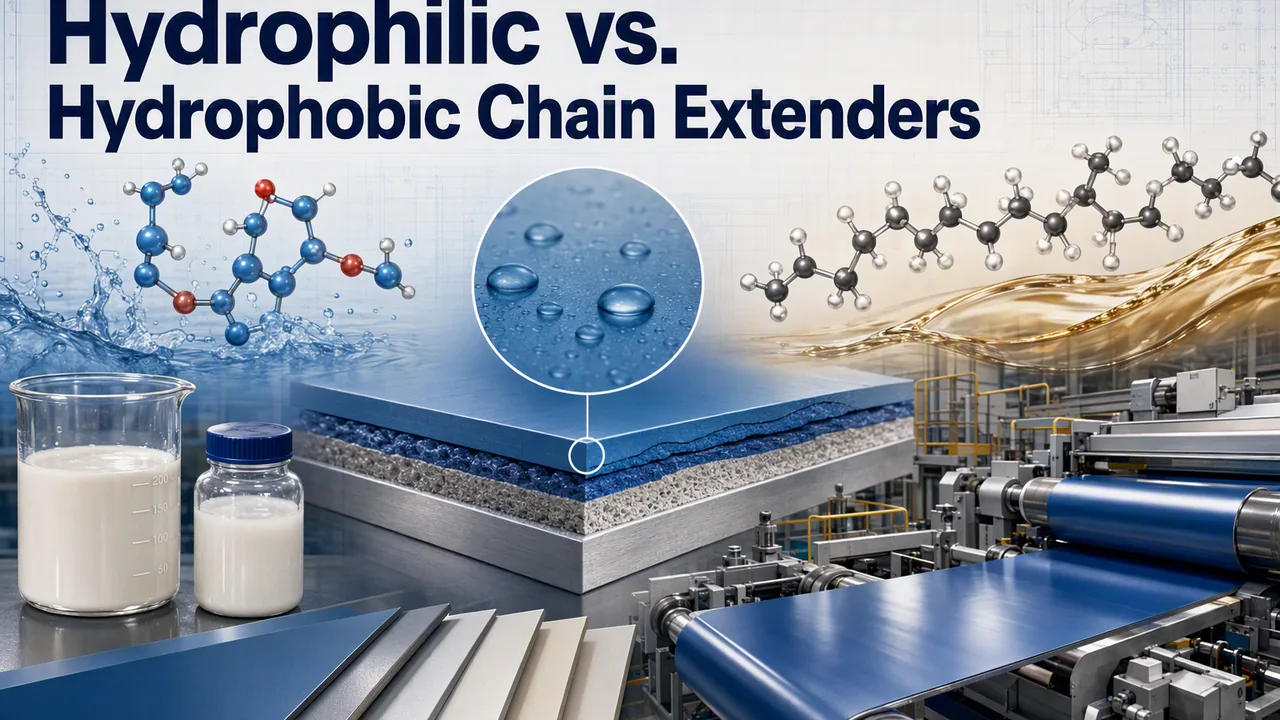
What failed is the part of the molecule that makes the resin dispersible at all. Chain extenders in PUD synthesis settle two questions at once: whether the polymer stays stable as particles in water, and how much water the dried film takes back up. Choosing between hydrophilic vs. hydrophobic chain extenders is where water resistance in a waterborne polyurethane gets decided, long before a paint plant adds a crosslinker. Here is how we size that trade, using our own published numbers.
Where water resistance in a waterborne PU film is really set
To force a high-molecular-weight polyurethane into water you build ionizable or strongly polar groups into the hard segment with the chain extender, neutralize them, and let the resulting particle charge keep the droplets apart. None of those groups leave with the water. In the dried film they sit as fixed ions, and fixed ions cluster.
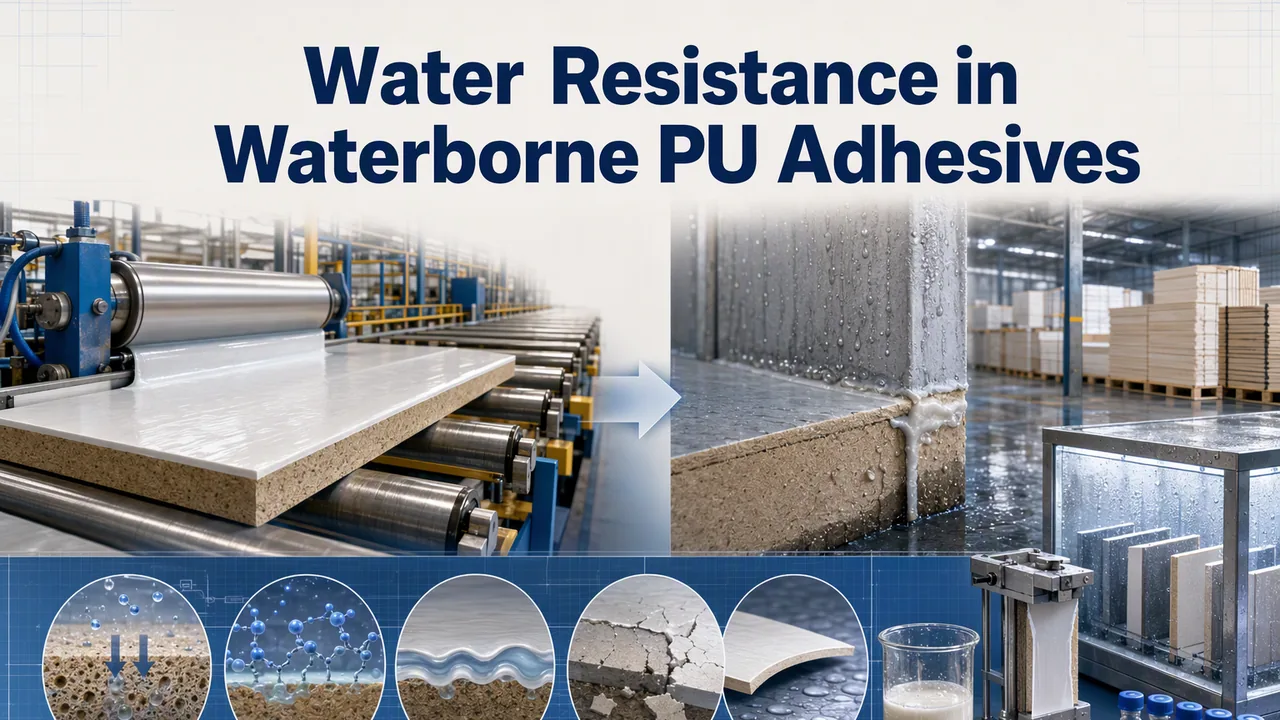
Those clusters are the water's front door. They absorb moisture well before the surrounding matrix does, swell, and plasticize the coating from inside. Three familiar symptoms come out of that one mechanism. Whitening is light scattering from water-filled ionic domains rather than a chemical change, which is why a dried panel looks fine again. Wet hardness and rub resistance collapse because the hard segments carrying the film's stiffness are the same ones holding the water. And adhesion fails at the interface instead of inside the film, because water collects where a coating meets a substrate carrying its own hydroxyls and soluble salts. We chased that third one in our piece on why waterborne PU coatings peel; same ionic domain, one layer closer to the wood.
Hydrophilic chain extenders: what each level of DMPA content buys
Carboxylate, mostly DMPA. The default for good reasons: one hydroxyl chain-extends while the pendant COOH neutralizes with an amine, the kinetics are predictable, the price is ordinary. Loading is the only dial. In our designs, roughly 1.5% DMPA on resin is the floor for a dispersion that survives dilution, and past 4% we stop enjoying the stability because the film has turned into a sponge. Two costs ride along: the dispersion collapses the moment it meets a cationic additive or an acid catalyst, and the neutralizing amine behaves very differently during drying.
Sulfonate extenders. The same single negative charge is spread over a larger, resonance-stabilized group, so ion pairing is looser and each equivalent drinks less water. Tolerance to hard wash water, low pH and multivalent cations is where sulfonate earns its price, and those electrolyte problems are far more common in a textile plant than in a lab. The trade: a sulfonate cannot be quieted by pH the way a carboxylate can, and the films run softer and more moisture-permeable.
Quaternary ammonium extenders. Permanent charge, no neutralizing amine, no pH window to defend. Our cationic grade YT-7010 exists because that charge never switches off: 16 ± 1% solids, pH 4 to 7, a pretreatment bath that needs no pH guard. Per equivalent it is the most hygroscopic family here, and that permanent charge is also what flocks an anionic pigment paste onto the fibre and curdles anionic thickeners in the can.
Nonionic polyether segments. Hydrophilicity with no counterion. YT-102 is spec'd nonionic and fully water-soluble, which buys unlimited dilutability, stability in acid and alkali, and no amine smell in the wet paint. The ether oxygens still coordinate water, so the film stays soft and moisture-moving. Good textile and fiberglass sizing binder, poor floor topcoat.
Hydrophobic chain extenders: molecular weight without charge
If ionic content is the leak, the useful chemistry is everything that grows the molecule without adding charge.
Diepoxides such as 1,4-butanediol diglycidyl ether chain-extend after emulsification. The epoxy ends open onto urethane N-H and lengthen the chain with no new ion in the structure, which is the standard route to a dispersion that keeps its viscosity when you thin it. The window is narrow and an overheated batch gels in the reactor, so this is a plant step rather than a bucket experiment.
Trifunctional extenders such as trimethylolpropane, at 0.3% to 1.0% on resin, build branches instead of linear length. Short branches disturb hard-segment packing and slow the formation of continuous ionic channels. The side effect is a lower softening point, so hot block and anti-tack can slip, and past 1% you get a gel rather than a branched polymer.
Bulky hydrophobic diols such as neopentyl glycol and cyclohexanedimethanol add molecular weight and heat resistance while keeping the backbone nonpolar. They cost you at coalescence: a hard, nonpolar chain needs a coalescent or warm drying, and without it the film stays micro-porous and wicks water mechanically. A chalky panel that passes a 24 h soak is a real result and a misleading one.
The soft segment is the biggest lever, and it is not strictly a chain extender. Polycarbonate diols are much less polar and far more hydrolysis-stable than adipate polyesters. Compare two of our own products: YT-5110 and YT-617 are both anionic polycarbonate-based PUDs at 30 ± 1% solids and pH 6.0 to 8.0, yet their TDS list 24 h water absorption at 6 to 10% and under 3%. Same backbone family, same solids, same pH, double the uptake. A hydrophobic soft segment makes a low-uptake film possible; ionic content and hard-segment design decide what it does under a wet cloth, and YT-617 holds 2H pencil hardness in the same package.
Silicone modification answers a different question. In YT-613 the low-surface-energy segments migrate to the air interface as the film dries, so water beads instead of wetting and TDS water absorption lands at 4 to 5%. A silicone-rich surface fights you on recoat adhesion, overprint varnish and foil lamination, and it handles beading rather than transport, so it is the wrong answer to a wet-strength complaint.
Reading PUD film water absorption off the spec sheet
Gravimetric water absorption, 24 h at 25 °C on a free cured film, is the figure we publish because it separates these chemistries cleanly. The method follows the logic of ASTM D870 immersion testing, with ISO 2812-1 as the equivalent: weigh, soak, blot, weigh, then dry the sample to see what came back.
| Grade | Hydrophilic unit | Solids | pH | Water absorption 24 h / 25 °C | Where it belongs |
|---|---|---|---|---|---|
| YT-102 | Nonionic polyether | 30% | 5.0 – 7.0 | Dispersion itself is water-soluble | Textile treatment, fiberglass sizing |
| YT-7010 | Quaternary ammonium (cationic) | 16 ± 1% | 4 – 7 | Not spec'd; charge stays on | Inkjet pretreatment |
| YT-5110 | Carboxylate, polycarbonate soft segment | 30 ± 1% | 6.0 – 8.0 | 6 – 10% | Industrial topcoat, leather finishing |
| YT-613 | Carboxylate plus silicone | 35 ± 1% | 6.0 – 8.0 | 4 – 5% | Waterborne ink, PVC and PET coating |
| YT-6122 | Anionic aliphatic (carboxylate) | 38.5 ± 1% | 6.0 – 8.0 | under 3% | Fabric coating, reverse-print composite ink |
| YT-617 | Carboxylate, polycarbonate, 2H hard | 30 ± 1% | 6.0 – 8.0 | under 3% | Hard clear wood and metal topcoat |
| YT-5130 | Anionic aliphatic, heat-stable | 32% | 7 – 9 | No whitening after 1 h at 60 °C | Hot-humid service, yellowing-sensitive work |
Two rules for reading it. Solids is not a proxy for water resistance: YT-6122 ships at 38.5 ± 1% and YT-617 at 30 ± 1%, both under 3%, while YT-5110 at that same solids figure sits at 6 to 10%. Solids only says how much water you are paying to transport. And a hot soak discriminates better than a cold one, which is why the YT-5130 note about no whitening after one hour at 60 °C tells a buyer more than another decimal on the cold number.
What to change first when a coating fails wet
- Change the neutralizing amine before you change the resin. Triethylamine largely leaves the film as it dries; AMP and other high-boiling amines stay behind, hold the carboxyl ionized and keep the local pH up. Same resin, different amine, different soak result, and the test costs nothing.
- Take ionic content out, put molecular weight back the hydrophobic way. Cut about 0.5% of DMPA-equivalent, recover the lost viscosity and toughness with a diepoxide or a small TMP level, then re-run dilution stability. Move in 0.5% steps; a single 1% cut is often the difference between a sprayable dispersion and a curdled one.
- Substitute part of the carboxylate for sulfonate when the constraint is water chemistry, not film chemistry. Hard wash water, mineral substrates and acidic pigments are electrolyte problems, and sulfonate solves them with less hygroscopicity per charge.
- Change the soft segment when the target is genuinely under 3%. A polycarbonate grade that already specs under 3%, such as our high-hardness water-resistant YT-617, is the reliable route, and also the most expensive one. The harder film then wants warm drying or a coalescent, which puts you back at the porous-chalk trap above.
- Lock up the carboxyl you could not design out. A polymeric carbodiimide such as YT-G30 reacts selectively with COOH, converting the exact site that was holding water into an amide at 1 to 5% on formulation. It cures far slower than aziridine at room temperature and wants a bake or a long cure for the full gain.
None of those five moves turns a PUD into a solvent-borne polyurethane. If the polymer needs ionic groups to exist in water, those groups are in your film for good, and what we are choosing is where the leak sits. A resin quoted at zero water uptake has either been over-crosslinked to the edge of brittleness or was measured as a dry film that never met a wet cloth.
Frequently asked questions
How much DMPA does a PUD need to stay dispersed?
About 1.5% on resin is the practical floor for an anionic dispersion that survives dilution, and 6% is roughly where the extra stability stops being worth the film it costs. Most coating grades live between 2% and 3.5%. Particle size, solids and neutralization level all shift those numbers.
Does a higher-solids PUD give better water resistance?
No. Solids describes the can, not the film. YT-617 at 30 ± 1% and YT-6122 at 38.5 ± 1% both spec under 3% uptake, while YT-5110 at the same 30% specs 6 to 10%. Ionic content and backbone polarity are what correlate.
Can a formulator fix water resistance without changing the resin?
Partly, and it is worth trying first: use a more volatile amine, keep coalescent at the minimum that still lets the film knit, add 1 to 5% of a carboxyl-reactive crosslinker, and give the film real drying time or a bake. No additive can remove a hydrophilic extender already built into the hard segment. Our waterborne polyurethane dispersion range covers carboxylate, sulfonate-balanced, cationic and nonionic designs, and our R and D program exists for the specifications between them.
If you have a panel that whitens, blooms or lifts under water and want a second opinion on where its ionic content sits, ask our application lab. Bench data for the grades above is in the YT-617 TDS (PDF).