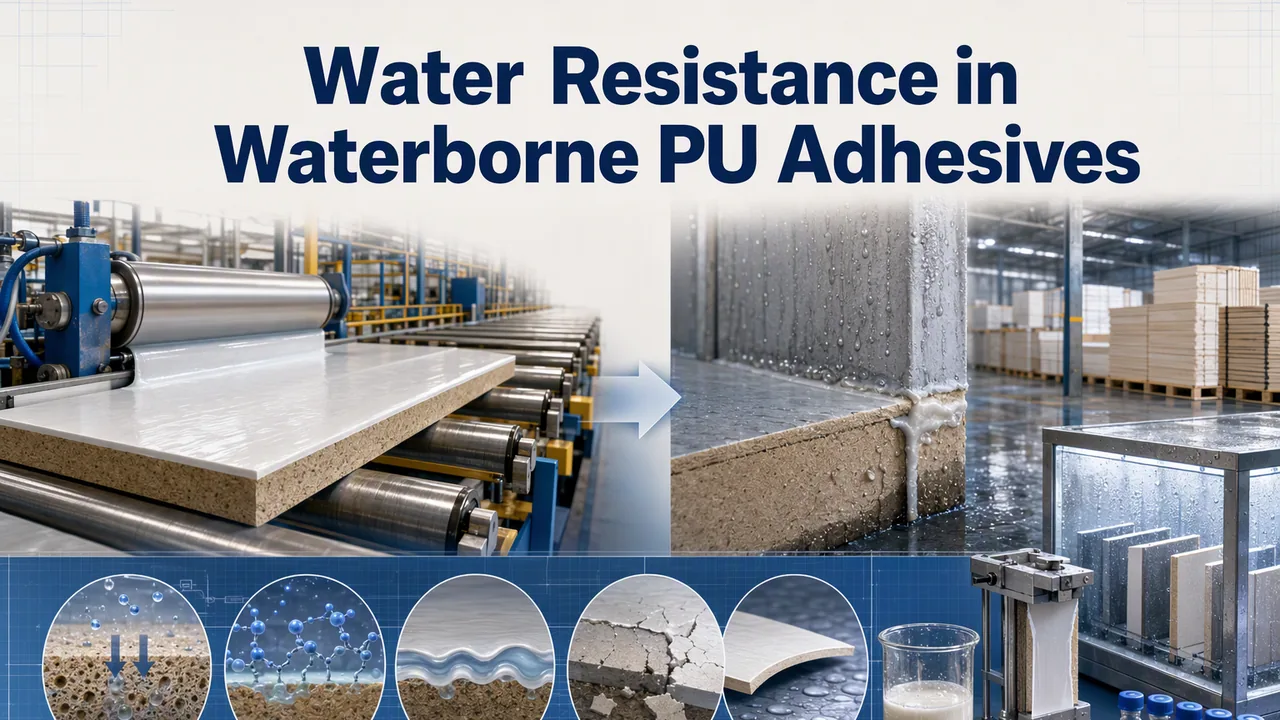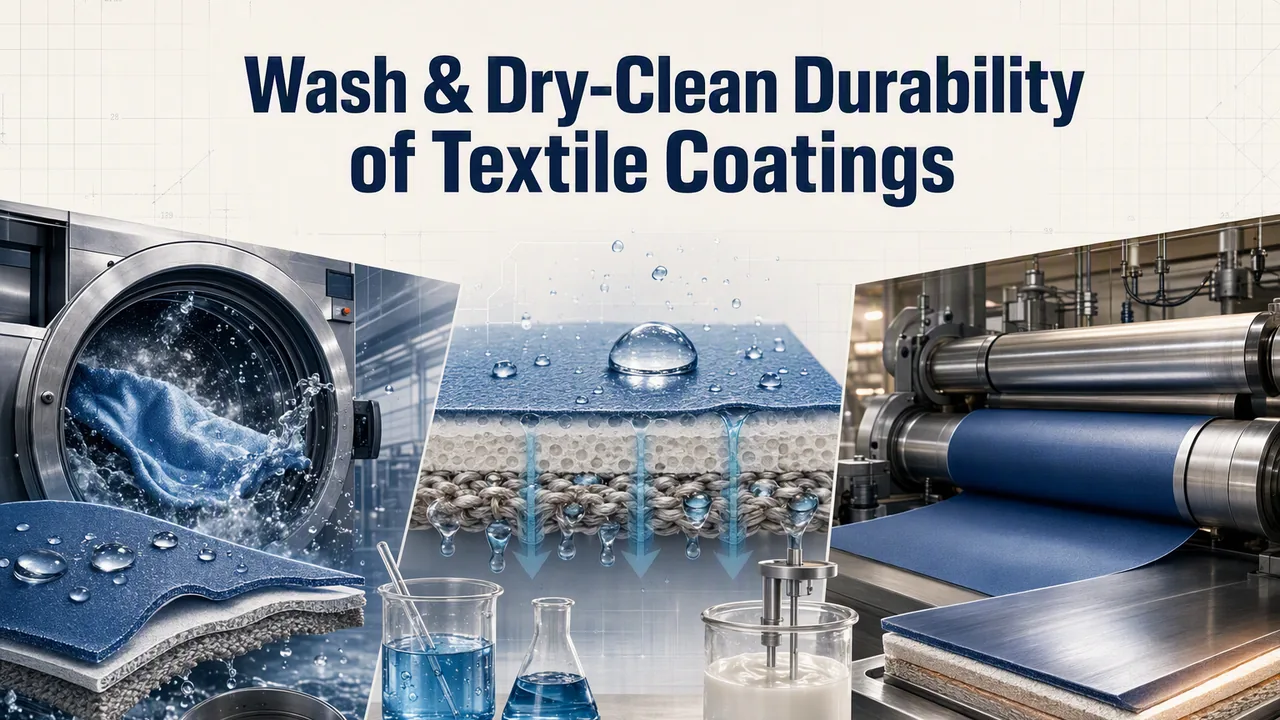
A coated stretch nylon that leaves our lab at grade 4 can come back from a brand's laundry protocol at grade 2, and the binder is usually not what changed. We approved that fabric on three cycles; their protocol ran twenty. A waterborne PU coating does not fail in washing as one event: the liquor swells the film, the drum flexes that swollen film over a moving yarn, and the detergent carries away everything that was never tied down. Dry cleaning takes the water out of the sentence and leaves the mechanics and the finishing press in it. Four things decide most of the result: how much water the dried film holds, what the backbone does at high pH, whether the film can still follow the fibre once it is swollen, and whether the cure was finished before the fabric was rolled up.
What a laundry cycle actually does to the film
A reference domestic wash to ISO 6330 at 40 °C with a heavy-duty powder runs at pH 9.5 to 10.5, and the cloth sits in it most of an hour. Three processes start in that hour, on three clocks.
Swelling is the fast one. Water in a polyurethane film is a plasticiser: the glass transition and the modulus fall together, and a film that felt crisp when dry is rubbery and weak when wet. That part reverses as the fabric dries.
Extraction is slower and it does not reverse. Residual emulsifier, neutralising amine, salts from the make-up water and low-molecular oligomers diffuse out through the swollen film. What leaves is the material that had been holding the surface together, so the first reading is gloss loss and a sandy hand, not a crack.
Hydrolysis is the slowest. Every ester group along the backbone is a site where alkali at temperature can cut a chain in two. Cycle two shows nothing you can measure. By cycle eighteen the film powders along the fold lines, because the molecular weight has dropped and nothing puts it back. That is why we refuse "washable" as a specification: a wash requirement has to carry a cycle count and a temperature.
The substrate moves too, and no binder datasheet can see it. Cotton swells by several percent in diameter when wet and shrinks back on drying, so the coating is peeled off the fibre and pressed back once a cycle, with the fatigue concentrating at the edge of the coated area. A detergent containing cellulase adds a route nobody predicts: the enzyme trims the surface fibrils the coating keys into. Biopolishing is a fabric benefit and an anchor removal at the same time.
On synthetic filament the fibre does not swell, so the question collapses onto the film, which is what our apparel coating grades are specified against. YT-6122 is 38.5 ± 1% solids, takes up under 3% water after 24 h at 25 °C, and still breaks at ≥ 700% elongation. On a polyester-elastane elastic, both of those have to be true at once.
Water absorption is only half the story
Twenty-four hour water absorption on a free film is the column every PUD sheet leads with, and it is only a snapshot. It does not report the rate, it does not report 60 °C at pH 10, and it says nothing about that film being flexed a thousand times while loaded.
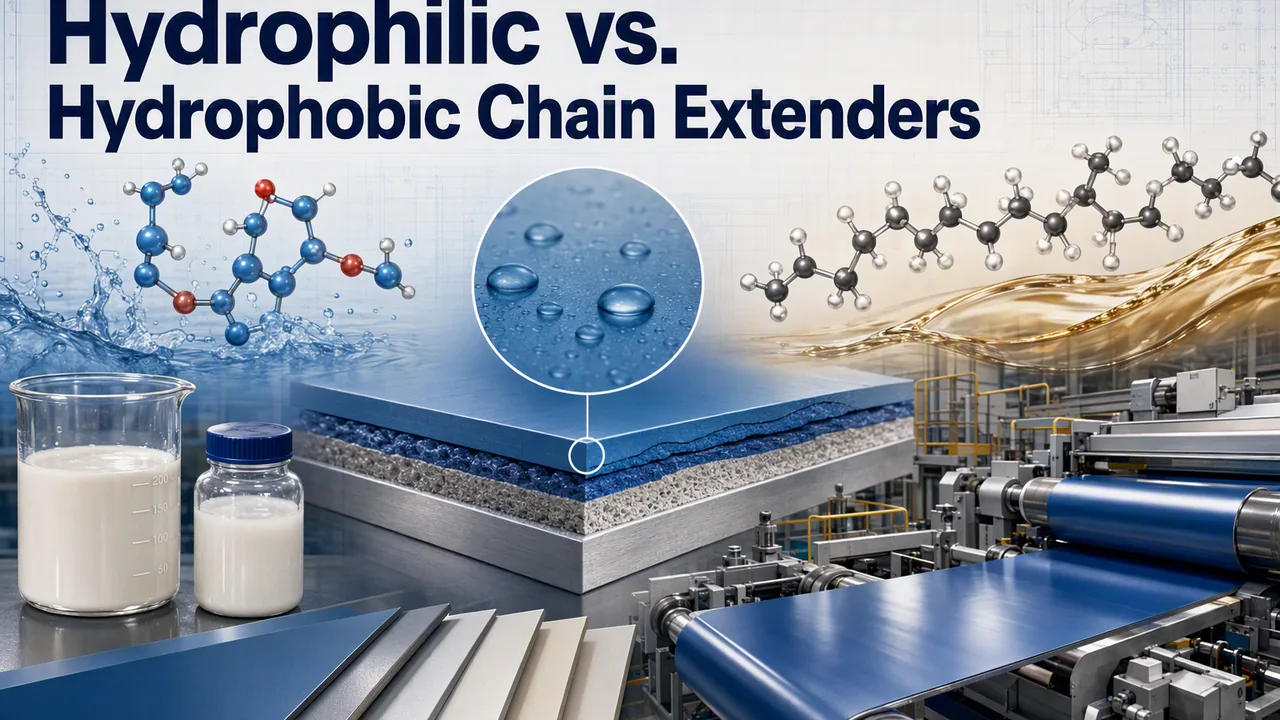
Ionic content drives most of the number. An anionic dispersion stays in water because its carboxylates hold a shell of hydrated counter-ion, and the same groups keep holding water after the film has dried. Raise the ionic level and the dispersion gets more stable and easier to thickness, while the wash behaviour gets worse. The hydrophilic versus hydrophobic chain extender piece walks the same ladder from synthesis.
Nonionic grades sit at the other end. YT-102 and YT-103 are nonionic aliphatic dispersions at 30% solids, and both sheets claim stability in acid and alkaline systems with good water and solvent resistance, which is what an alkaline liquor tests. The cost is real: without ionic stabilisation they take less electrolyte and less shear in a paste.
Below are the grades we sell for apparel coatings and printing varnishes. The uptake column is the wash argument; the last two are whether the film can still move while holding water.
| Grade | Solids | Water absorption (24 h, 25 °C) | 100% modulus | Elongation | Where we start with it |
|---|---|---|---|---|---|
| YT-6122 | 38.5 ± 1% | < 3% | 4.0 – 5.0 MPa | ≥ 700% | Low uptake and high stretch on one sheet; the default on elastic apparel |
| YT-6120 | 35 ± 1% | < 3% | 4.5 – 6.0 MPa | ≥ 500% | Most cohesive film of the group, and the stiffest |
| YT-6110 | 35 ± 1% | < 5% | 3.0 – 4.5 MPa | ≥ 650% | Softer hand where a little more uptake is acceptable |
| YT-611 | 35 ± 1% | 4 – 5% | 3.0 – 4.0 MPa | ≥ 700% | Silicone-modified: flex, release and a fuller hand in mid coats |
| YT-613 | 35 ± 1% | 4 – 5% | 6.0 – 8.0 MPa | ≥ 400% | High gloss and solvent resistance on a dimensionally stable ground |
| YT-1128 | 27 ± 1% | - | 1.5 – 3 MPa | ≥ 400% | Self-crosslinking; wet-heat anti-tack ≥ Grade 3.5 with nothing dosed in |
| YT-1150 | 50 ± 2% | - | 0.6 – 1.2 MPa | ≥ 1000% | Softest film here; its wash behaviour comes from the cure, not the grade |
Two conclusions come out of that table. Only YT-6120 and YT-6122 sit under 3% uptake, and they are also the two hardest films in it, which is the price of cohesion on a fine denier. The row with no uptake figure, YT-1128, is where we go when a customer will not run a two-part system: the crosslinking is built into the chain, so the wet behaviour arrives without a metering pump. And YT-613 at 6.0 – 8.0 MPa is the wrong tool on four-way stretch, where a stiff film cracks first and flakes second.
Dry-clean durability is decided at the press
Tetrachloroethene is non-polar, and a polar polyurethane film barely swells in it, so a strong water absorption number predicts dry-clean behaviour badly. Hydrocarbon solvent is milder still. Over five cycles to ISO 3175-2, the bath is rarely what takes a coating off.
Three other things are. Finishing comes first: a garment press runs at 150 to 170 °C with steam, and a thermoplastic waterborne film that came through the bath unharmed is re-plasticised in eight seconds and pressed into the weave, so the garment returns with shine marks and a boardy hand. More coated fabric dies at the press than in the drum. Second is the spotting table, where the remover is a glycol ether or ketone that will do to a PU film what perc cannot. Third is mechanics: small liquor ratio, long cycle, high shear.
So the dry-clean question comes back to the wash answer. Make the film unable to flow, because a crosslinked network softens with heat and does not reflow into a platen. YT-G30 is a polymeric carbodiimide at 50 ± 2% in PMA, worked in at 1 to 5% on resin solids, and it reacts with the same carboxyl groups that hold water in the film. It is slow at room temperature, so the paste keeps its open time, and it accelerates as the stenter heats. It is non-sensitising and it yellows less than a polymeric aziridine. The two-part route is YT-1102, an aliphatic non-ionic curing agent at 19 – 21% NCO with a 5 to 6 hour open time, or YT-6300 at 20.5 – 21.5% NCO, hand-dispersible, with 3 to 4 hours. Both buy cohesion with a pot-life clock, and on a printing line that clock runs at three in the morning.
Four levers, in the order we pull them
- Take the water out of the ionic sites. Lower the carboxylate level, move to a nonionic grade, or leave the resin alone and cap the groups with a carbodiimide. Only the last one is a two-hour change on a running line.
- Ask what the backbone is. Ester content is the alkaline liability. YT-6136 is polyester-based, and we sell it for what that buys: adhesion to PVC, gloss, weathering, and water and solvent resistance on a coating that will never see a hot alkaline bath. Before committing any grade to a 60 °C spec, ours included, ask which diol is in it.
- Match elongation to the fabric wet, not dry. A swollen film follows less stretch than the same film conditioned at 65% humidity, and crosslinking shortens that margin again. On elastane we start soft and dose to the pass: YT-1150 at 0.6 – 1.2 MPa, or YT-206 at 1.0 – 1.5 MPa with ≥ 1200% elongation and real adhesion to nylon, which is why it is the down-proof grade. Its sheet puts a 24-hour limit on a crosslinked paste.
- Finish the cure. Coalescence is not crosslinking. Stenter air temperature and fabric surface temperature are two different numbers, and the second is the one that matters. Put indicating tape on the moving cloth once and the argument ends.
What those four levers will not do is turn a single-component soft dispersion into an industrial-laundering binder. Ninety degrees, pH 11, a percarbonate brightener and a forty-minute main wash: at that specification we point you at a two-component or a silicone system and quote the price difference with it.
Write the protocol before you book the lab
We get called into arguments about grades that are really about a protocol nobody wrote down. Five lines, before a test is booked.
- Cycle count and reading points. Three cycles is a screen, twenty is a specification, and reading at 5, 10 and 20 tells you whether you have a drift or a cliff.
- Liquor temperature, detergent class, and whether an oxygen bleach is in. That last one moves the answer more often than the binder does.
- Drying method, because tumble at 80 °C and line-dry are two tests on a thermoplastic film.
- Conditioning before grading. Twenty-four hours at standard atmosphere; score a damp cloth and you are measuring something else.
- One finishing pass at the cleaner's temperature and dwell, coated face up.
At every reading point measure the same three things in the same order: a flex-and-tape check for anchor loss, 60° gloss, and hand, by feel and by how the fabric lies. Free-film water absorption forecasts none of the three.
The grades above sit behind our waterborne polyurethane dispersion range, and the textile coating and printing page maps them onto knife-over-roll coating, rotary screen and inkjet. Check the uptake and modulus figures against your own recipe with the YT-6120 TDS (PDF).
Send us the fabric, the care label and the cycle count. Ask our application lab and we will run 5, 10 and 20 cycles and send back the report.
Frequently asked questions
How many wash cycles can a waterborne PU coating survive?
On polyester or nylon, a low-uptake grade such as YT-6122 with 1 to 3% YT-G30 and a full cure holds twenty cycles at 40 °C as routine commercial territory. The same film on a cotton-elastane ground can pass twenty and fail forty, because there the fibre gives first.
Is dry cleaning harder on a textile coating than washing?
The bath, no. The finishing, yes. Perchloroethylene barely swells a polar polyurethane film, while a steam press at 160 °C reflows a thermoplastic binder in seconds. When a garment comes back from the cleaner boardy or shining, look at the press before you look at the resin.
Why does my coated fabric go tacky after washing?
In order of how often we find them: undercure, a hydrophilic soft segment the water has plasticised, or extracted surfactant redeposited on the surface. Anti-tack after heat and moisture is the figure worth comparing, which is why YT-1128 carries a wet-heat rating of ≥ Grade 3.5 with no crosslinker dosed.