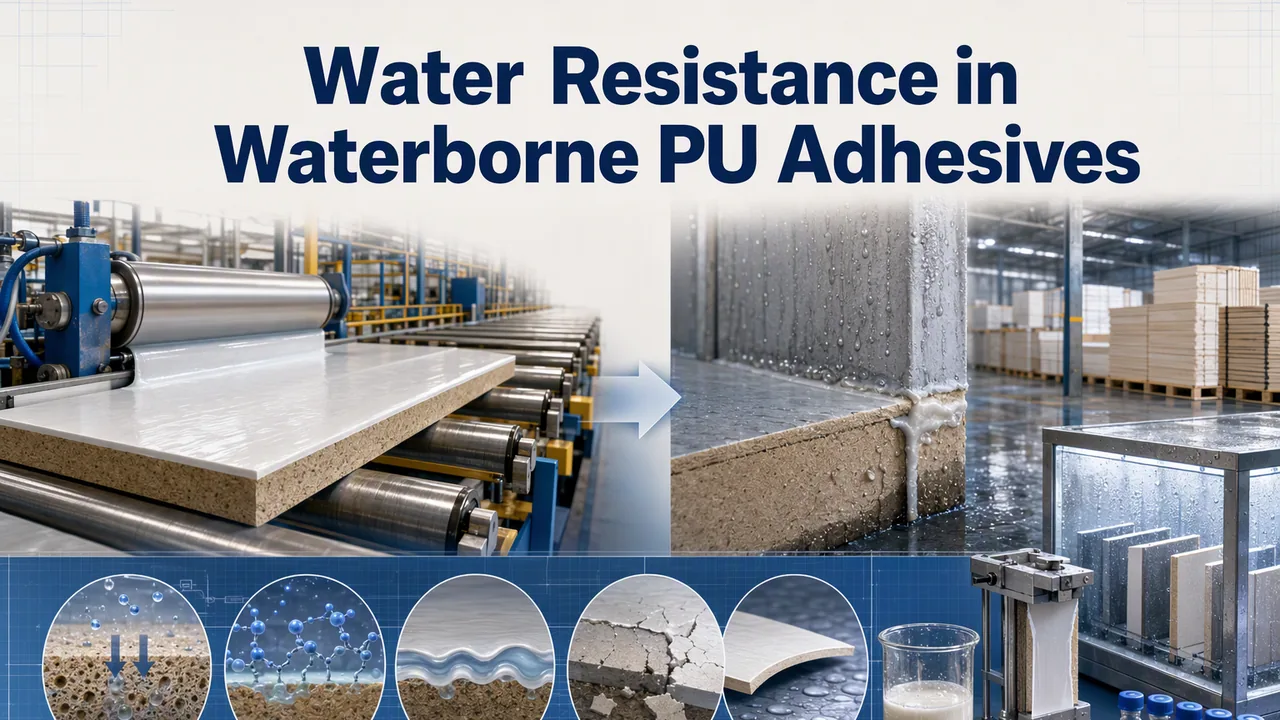
A pair of shoes can leave the lasting machine bonded and come back three weeks later with the uppers opened at the toe. It is rarely the machine that changed. Waterborne PU adhesives are strong enough for most footwear and lamination work when they are dry and fully set; the question a buyer actually asks is what is left after humidity, sweat or a hot warehouse gets into the film. In our lab a bond that measures fine on day one tells us very little. What water does is not one event but three: it softens the film, it pulls out whatever was never chemically tied down, and given heat and time it cuts the backbone itself. Five things decide most wet-bond results, and once you can name them the failures stop looking random.
What water really does to a polyurethane bond
Start with the reversible part. Water is small and polar enough to sit between urethane groups and break the hydrogen bonding that gives a PU film most of its strength. Modulus falls, tack falls, and a bond that held the toe down dry can slide while it is wet. Dry the joint and much of that comes back, which is exactly why "fine on the line, gone in the rain" is such a common and such a misleading result.
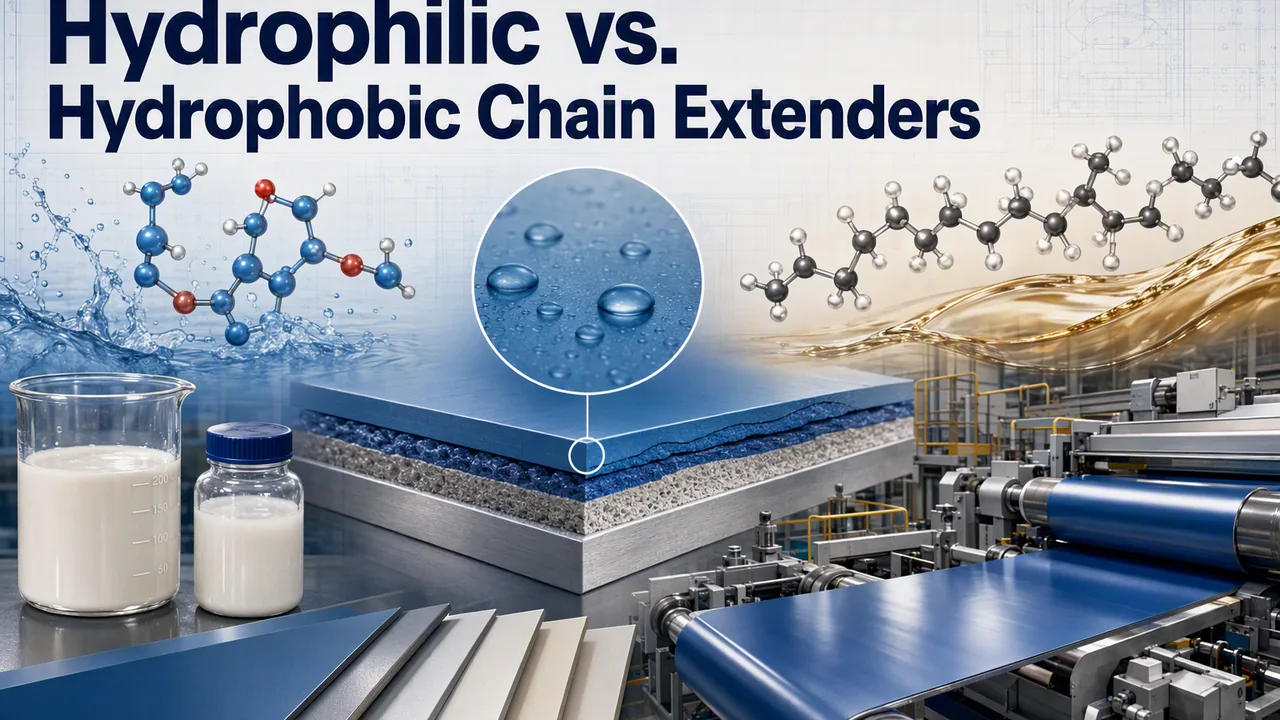
The irreversible part depends on how the dispersion was stabilised. An anionic waterborne PU carries carboxylate groups and a neutralising amine, plus residual emulsifier, to stay pourable. Those are the sites that drink. Underlying that is the balance our hydrophilic versus hydrophobic chain extenders piece keeps coming back to: the same ionic content that keeps the particle stable keeps water in the film. Strip the hydrophiles and you get better wet strength and a dispersion that no longer wants to sit still.
Left in the film, water then does the slow damage. Every ester along the backbone is a place that heat and alkali can cleave, and each cut is molecular weight you never get back. That is why hydrolysis failures arrive weeks late, in a humid container, and not on the first shift.
The five reasons a wet bond fails
We keep a short list, because on customer lines the causes recur in the same order.
- Too much hydrophilic content. The ionic group and emulsifier that make a stable dispersion also make a film that swells. Swelling is the softening that starts the failure.
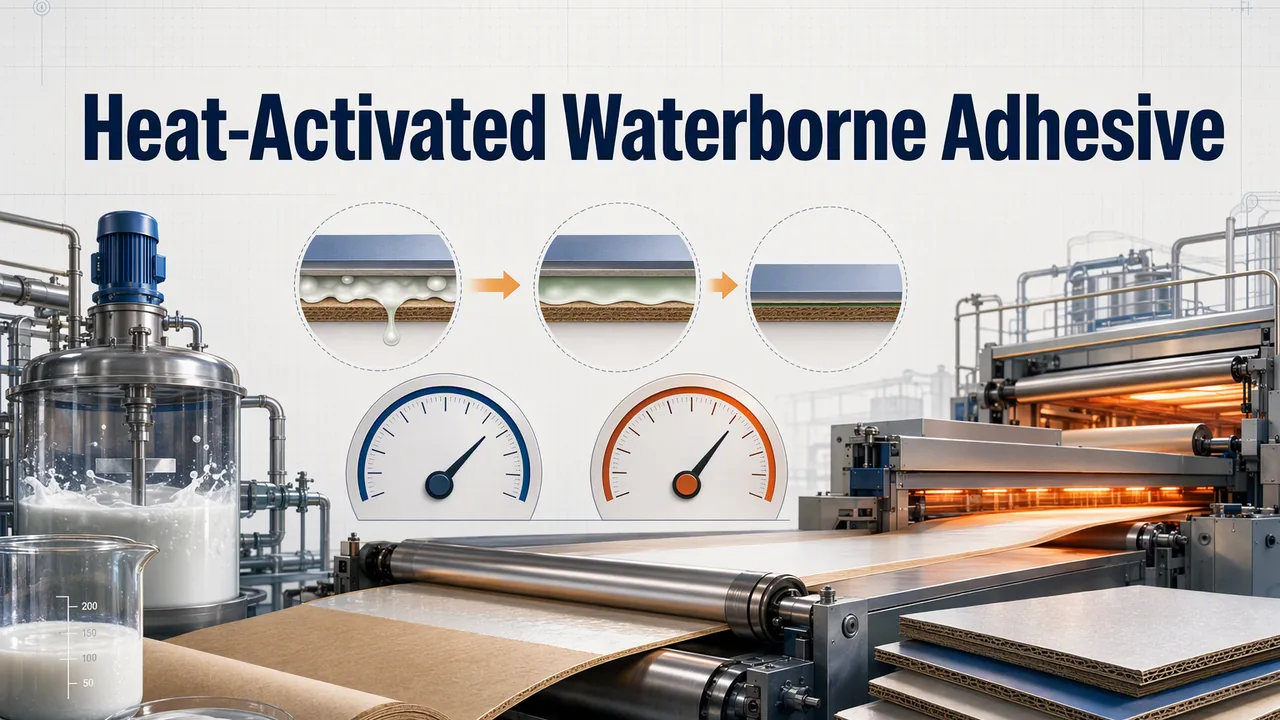
- Under-activation. Our heat-activated grades build strength as the hard segments crystallise, and crystallisation needs both temperature and dwell. Hit 50 °C for a second and the bond looks fine and still has no water resistance.
- Ester hydrolysis. Hot-humid or alkaline service, and the backbone gives. If the failure comes late, a humidity oven reproduces it in days.
- Plasticiser migration. Bond to PVC or to a soft synthetic leather and the plasticizer diffuses into the adhesive, re-softens it, and drags water along. The substrate, not the glue.
- Water trapped at the interface. Pack or use a bond while the film is still carrying water and you have put the failure agent inside the joint yourself. This is what a fast line with enough flash-off is there to avoid.
The list is diagnosis; the table is triage, so an operator can start from what they can see. A bond that lets go at the seam edge and feels soft is plasticiser; one that is sound dry and slides wet is activation; one that only fails after humid storage is hydrolysis.
| Symptom | Why | First lever |
|---|---|---|
| Opens only after humid storage | Ester hydrolysis or extracted hydrophiles | Crosslink, or move to a more hydrophobic backbone |
| Strong dry, slides wet | Film swelled; hydrogen bonds broken | Lower ionic content; raise crystallisation |
| Fails the same day it was bonded | Film still carried water, or cure unfinished | Longer flash-off and dwell; check the oven |
| Lets go at the seam edge, still soft | Plasticiser migrating from the substrate | Change the substrate primer, not the adhesive |
| Good on one shift, bad the next | Activation temperature drifting on the press | Log press temperature and dwell every lot |
How we test whether a grade will hold up
The first thing we throw out is the dry bond test. It answers a question nobody is asking. What we want is wet-strength retention: the percentage of the original shear the joint still carries after water has had its turn.
We bond the real substrate pair, condition it at room temperature for a day so the film can coalesce before we judge it, then pull lap shear dry. A second set goes into conditioning under humidity or into warm water, drains, and comes straight to the rig. We run two severities: a cold immersion for the handle of a rain, and a forty-eight-hour humidity stack under load for the warehouse. The retention ratio is the number that goes on the report, never the absolute wet value alone.
Then we look at whether the loss comes back. A bond that drops forty percent wet and recovers on drying has a swelling problem, and swelling is usually a formulation lever. A bond that has lost ground permanently has been hydrolysed or extracted, and no later drying will hand it back. Those two failure signatures send you to different fixes, and telling them apart is the whole point of conditioning before you test.
Which grades hold up, and where each one stops
All of our adhesive grades are anionic and aliphatic, so water resistance here is a matter of degree and duty, not a pass or fail on chemistry.
For the wet-and-hot duty cases we reach for YT-507 first. It is a one-component aliphatic dispersion at 50 ± 2% solids and 200–500 mPa·s, thin enough to spray and atomise cleanly and concentrated enough that there is less water to drive off before the bond has to work. It is the grade we describe to customers with water resistance and scrub resistance on the sheet, and the one to ask for when a shoe is going to sweat.
YT-502 is the brush-on upper adhesive. It runs 40% solids and activates at 50–55 °C, with fast crystallisation and a film tensile in the 35–50 MPa range. It gives you good wet and heat resistance once the bond is actually activated and crystallised, and none if you are chasing line speed and shortening the dwell.
When the process needs a high activation temperature, YT-503 activates at 100–110 °C rather than body temperature, keeps 39 ± 1% solids, and adds a 100% modulus around 7–8 MPa with anti-blocking. That higher wall is what you want when the article is going to sit somewhere genuinely hot; it is also what makes it forgiving on an automated press that overshoots.
YT-504 is the general bonding resin, 45 ± 2% solids at pH 7–9, chosen for a smooth film and grip across paper, textile and plastic. We would not sell it as a waterproof adhesive; it is the right call for paper and textile lamination where the humidity is incidental rather than the load.
The honest limit: every grade here is an anionic waterborne dispersion, so the film can be re-emulsified if you leave it standing in water. None of them is for a bond that will sit immersed. Where you truly need that, run the adhesive with a crosslinker from our crosslinker range and let it react; that is the aziridine versus isocyanate conversation, and it changes the answer more than any choice of PUD grade will.
The full numbers are on the YT-507 TDS, and the rest of the footwear and lamination grades are gathered on the adhesives application page.
Pick the grade by the wettest moment the bond will see, not the driest. Decide what retention ratio your product actually has to hold, build it into the incoming check, and put the activation temperature and dwell on a log. If a joint is failing and you cannot tell which of the five it is, send us the conditioning you ran and we will read it with you at the application lab.
Frequently asked questions
Why does my waterborne PU adhesive test fine dry and fail once it gets wet?
Because you tested the dry bond, which is the easy case. Water sits between the urethane groups and breaks the hydrogen bonding that carries the strength, so the film softens and the joint slides. If the loss comes back on drying, that is swelling and you fix it at the formulation; a grade built for the duty such as YT-507 starts from a better place than a general adhesive.
Does a crosslinker really improve water resistance?
Yes, and it is the strongest single lever. Crosslinking ties the chains together so water cannot dissolve or extract them, which is exactly what an anionic dispersion is vulnerable to. The trade-offs are pot life and cost, laid out in our aziridine versus isocyanate piece; a blocked aliphatic like YT-G30 is the usual first try.
Is a higher heat-activation temperature a sign of better water resistance?
Not on its own. Activation temperature tells you what the process has to reach, while water resistance comes from how fully the hard segments crystallise once they get there. YT-503 activates at 100–110 °C and YT-502 at 50–55 °C; underdone, either one will feel strong on day one and let go wet.