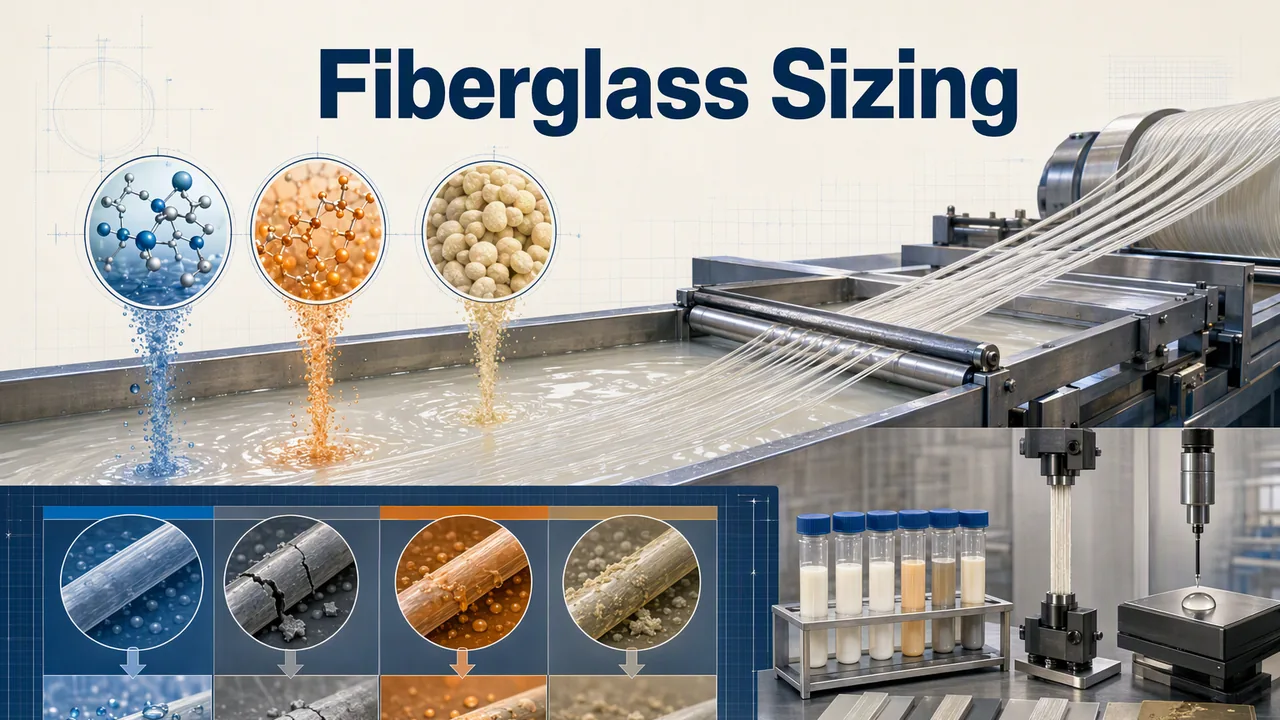
A sizing bath misbehaves long before the composite shop complains. On a winder pulling 2400-tex E-glass direct roving at around 1,800 m/min, the first symptoms are small: fuzz building at the applicator roll, binder dragging off in slivers on the drying drum, a doffed cake that squats an hour later in the warehouse. Nobody files a complaint over those. They file it when chopped strand bridges the hopper, or when laminate tensile results land 12% low after a binder supplier quietly reformulated an emulsion.
We have chased enough of these investigations (ours and customers') to have opinions about the film-former at the center of them. That is the subject here: what fiberglass sizing actually asks of a binder, where the traditional options give out, and what shifts when you run a waterborne polyurethane dispersion, a PUD, in the bath.
What the film-former actually does in a sizing bath
A sizing package is a small, mean environment. Four things happen at once. The binder has to coat two to four hundred filaments into a coherent strand from a bath running 5–12% solids, then coalesce into a continuous film during the bake, while the silane coupling agent does the real interface chemistry, while lubricants keep the strand from abrading itself on guide pins, and while the whole mixture recirculates through a warm steel tank that is a gift to any microorganism that wanders in.
The film itself has to reconcile two demands that pull against each other. Soft enough to survive the bend radii of winding and the hammering of a chopper running 90 cuts per minute. Tough and water-insoluble enough that the strand does not turn into a rope sitting in a humid warehouse for a month. Pick a traditional binder and you are picking one side of that trade.
Waterborne PU vs. epoxy, PVAc and starch: where each binder gives up
Epoxy became the benchmark for one job in particular: maximum laminate property retention. It pays for that in brittleness everywhere else. PVAc is cheap, fast and dries tacky enough to hold a mat together, and it re-emulsifies the moment humidity gets serious. Starch and casein blends still run much of the powder-bound mat business on cost alone, with bath life to match. The table is the honest version of how we think about it.
| Binder | Does this well | Gives up at |
|---|---|---|
| Emulsified epoxy | Stiff, chemically resistant film; unmatched interlaminar retention in structural parts | Brittle under chopping; tight bath control and hot cure needed; dust and fuzz unless you over-apply pick-up |
| PVAc latex | Cheap, fast-drying, good initial tack; the classic mat binder | Re-emulsifies in humidity; film stiffens with age; fuzz appears as winder speed climbs |
| Casein / starch blends | Excellent wet-out, near-zero binder cost | Bath life measured in days, not weeks; moisture sensitivity; light-duty conversions only |
| Waterborne PU (PUD) | Soft/hard balance tunable; continuous film at low pick-up; strand integrity holds at line speed | Costs more per kg of solids than starch; will not hand you epoxy-level stiffness at equal pick-up |
That last cell deserves to stay on the page. A PUD will not match a purpose-built epoxy sizing on interlaminar retention in aerospace prepreg, and we do not pitch it that way. Its case starts where day-to-day production lives: direct roving for chopped strand, thermoplastic reinforcement in PA, PP and PBT, and any winding line that has outgrown the binder it was qualified with.
Testing a sizing change before you commit a winding line
In our lab the fast screen is a cast film: bar it out, read elongation against modulus. A soft PUD film goes several hundred percent before it lets go; an epoxy film snaps in the single digits. That number predicts chopper performance better than anything else we have found. Then, and only then, move to real fiber.
- Fix the ignition loss target. Commercial roving sizings typically sit between 0.4% and 1.2% on the fiber; hold LOI constant so you compare chemistry, not pick-up.
- Break the hardest station first. Run the chopper before the winder; if the strand survives 90 cuts per minute with low dust, winding fuzz is usually a follow-on, not a new problem.
- Measure strand integrity, dry and after conditioning: roving abrasion fuzz weight, and a doffed-cake squat check after 48 h at 40 °C.
- Cast the laminate and read void content per ASTM D2734 before arguing about strength numbers. A film-former change moves wet-out first, and voids catch it earlier than tensile bars do.
A binder that clears all four inside six weeks has earned a line trial. Run it against your current sizing as the reference, not against remembered results; absolute numbers drift with glass batch and humidity.
Which waterborne PU grade goes into your sizing bath first
Moving from an emulsion or solvent system, we almost always start with a nonionic grade: it behaves with silane packages the way you want and shrugs off the pH swings that kill an anionic bath in summer. The film-formers behind our YT-FB series sit in the waterborne PU line (PUD binders for coatings, inks and fiber), and three grades cover most sizing trials.
| Grade | Ion type | Solids | pH (as supplied) | Put it in the bath when… |
|---|---|---|---|---|
| YT-101 | Nonionic | 30% | 5.0–7.0 | Bundle flexibility decides the trial: high-tex roving, tight bend radii, anything downstream of a chopper. Soft, highly elastic film. |
| YT-102 | Nonionic | 30% | 5.0–7.0 | The part sees humidity before the press: strong initial tack holds filament count down through conversion, plus water and solvent resistance. |
| YT-103 | Nonionic | 30 ± 1% | 6–8 | You run amino-silane packages or the bath drifts alkaline: stable across both acid and alkaline conditions. |
Start at the pick-up you already run and come down from there. On a 1200-tex winding trial last year we got fuzz weight down roughly a third at 0.3 points lower ignition loss than the incumbent emulsion, which is the kind of margin that pays for the solids price difference. Full parameters for YT-103 are in its TDS. One honesty note: YT-103 carries a six-month shelf life where YT-101 and YT-102 hold twelve months, which matters if you stock 120 kg drums at a remote sizing line.
Fiberglass sizing FAQ
Can a waterborne PU film-former fully replace epoxy sizing?
On chopped strand, thermoplastic reinforcement and most commercial roving, yes, and usually with better handling at lower fuzz. On high-performance epoxy prepreg where interlaminar retention under hot-wet conditions is the contract, the engineered sizing is still epoxy. We would rather say that up front than lose a customer in panel testing.
Our bath starts foaming the day PU goes in. What do I change first?
Cut recirculation shear and aeration at the applicator tank before you blame the binder; foam is usually the lubricant package and the pump, not the PUD. Then check free amine from the silane. If you still need a defoamer, dose in 50 ppm steps; craters showing on doffed cakes mean you went one step too far.
How long does requalification take after a sizing change?
Plan four to eight weeks of panel work against your current reference: strand integrity and ignition loss first, then void content and the mechanical properties your datasheet promises customers. Trials we have supported that skipped the conditioning steps came back to bite in the market, not the lab.
The longer process write-up, including where each conversion segment sits, is on our fiberglass sizing application guide. If you want a starting grade for your fiber, tell us the tex, the silane system and the composite resin, and ask our application lab.