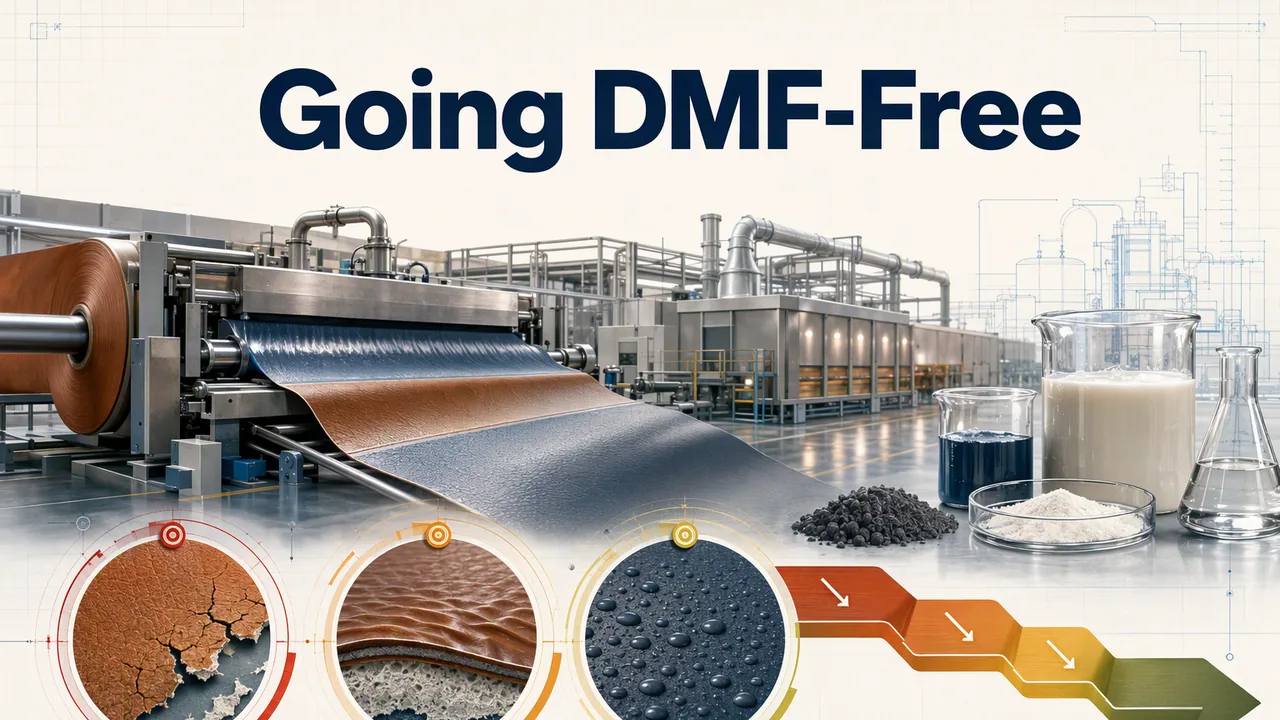
A finishing plant in the spring of last year had run the same DMF-based wet line for eleven years and was told, by a footwear customer's restricted substances list, that it had eight months to stop. They bought a waterborne PU, thinned it the way they had thinned the old paste, kept the oven settings, and got out a base that was a sponge one week and a sheet of cardboard the next. Nobody had sold them the wrong resin. The line had been built around what DMF does, and once that was gone, every setting the operators trusted was describing a process that no longer existed. That is the honest version of going DMF-free: it is a machine conversion that happens to involve a chemistry change, not the reverse.
What DMF was actually doing on your line
In a conventional wet-process base, DMF is not a carrier that politely evaporates. The PU is dissolved in it, the paste is knife-coated onto the non-woven, and the whole thing goes into a water bath where the water trades places with the DMF. The polymer precipitates as it goes, and the micro-void structure that gives the base its leather-like compressibility is a direct product of how fast that exchange runs. The bath then has to strip the DMF out of the water and send it back to a recovery column, because venting it is expensive and, increasingly, not permitted.
Two consequences follow, and both are easy to miss until you are three weeks into a trial. The first is that your base structure was being set by a phase-inversion rate, not by the resin alone, so the same resin at the same solids can give you two different hands depending on bath temperature and liquor concentration. The second is that a great deal of your line's energy budget was going into recovering a solvent, which is money you now no longer spend, and a great deal of it will go into evaporating water instead, which is money you now do. DMF boils at 153 °C and water at 100 °C, which looks like an advantage for the switch right up to the point where you notice how much more heat it takes to drive a kilogram of water out of a film.
The three failures that show up first
We have watched this sequence on enough customer lines that we now expect it in this order.
- Skinning, and everything that follows from it. Water leaves the surface film and sets a skin over a wet core. The core keeps outgassing, the skin blisters or pinholes, and in a foamed system the bubbles coalesce instead of freezing in place. The tell is a base that is under-cured in the middle and passes a surface touch test.
- Build and hand drift. Solvent systems tolerate a wide gap between a thin coat and a thick one. Waterborne coats read the substrate: knife clearance, blade wear and base fabric porosity all move the dry thickness, and with it the hand. A line that was set by feel has to be set by measured grams per square metre.
- Wet-on-wet adhesion and rubfastness. Each new waterborne layer partially redissolves the layer underneath it, because the carrier is water and the underlying film is not fully coalesced yet. Colour rubs off, interlayer peel shows up in flex, and the defect appears at the customer's press rather than at your own.
All three are drying and sequencing problems before they are formulation problems. Fix the oven and the applicator and most of the trial complaints disappear, which is why the first conversation on a new line should be about your drying profile, not about resin choice.
Move in the order the risk falls
The single most expensive mistake we see is a plant converting its base first. The topcoat is where a waterborne grade will match what you already ship, and the foamed base is where it will not, so the stages below are ordered by how much of the old process you keep.
| Stage | What you change | What you keep | Accept it when |
|---|---|---|---|
| 1. Topcoat / finishing | Resin only; same knife, same line speed | Touch, gloss, colour, drying schedule | Rubfastness and flex match the control panel |
| 2. Mid and base coats | Resin, solids level, and the interlayer flash-off window | Substrate, backing, build schedule | Interlayer adhesion survives 50,000 flex cycles |
| 3. Foamed base | The whole forming mechanism, plus the oven | Almost nothing except the fabric | Cell structure, compressibility and weight hold across three consecutive drums |
Stage 1 is a purchase order. Stage 3 is a project with a budget and a calendar, and if you try to do both in the same quarter you will not be able to tell which change caused the defect you are looking at.
Rewrite the oven, not only the formula
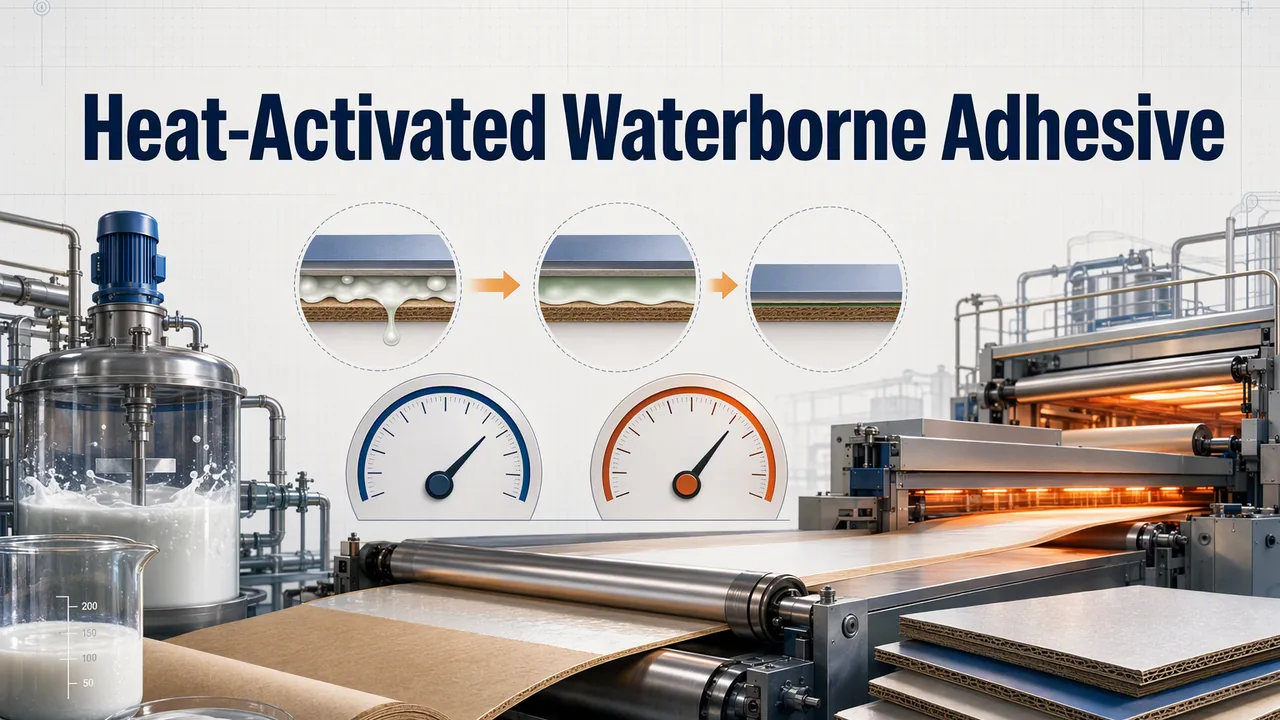
Our practical guidance is to split the drying into a long, gentle, high-airflow first zone and a hotter finishing zone, rather than one hot pass. Moving more air across a wet film at a moderate temperature carries far more water out than raising the temperature an equal amount, and it does it without setting the skin that traps the moisture underneath. Humidity control earns its keep here in a way it never did on a solvent line: the dehumidified air is what lets you run the first zone cool enough not to skin.
Budget for line speed loss on the first pass. On a base line we would rather plan for something real, then win it back with zone count and airflow, than promise a like-for-like rate and have the plant discover the shortfall during a customer audit. The economics usually recover: you stop buying DMF, you stop running a recovery column, you stop permitting the emissions, and the VOC story gets simpler in front of a brand auditor.
Which grades, and where each one stops
For the finishing and mid coats, the two we reach for first are YT-612 and YT-613, both silicone-modified anionic aliphatic dispersions for leather mid and base coat work, both declared free of formaldehyde, nonylphenol, heavy metals, PAHs and DMF. They sit at 35 ± 1% solids and pH 6.0–8.0 with 24-hour water absorption of 4–5%, and they differ in stiffness rather than in chemistry: YT-613 is the harder, stronger film at 6.0–8.0 MPa modulus and ≥ 20 MPa tensile with ≥ 400% elongation, while YT-612 gives 4.0–6.0 MPa modulus, ≥ 15 MPa tensile and ≥ 500% elongation for the coats that have to flex rather than push back. Both are low viscosity at ≤ 300 mPa·s (30 °C), which is a gift on a roll coat and a problem on a vertical knife until you thicken it.
For the self-matting top of a finished piece, YT-X51 is where we start: 30 ± 1% solids, 100–300 mPa·s at 25 °C, an oily-smooth hand with good black haze, and it takes baking up to 240 °C, which matters if your line runs hot for other reasons. Two honest caveats. It is a medium-soft resin, so it is not the answer when a customer wants a dry, waxy touch, and its dispersion medium is listed as deionised water with NMP as co-solvent, so if the reason for your conversion is a brand RSL that names both solvents, screen it against that list before you specify it. Filter through 150 mesh before it goes on the piece, which is advice worth following on any waterborne topcoat.
The base is where the argument gets harder. YT-1040 is our anionic aromatic dispersion for foamed and impregnated bases: 40 ± 2% solids, pH 7.0–9.0, 1.5–2.0 MPa at 100% modulus, 20–30 MPa tensile and 1000–1500% elongation, with good water and toluene resistance and, more to the point, uniform fine foaming with a soft hand and a smooth base surface. The published route is 20%–50% filler on the measured resin, 3%–5% foaming agent, foam to target ratio, adjust viscosity, coat and dry; for impregnation, drop the solids to 10% or below and run the impregnate-and-dry cycle several times rather than once. YT-2540 plays the same structural role at the cheaper end, at 40 ± 2% solids and pH 6.0–8.0 with ≥ 5 MPa tensile and ≥ 500% elongation, and it takes powder well when you are loading filler hard to hit a weight target. Its tensile is a fraction of YT-1040's, so we keep it out of anything that will be flexed hard.
Full numbers for the base grades are in the YT-1040 technical data sheet, and the whole waterborne polyurethane dispersion range is catalogued in one place when you want to look past these five.
Where waterborne still loses
A waterborne foamed base does not currently reproduce the exact compressibility curve of a DMF-coagulated one, and we would rather say so than have you find it out from a brand's hand panel. What it does match is abrasion and flex endurance, provided the interlayer flash-off is respected and you crosslink. That proviso is doing real work. Waterborne films are vulnerable to the two things a synthetic leather gets asked to survive: repeated flexing at an interface that never fully dried between coats, and a rubfastness requirement met by a film that re-emulsifies under pigment paste. Metering in a crosslinker from our crosslinker range is the standard answer to both, and it is cheaper than a failed audit.
Prove it before you commit a production run, and prove it on panels that went through your own oven rather than a laboratory dryer, because the drying history is most of the result. Condition and test at a stated atmosphere to ISO 291 so your numbers and your customer's numbers describe the same panel, then run flex endurance, wet and dry rubfastness, abrasion, water vapour transmission if the spec asks for it, and a residual solvent determination on anything you still call low-VOC.
If you are inside an RSL deadline and cannot tell which of your four coats is actually the blocker, send us the layer structure, the oven profile and the hand target. Our application lab will run your own non-woven against these base grades and post the panels back, so the decision gets made on your substrate rather than on our datasheet; the grades we keep on the shelf for this job are listed on the synthetic leather application page, and if you want the market picture before the technical one, how the supply chain moved off DMF covers why the deadline arrived. and you can ask our application lab directly.
Frequently asked questions
Can I drop a waterborne PU into my existing DMF wet line without changing anything?
Not into a wet bath, no. The bath works by DMF and water exchanging places to precipitate the polymer, and a waterborne dispersion has no DMF to trade; it is already dispersed in the water. The topcoat and mid coats are the layers where a drop-in is genuinely realistic, and that is why we start there. The foamed base needs a drying line rather than a coagulation bath, which is a different machine conversation. Start with YT-612 or YT-613 overhead and leave the base for the second phase.
Will a waterborne base feel like my DMF base?
Close on the surface and different in compression, at least for now. The micro-void structure formed by phase inversion has a specific rebound that a dried waterborne foam approaches rather than copies. YT-1040 at 1000–1500% elongation with 20%–50% filler gets you a soft, uniform hand that most fashion and shoe-lining buyers accept; automotive hand panels are the ones we tell customers to bring their own target to. If your hand target is a dry, waxy one, YT-X51 is a medium-soft resin and is not the right lever.
What usually causes the colour to rub off after the switch?
An interlayer that never flashed off, more often than a bad pigment paste. Water is still leaving the coat below when the next one goes on, so the new layer partially re-takes the old one and the pigment sits at a weak interface. Extend the flash-off, drop the pickup a little, and meter a crosslinker from the crosslinker range into the top layer before you blame the colorant. If it only rubs after humid ageing, look at water absorption instead: the finishing grades above sit at 4–5% over 24 hours, and a cationic or solvent-based colourant in the mix can wreck that number on its own.