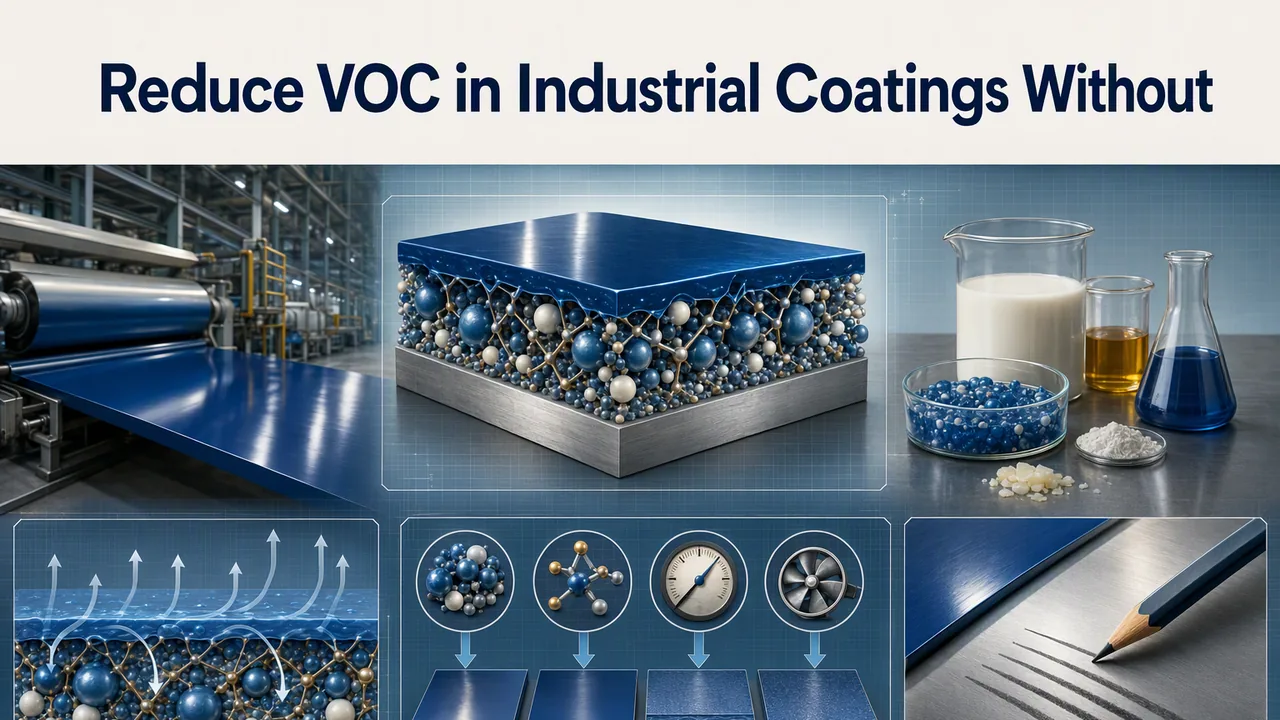
The first low-VOC conversion we ever supervised lost the argument before it started. A coil line running a solvent-borne PU topcoat at about 420 g/L had been told by a brand's restricted-substances audit to come under 100. The trial resin was a standard waterborne dispersion, applied at the same line speed and the same wet film thickness, and it cleared the VOC number cleanly. Then 60° gloss fell from 85 GU to 58, and pencil hardness slid from 2H to HB. Nobody on the line wanted either number waived. That is the whole difficulty of trying to reduce VOC in industrial coatings: the solvent had been doing two quiet jobs that were never itemised on any data sheet, and after the switch you have to rehire them one by one.
What the solvent was actually doing in your film
Gloss and hardness read like two separate lines on a quality checklist. In a converting formula they get decided at the same moment: the few minutes between wet-down and set.
Solvent keeps the binder deformable long after it leaves the applicator, so the film can pack dense and flow mirror-smooth while it dries. It also sets the time budget, because nothing much happens once the solvent is gone. And visible light scatters off surface structure in the 0.1–0.5 µm band, which is why a coating that looks dead level to your eye can still measure twenty gloss units below the baseline.
Water carries neither job well. It flashes slowly, and the latex particles lock into a packed lattice early; from that point on, coalescence depends entirely on the polymer being soft at application temperature. The textbook fix, stepping to a higher-Tg grade, walks straight into the trap. Stiff particles that refuse to deform leave micro-voids behind, and the voids do double damage: they scatter the light that should have reflected, and they cut the cohesion of the dry film. A low-VOC coating converted that way ends up hazier and softer than the solvent-borne it replaced, in the same trial.
The way out is to decouple the two jobs. Let the particles coalesce while they are soft, then turn the film hard after it has formed, using chemistry that brings no solvent of its own. Everything below is a variation on that one idea.
The four levers we pull to reduce VOC in industrial coatings
We pull them in a fixed order, because each lever spends budget the next one needs.
- Raise applied solids before anything else. High-solid PUDs such as YT-2250 (50 ± 2% solids) and YT-1155 (55 ± 2%) run far above the 30–35% of a typical general-purpose dispersion. More binder behind every micron of wet film means less water to drive off, so the oven can run shorter or cooler while the film stays open long enough to level. Both grades sit in our waterborne polyurethane range.
- Buy hardness from curing, not from Tg. YT-1102 is an aliphatic, water-dispersible isocyanate curing agent at 99–100% solids, so it adds essentially nothing to the VOC number while doing the job the solvent used to do: NCO content 19–21%, 5–6 h open time at 25 °C, and in our lab it reliably pulls pencil hardness one to two grades up on films cast from soft high-solid dispersions.
- Put the coalescent on a diet. Glycol ethers and esters count toward the regulated VOC figure under the definitions the US EPA documents for coatings, and older waterborne formulas routinely carry 6–10% of them. With solids and crosslinking doing the packing work, we usually take that package down to 2–3% and never feel it in gloss.
- Fix the line before letting the lab fix the resin. On the coil trial, nothing in the chemistry was wrong. Adding a 1–2 minute ambient flash-off zone ahead of the first heated section, dropping the peak ramp to a gentler slope, and metering wet film instead of trusting the roll gap recovered most of what the first pass had lost. A 100-mesh filter polish on the high-solid grade also killed two speck complaints we had been about to blame on the resin.
| Grade | What it is | Solids | Viscosity (25 °C) | Where it fits the conversion |
|---|---|---|---|---|
| YT-2250 (TDS) | High-solid aliphatic PUD | 50 ± 2% | 100 – 500 mPa·s | Soft-touch industrial topcoats, highly filled matte systems |
| YT-1155 | High-solid tough-elastic PUD | 55 ± 2% | 200 – 1,200 mPa·s | High-build flexible films, tough clear coats, paste systems |
| YT-6073 | PU-modified specialty resin | 45 ± 2% | — | Gloss and hardness boost when blended with softer grades |
| YT-1102 | Non-ionic aliphatic curing agent | 99 – 100% | 1,200 – 4,000 mPa·s | NCO 19 – 21%; hardness and chemical resistance at zero carrier VOC |
Scoring the switch: gloss units and pencil hardness
If the two sides of a conversion are judged at whatever film thickness each pass happened to land on, the trial will fail on paper and nobody learns anything. Compare at the same dry film thickness on the same primer. At 50% solids that means a 20 µm wet film dries to 10; do that arithmetic before you read the meter, because wet-on-wet comparison is the most common way a good waterborne gets fired.
We measure 60° gloss per ISO 2813. Two panels of the same batch can sit 3 GU apart on an honest day, so anything within 5 GU of the solvent baseline is, in our experience, a pass the customer cannot see on the line. Pencil hardness gets pulled across the film at the standard 45° angle, on a fresh pull per panel set. And grade the reading against the cure schedule, not the calendar date on the trial record: crosslinked films keep building hardness over several days at room temperature, and a panel measured at 48 hours will unfairly lose an argument it wins at day seven. That one detail changed the outcome of two failed conversions we were asked to autopsy.
Where the waterborne still loses
Let's be straight about the ceiling. A solvent-borne PU can hold gloss above 90 GU on a smooth steel or aluminium substrate, and our high-solid builds level out in the low 80s; if your spec floor is 90, this conversion is not the one to sell your plant. Single-pass high build stays sag-prone even at 50% solids, and the crosslinker route buys hardness at the cost of a mixed-batch pot life that a spray booth left running to the end of shift will punish you for.
What the numbers on our trial sheet eventually settled at: 78 g/L, 82 GU, F hardness on the day-two panel and 2H by day seven, at a line speed the plant kept. Reduce VOC in industrial coatings as a solids-and-curing problem rather than a solvent-substitution problem, and the gloss-and-hardness conversation stops being a waiver request.
If your conversion is really a coating-line re-engineering story (the same logic one of our customers worked through in our DMF-free synthetic leather transition guide), the sustainability page frames it the way we pitch it internally. Send the current VOC number and the two properties you refuse to lose, and ask our application lab to run your baseline alongside two or three grades.
FAQ: VOC reduction questions from the lab bench
Why not just add more coalescent to the dispersion we already run?
It is the fastest route to a passing pencil hardness, and the slowest route to a low-VOC coating. Coalescents are counted solvent; lifting them from 6% to 12% to force a soft film to coalesce spends most of the budget the conversion was meant to save, and the extra flash-off time caps line speed. It is a reasonable bridge for a quarter, not a formulation.
Does the crosslinker change how we run the booth?
Yes. YT-1102 gives 5–6 h of open time at 25 °C, which covers a shift but not a weekend. Mix against projected use, and flush the lines at end of day; a cured skin in a spray header is a far more expensive way to save two gloss units.
Will high-solid dispersions run on our existing applicators?
Usually. YT-2250 arrives at 100–500 mPa·s and YT-1155 at 200–1,200 mPa·s, both inside the window of standard roll and airless spray equipment. If a water adjustment is needed, keep it small: diluting a 50% solids grade back to 35% gives the water problem straight back.