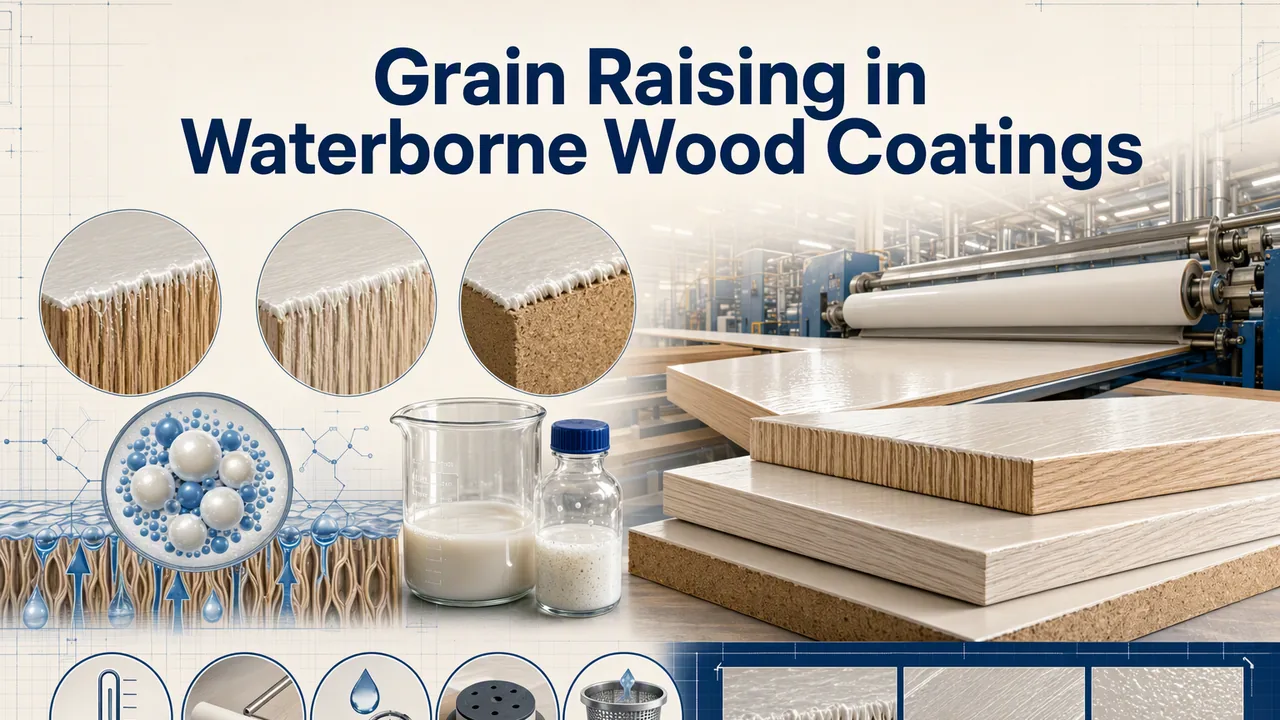
Two drawer fronts came off the spray line looking like 80-grit under a clear topcoat, and the finisher’s first move was to blame the resin. The grain had stood up because the wood was wet, not because the binder was weak. Grain raising in waterborne wood coatings is a moisture event: water swells the cell wall of the surface fibers, the fibers lift a few microns, and the first coat locks them in that position. Everything below is about either controlling that event or removing its consequences before a topcoat makes them permanent.
We have run this investigation on oak, ash, beech and MDF edges, and the pattern never changes. The raise is worst on the first waterborne coat over bare, freshly sanded wood. It gets weaker with every coat after that, because there is less bare fiber left to lift. So the fix belongs at the front of the sequence, not in the topcoat.
Why the first waterborne coat lifts the grain
At the scale a coating sees it, wood is not a solid. Fibers cut at the surface are open tubes. Water wicks into the lumen by capillary action, the cell wall takes it up and swells, and a fiber that sat flush with the surface now stands proud of it. Oak and ash do this eagerly, because their earlywood pores are large. Softwoods with a hard latewood band do it unevenly, and uneven is worse to live with: you get ridging that follows the rings instead of an even fuzz a single pass of paper would take off.
Three variables decide how bad it gets. How much free water reaches the surface, which is a wet-film question before it is a solids question. How long that water stays there, which the shop and its air movement decide. And how the surface was prepared, because a panel sanded past P320 is burnished: crushed fibers holding a smear of dust, and water lifts that layer as a sheet rather than fiber by fiber.
One detail surprises people, so it is worth naming. In a waterborne system the slow glycol ethers often stand up more grain than the water does. They hold the surface wet for longer, and several of them swell wood quite well on their own. Trimming water out of a formula while leaving a heavy coalescent load in place changes your flow and your open time. It does not change the surface you are looking at.
Five ways to keep the fibers down
In the order we reach for them. Most shops need only the first two, but the last one costs nothing and gets skipped constantly.
- Raise the grain on purpose, then cut it back. Water-pop the panel before it sees any coating: mist or wipe the surface, let it dry completely, then sand the standing fibers off with P320 to P400. The fibers that were going to lift have now lifted and left, and everything you spray afterwards sits on stable wood. On veneered panels keep the passes light and count them, because a 0.6 mm veneer is exactly where a raise-and-sand cycle turns into a sand-through claim.
- Put a penetrating primer under the film instead of a film former over the fibers. A film-forming binder sprayed on bare wood has to bridge fibers that are already lifted. A penetrating grade reaches the fiber roots and binds them. YT-6035 high-penetration primer is what we recommend for that first pass: 35 ± 2% solids and 50–200 mPa·s, low enough to wick in, with a hard 100% modulus so the bound fibers do not spring back when the topcoat’s water arrives. Spray it wet but thin, at the low end of your wet-film target, and denib it before anything else goes on. It has a limit worth saying out loud: a flooded first coat wets the wood harder than a thin one, so the raise gets worse before the binding helps.
- Cut the water per pass, not the film build. Two normal passes with a real flash-off beat one heavy pass every time, because the wood sees less water per unit time. Where the sequence needs a build coat, moving up in solids helps: sandable mid-coat YT-6059 at 40 ± 2% and H–2H modulus carries more film per gram of water than a 30% grade and still sands clean, and YT-6058 at 40 ± 2% with 1H–2H pencil hardness covers the topcoat over hard substrates. If your gun lays a 90 micron wet film in one pass, the water budget was decided before the resin choice mattered.
- Sand on a schedule rather than harder. Bare wood gets P180 to P220 with fresh paper, no burnishing and no polishing. After the sealer, denib with P320–P400 and then leave the film alone. Sanding harder before the first coat does not remove grain that has not lifted yet; it cuts fresh fibers, which is more raw material for the problem you were trying to solve.
- Shorten the wet time: substrate moisture, shop air, material temperature. Hold wood moisture at 8–10% and measure it instead of guessing (the oven-dry reference method is ASTM D4442). Keep the shop under roughly 60% RH. Warm the coating to 20–25 °C so viscosity and wet-film build stop drifting between shifts. And move air across the panels instead of only through the booth. None of this costs a cent, and all of it changes how much water the fibers actually see.
Raised grain, sanding scratch or dry spray? Read the surface
Confirm the defect before anybody reformulates. Under a raking light at about 30 degrees these look different, and so does the first move.
| What you see | What it usually is | First move |
|---|---|---|
| Fuzz that follows the pores and the annual rings, gone under the second coat | Classic grain raise on the first coat over bare wood | Water-pop and denib before the primer; drop the wet film on pass one |
| Single fibers standing like hairs, worst along an edge or a joint | End grain and veneer edges, which take up water far faster than the field | Seal the edges and end grain first; keep the first pass off the edge |
| Straight scratches that only appear once the film is wet | A loaded or worn abrasive belt, amplified by the wet coat | Go back one grit and sand the whole panel, not the spot; check the belt |
| Fine roughness in the corners, film looks dry | Dry spray or overspray, and the wood is innocent | Fix atomisation and gun distance before touching the formula |
| Gloss drops in patches with a faint texture and no visible fibers | Poor flow from a fast coalescent or a cold panel | Slow the coalescent a step or warm the panel; do not sand it |
Which grade for which step in the sequence
The sequence is sand, seal, colour, topcoat. These three grades cover the seal step and the topcoat on a waterborne wood line, and every number is straight from the data sheet.
| Grade | Solids | Viscosity / film | Where it goes in the sequence |
|---|---|---|---|
| YT-6035 | 35 ± 2% | 50–200 mPa·s, hard modulus | First pass on bare wood as a penetrating sealer; thin wet film, denib once it dries |
| YT-6059 | 40 ± 2% | 50–200 mPa·s, H–2H | Mid and base coats where the build has to sand clean without loading the paper |
| YT-6058 | 40 ± 2% | 50–200 mPa·s, 1H–2H | Topcoat over hard substrates, where clarity and gloss development decide the spec |
Full parameters for the primer are in its TDS. The wider shortlist for furniture, cabinetry and industrial wood sits on the wood and furniture coating page, and the film-formers themselves are part of the waterborne PU range.
Proving a fix in the lab before it reaches the line
- Turn “it raised” into a number. Read a roughness profile on the sanded panel and again once the primer is dry, using the parameters defined in ISO 21920-2. A peak-to-valley change of a few microns is a surface a fingertip catches. If nothing moves on the profile, you are not looking at grain raise and the formula is not the problem.
- Fix moisture before you test anything else. A panel at 14% moisture will raise grain under every coating you own, and the trial will tell you nothing about the resin.
- Build the panel in the real sequence, stain included. A fair share of “grain raise” complaints are stain-water complaints, where the colour step put the water in and the sealer carries the blame.
- Read it twice on the same day, raking light and fingertip, the same pair of eyes both times. “It looks better” is not a result, and a gloss meter will not see a fiber that only a hand can feel.
- Re-coat and cross-hatch the panel before you touch the line. A surface sanded past flat to chase grain raise passes a visual check and fails adhesion six months later, which we wrote up in waterborne PU peeling off wood.
One more thing worth knowing: the fix for grain raise and the fix for blocking pull in the same direction. Anything that gets water out of the film faster also helps a stack that was packed warm, so we treat them as one project. If you are reformulating for winter anyway, the other half of the work is on our blocking checklist.
Wood grain raising FAQ
Does a waterborne primer have to be sanded after the first coat?
Yes, and it is the step most lines skip. The primer pass lifts a thin layer of fiber even when the panel was water-popped, because the coating carries its own water. A light denib with P320 takes it off for about a minute per panel. Skip it and you are spraying a topcoat onto a rough surface, then sanding through expensive film to fix what one pass would have caught.
Will more coats hide raised grain?
They bury it, which is not the same thing. Three coats over a whiskered surface can look acceptable in the shop and still read as roughness under raking light in a customer’s living room, with extra blocking risk and cost attached. Sanding between coats is cheaper than film build.
Can a wetting agent solve grain raising?
No, and it can make it worse. A strong wetting package lowers surface tension, which pushes more of the same water deeper into the same fibers. Additives earn their place when the problem is flow or cratering on a sealed surface. On bare wood, spend the effort on the sealer and the sanding schedule.
Send us the species, the moisture reading and your current sequence, and ask our application lab which of the five levers moves your panel first.