A converter in Foshan called us eighteen months after switching a shoe-upper topcoat to waterborne. The uppers had passed every incoming test. Stored for one monsoon season in a humid warehouse, the film went brittle, cracked at the toe fold, and peeled off in one piece. We ran GPC on a scraped sample. The number-average molecular weight had dropped about 40 percent against the retained drum. That is not a process defect. That is PUD hydrolysis finishing what the resin choice started.
Most formulators pick a polyurethane dispersion by hardness, gloss and price. The soft-segment backbone decides how long the coating still works in year two, and it is the spec sheet line nobody argues about.
What actually breaks when a polyurethane hydrolyses
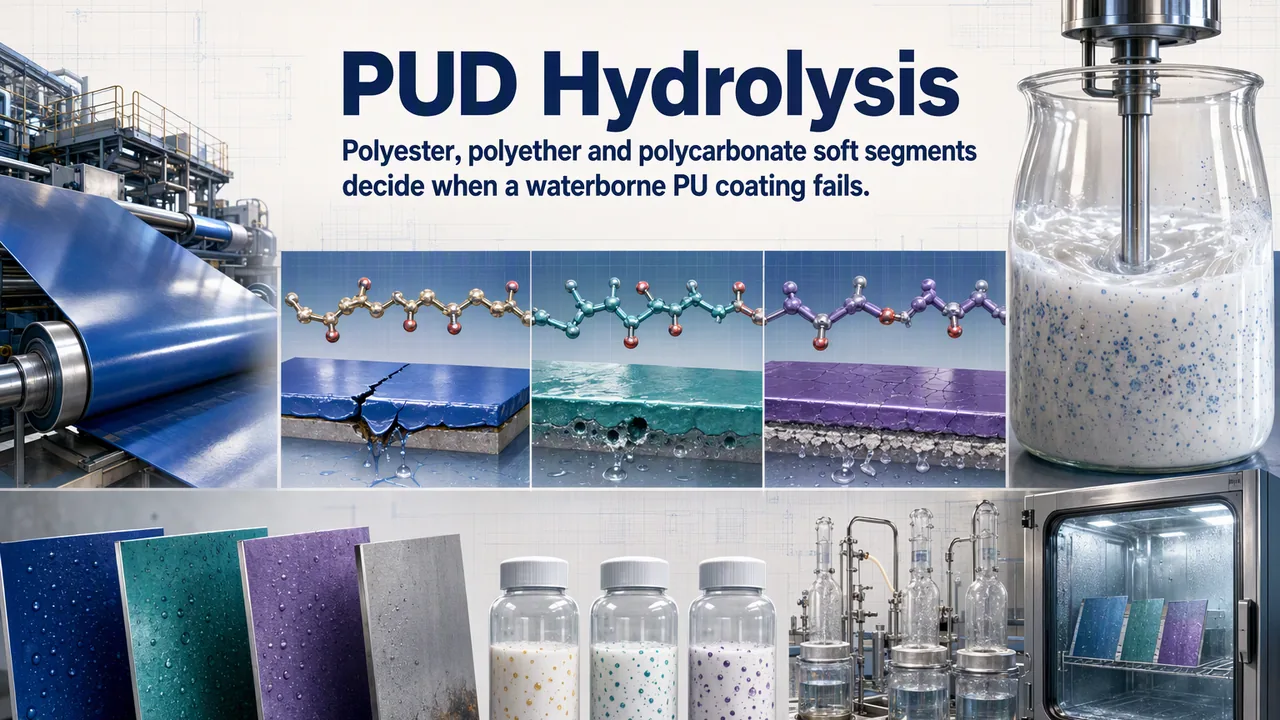
Water attacks the ester carbonyl in the soft segment. A polyester-based PUD is built from a diol such as adipate-based polyol, and the ester linkage is exactly the bond that water cleaves. One scission gives you a hydroxyl end and a carboxylic acid end. That acid is now sitting inside your own film, catalysing the next cleavage. Autocatalysis is why hydrolysis looks fine for fourteen months and then fails fast.
Chain scission shows up as a mechanical collapse before it shows as a visual defect. The film loses elongation first, then adhesion, then cohesion at the cut edges of a cross-cut test. Hardness can read higher while the coating is actually getting worse, because short chains pack and stiffen.
Polyether backbones have no hydrolysable carbonyl in the soft segment. The C–O–C chain does not unzip in hot humidity, which is why polyether PUDs hold their properties in wet service. Their failure mode is different and slower. Oxidation starts at the tertiary carbon next to the ether oxygen, driven by heat and UV. The film yellows first and embrittles later. Polyether is also intrinsically more hydrophilic than polyester at the same molecular weight, so water pickup can be higher even though nothing is breaking.
Polycarbonate diols sit between the two. The carbonate linkage does carry a carbonyl, but it is sterically shielded and far less reactive than an aliphatic ester. Hydrolysis rates fall close to polyether territory while the mechanical profile stays polyester-like. That is the whole argument for paying more.
The three backbones compared, with the grades we ship
| Soft-segment backbone | What you buy | What fails first | Grades in our range |
|---|---|---|---|
| Polyether | Wet and hydrolysis stability, low-temperature flexibility | Oxidative yellowing and embrittlement; higher water pickup | YT-X65 aliphatic polyether self-matting, 30 ± 2% solids, 500 to 1,000 mPa·s |
| Polyester | Tensile strength, green adhesion, heat resistance, price | Ester hydrolysis in hot humidity, autocatalysed by its own acid | YT-X51 polyester self-matting, survives a 240 °C bake; YT-6136 polyester aliphatic for PVC ink, 35 ± 1% solids |
| Polycarbonate | Hydrolysis and solvent resistance with polyester-like mechanics | Budget and lead time, not the film | YT-617 2H pencil hardness with water absorption under 3%; YT-5137 softer, YT-5140 medium-hard |
Our full polyurethane dispersion range spans all three backbones. The mechanical spread inside one backbone class is as useful as the class difference. YT-5137 runs a 2.5 to 3.5 MPa modulus with elongation above 700 percent. YT-5140 is the same polycarbonate chemistry at 4 to 6 MPa and tensile above 40 MPa. You pick the backbone first and the stiffness second, not the other way round.
How we test hydrolysis life, and what each test hides
A standard water immersion test will not catch this failure. ISO 2812-1 at 23 °C for 24 hours measures pickup, not scission. Our polycarbonate film absorbs under 3 percent in that window and still tells you nothing about month eighteen.
What we ask for on any hydrolysis-critical job:
- Wet heat aging at 70 °C and 100 percent relative humidity for 500 hours, not 168. Re-measure elongation and cross-cut adhesion after, not just appearance.
- Molecular weight by GPC before and after. A drop over 15 percent means the backbone is the problem, whatever the panel looks like.
- Carboxyl number or pH of the can at three and six months. Rising acidity is the autocatalytic loop starting inside the drum.
- Freeze-thaw per ASTM D2243, five cycles, because a container crossing Siberia is its own hydrolysis accelerator once the emulsion breaks.
- Wet adhesion after the aging, on the actual substrate. Cohesion can survive while the interface goes first.
Be honest about the limits of the first test. Water absorption and hydrolysis rate correlate weakly. A tight polyether film can absorb more water and outlive a dense polyester one.
Where polycarbonate earns its price, and where it does not
Polycarbonate diol costs more per kilogram than an adipate polyol. The dispersion also usually lands at 30 percent solids, where a polyester can be pushed to 40 or 45. On a solids basis the resin line goes up, and we stop pretending otherwise.
It pays back in three places. Alcohol and solvent wipe service, where YT-5137 reaches beyond 80 wipes with an aziridine crosslinker and holds 50-plus on its own. Wet-contact topcoats and adhesives that see humidity cycles, where the numbers in the YT-617 data sheet hold after wet heat. And any clear system where you refuse to accept the acid-driven haze that shows up late on a polyester film.
It does not pay back on a part with a one-year lifecycle. Nor where the real requirement is adhesion to PVC and similar plasticised film. YT-6136 is a polyester aliphatic built for exactly that job: outstanding PVC adhesion and high gloss. No polycarbonate will beat it on price there. Polyester also still wins on heat resistance: YT-X51 takes a 240 °C bake, which no polyether self-matting grade in our list will survive.
Levers when you are stuck on polyester
Cost pressure keeps most customers on polyester, and that is a legitimate decision if you manage the ester. Four levers, in the order we pull them.
Add a carbodiimide. YT-G30 is a polymeric carbodiimide at 50 ± 2% solids in PMA. It reacts with the carboxyl groups in the resin, so it does two jobs. It crosslinks, and it removes the acid end-groups that catalyse further hydrolysis. It reacts slowly at room temperature, which keeps a workable open time in the tank, then crosslinks fast as the film dries and warms. Its stated role is lasting hydrolysis and heat resistance, and it is the non-sensitising route when you would otherwise reach for an aziridine.
Raise crosslink density properly. A two-component aliphatic isocyanate gives the film a three-dimensional network that water has to swell rather than unzip. YT-6300 runs 20.5 to 21.5 percent NCO and disperses into the resin by hand stirring. Open time is 3 to 4 hours. YT-1102 is the non-ionic version with a 5 to 6 hour window and better anti-yellowing, which matters on white leather. The crosslinker comparison sits in aziridine versus isocyanate curing agents.
Watch your pH. Ester cleavage accelerates hard above pH 9, and a neutraliser overdose is a common way to buy a three-month-old failure out of a drum. We hold anionic dispersions at 7.5 to 8.5 and recheck after one month.
Then design the service life around the weakest interface. In hot-humid lamination, the adhesive line fails before the coating does, and the failure looks identical to a topcoat problem. Waterborne PU adhesives for composite and footwear lamination deserve the same wet-heat protocol. We wrote up the water-resistance failure modes for that product family in why waterborne PU adhesives lose water resistance.
Questions formulators ask us
Does a polyether backbone mean I have no hydrolysis problem?
It means you traded one failure mode for another. Polyether soft segments do not cleave in wet heat, so the molecular weight holds. What moves instead is oxidation. The ether alpha-carbon degrades slowly under heat and UV, the film yellows, and it stiffens over years rather than months. Polyether also absorbs more water at equal molecular weight. A YT-X65-type grade can look worse on a 24-hour immersion and still be the right call for humid service. Judge the two numbers separately.
Can I rescue a polyester coating that is already hydrolysing in the field?
No. Chain scission is not reversible, and the acid in the film keeps working. Overcoating a degraded film transfers the problem to your interface, because the weak layer is still underneath. The honest options are stripping and recoating, or accepting the part as scrap and changing the backbone or the crosslinker on the next order. A carbodiimide added to a fresh batch protects that batch. It does nothing for a cured polyester film.
Which backbone should a wet-contact lamination adhesive use?
Polyether or polycarbonate, and we will quote both. Polyester hot-activation shoe cements are excellent on the line and mediocre after a monsoon. If the article has to survive 70 °C and full humidity for hundreds of hours, the soft segment is where the money goes. Send us the aging protocol and we will tell you whether the backbone is worth the premium on your part.
Ask our application lab for the wet-heat curve on a specific grade before you commit a line.