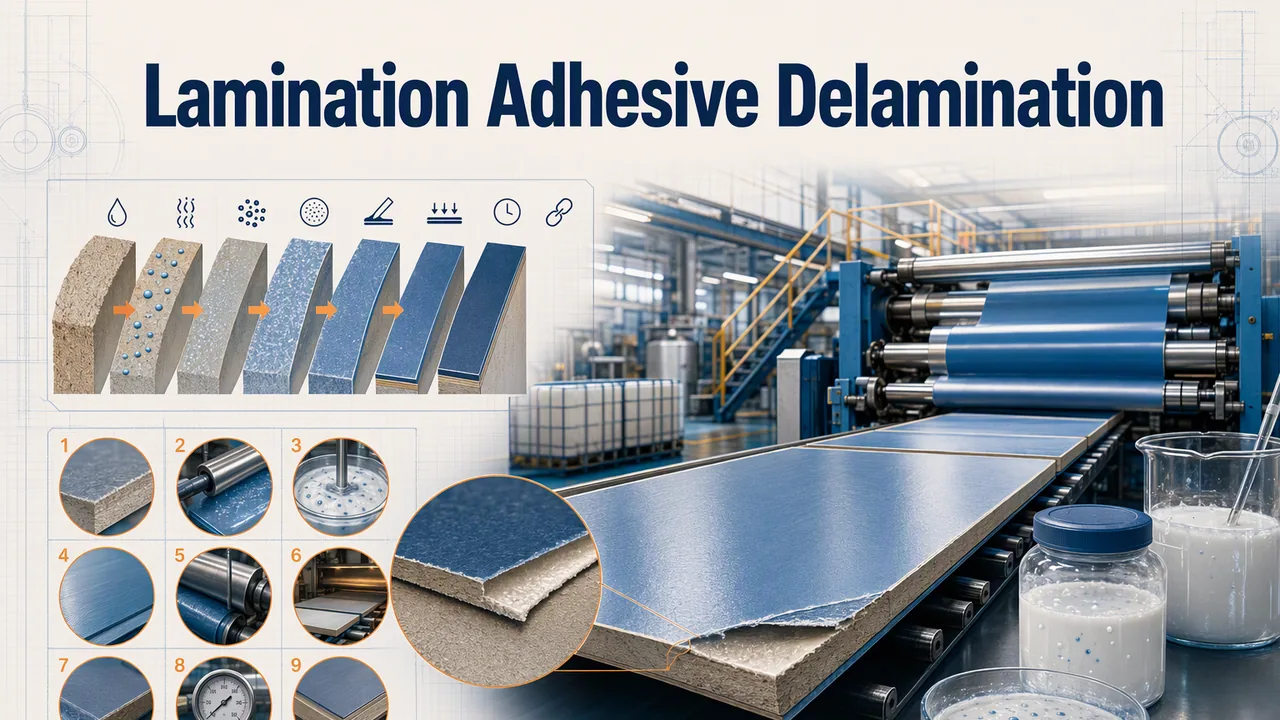
Two rolls come off the laminator with a clean, flat bond and nothing worth complaining about. A week later the converter runs the same reel and one film lifts away from the other almost by itself. Clean release, no fibre pulled, no adhesive transferred.
Waterborne lamination adhesive delamination almost always gets blamed on the resin, and in our lab it usually is not the resin. When a customer sends in a failed laminate, the adhesive itself passes its own QC more than half the time. Something on the line has drifted, and nobody caught it, because the roll looked perfect at the winder.
What follows is the list we work through on a delamination claim, in the order that finds the answer fastest, plus the peel test that would have flagged the problem before the reel shipped. It applies to the waterborne adhesive range we supply, but nothing in it is specific to our chemistry.
What has to happen before a waterborne laminate holds
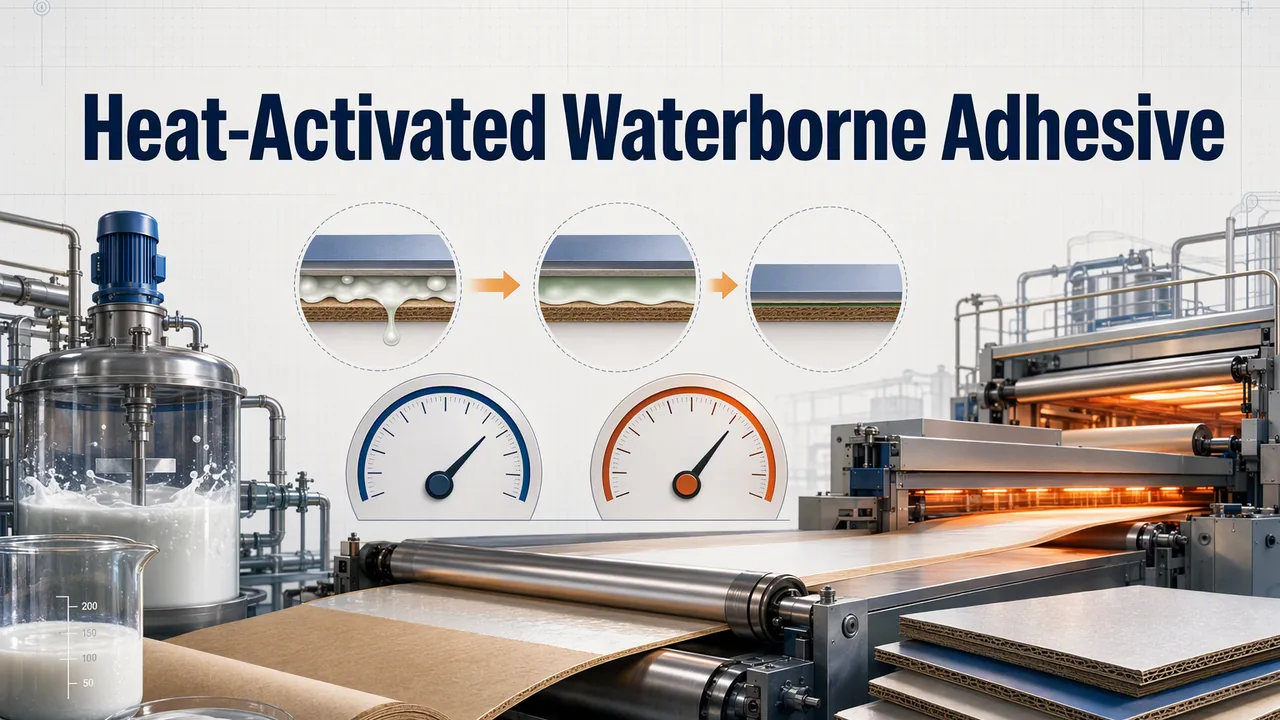
A bond forms in three steps. The dispersion wets the film, the water leaves the film, and the polymer chains knit under heat. Corona treatment governs the first, the dry tunnel governs the second, the nip governs the third. Skip any one of them and you get a laminate that peels clean at the machine and opens in a warehouse.
Water makes the second step far harder than formulators expect. Its surface tension is about 72 mN/m, and untreated BOPP sits at 29–31 mN/m. A solvent adhesive wets that film without being asked. A waterborne dispersion only wets it because of the surfactant package and because somebody set the treater correctly. Water also takes roughly six times the energy of ethyl acetate to evaporate from the same mass. That is the whole reason a waterborne line needs a longer tunnel and a corona unit that actually works. It is not a difference in resin quality.
Nine parameters, in the order we check them
This list stays short on purpose. Delamination claims resolve to one of these nine, and usually to the first four.
- Dyne level on the treated film. BOPP needs at least 38 mN/m and PET at least 42 before any other discussion is worth having. Pull a dyne pen at the unwind rather than beside the treater, because treatment decays over days and decays faster in a hot press room. Below spec, no adhesive choice saves the laminate.
- Dry coat weight. Coating, drying and weighing a known area of film takes ten minutes and settles most arguments. Film-to-film laminates typically want 2.5–4 g/m² dry. Porous substrates such as paper, nonwoven and foam can drink the first pass entirely, and need roughly double before a continuous bond line forms.
- Residual water entering the nip. The number almost nobody measures. If the web still carries water when the nip closes, you are sealing water into the interface, and the peel strength you record off the line is a drying artefact that fades over the following week. Our rule of thumb is to keep the incoming web below about 2% and to prove it on a balance, not with a finger.
- Tunnel profile, not tunnel set point. A first zone hot enough to skin the surface traps the water underneath, and the film feels dry without being dry. Air velocity carries water away; temperature mostly softens the skin that blocks it. On a three-zone tunnel we normally want the middle zone warmer than the first.
- Line speed against tunnel length. Speed, wet coat weight and tunnel length are one equation. Pulling a shipment forward by running 20% faster is the single most common cause of a laminate that fails three weeks later, and nothing about the failed roll looks different.
- Nip temperature matched to the grade. Our YT-502 reactivates at 50–55 °C, while YT-503 needs 100–110 °C. If the previous job on that press ran a low-activation grade, the set point is probably still wrong for this one, and an under-activated bond can still pass a pull test on the day. How dwell time and green strength interact is covered in tuning green tack and activation dwell.
- Nip pressure and dwell. Too little pressure leaves microvoids along the interface. Too much squeezes adhesive out of the bond line and starves the edges. Run a nip impression test across the full width before touching anything else. A crowned or worn roll shows up as mid-web delamination and gets misdiagnosed as a chemistry problem for weeks.
- Moisture regain in the substrates. Nylon, EVOH and paper arrive carrying water that migrates to the interface during aging. Pre-dry them, or slow the line and absorb the cost.
- Crosslinker dose and working life. Adding 1–5% of a carbodiimide such as YT-G30 lifts cohesion and hydrolysis resistance considerably, but only if it is metered into a stirred tank and consumed inside its pot life. A batch mixed before a shift change and used after it is a different adhesive.
Read the failure mode before you change a setting
The peeled sample is more informative than any single number. Tear the bond apart by hand at both edges and in the middle of the web, then look at where the failure sat.
| What you see on the peeled sample | What it usually means | First thing to check |
|---|---|---|
| Adhesive fully on one face, clean release from the other | Adhesion lost at the low-energy surface | Dyne level at the unwind, corona decay |
| Adhesive split evenly, both faces tacky | Cohesive failure inside the adhesive | Dry coat weight, residual water, crosslinker dose |
| Good edges, opens in the middle of the web | Uneven nip pressure or a cold band across the web | Nip impression, heater profile |
| Fails only towards the end of the roll | Skinning in the tray, viscosity drift, pot life exceeded | Tank agitation, filtration, working life |
| Milky haze or fine bubbles in the bond line | Water trapped at the interface | Tunnel profile against line speed |
| Holds at 20 °C, opens in a hot warehouse | Bond never finished crystallising | Nip temperature against grade activation |
A clean release with all the adhesive left on one face means adhesion was lost at the low-energy surface, so go to the treater. A tacky split down the middle of the adhesive means cohesion was never there, so go to coat weight, residual water and crosslinker. Mid-web failures with good edges are mechanical. Failures confined to the trim edge are usually a tension problem, not a chemistry problem at all.
Peel testing that predicts field delamination
Testing a laminate an hour off the winder tells you what the roll looks like, not what the customer will receive. Heat-activated polyurethane bonds keep crystallising for days. A peel value taken at 24 hours and again at 7 days often differs by 20% or more, so we report both and treat the 24-hour figure as provisional. Condition at 23 °C and 50% RH.
Run a T-peel at 25 mm width and 300 mm/min to ASTM D1876 or ISO 11339, and report the mean over the middle 60% of the curve. The first peak is the specimen being loaded, not the bond failing, and quoting it flatters every laminate you test.
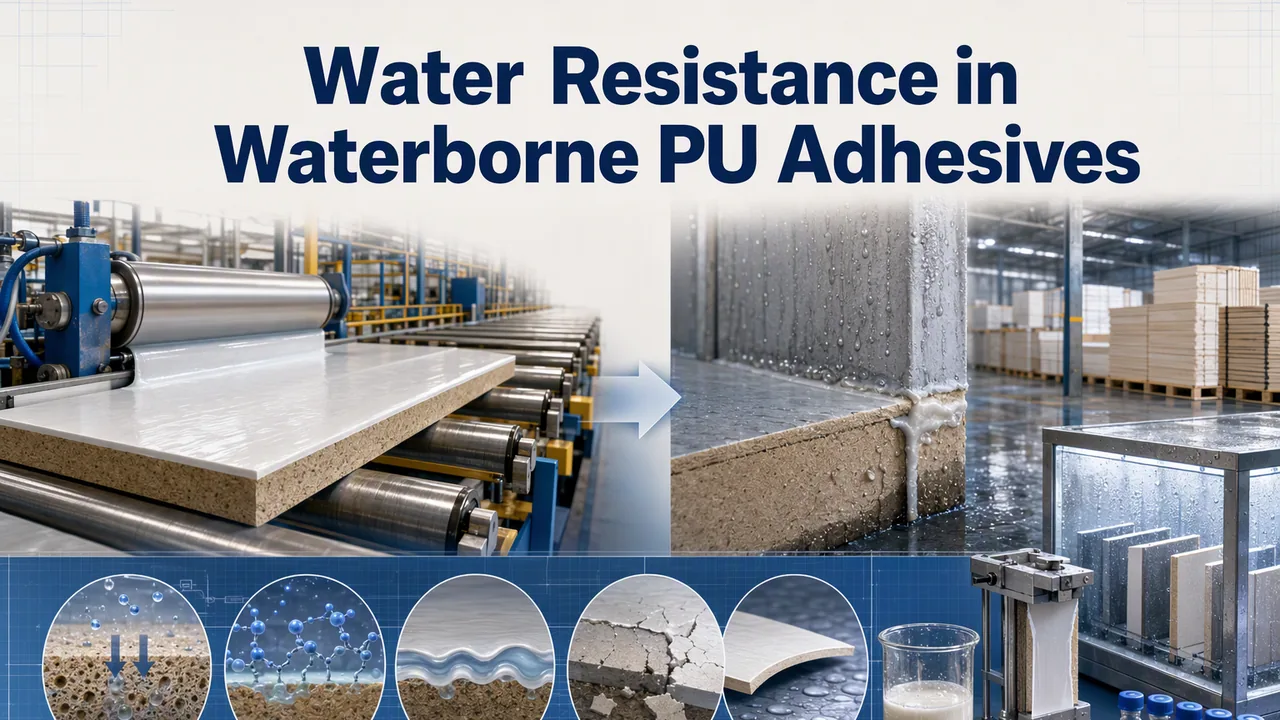
Then add the leg that actually predicts complaints: one hour in water at 60 °C, blot, and peel while still damp. Retention against the dry value is the number a customer's warehouse cares about, and it is the one number a dry peel test cannot produce. That is the same wet-retention reasoning we set out in why water resistance in waterborne PU adhesives fails, applied to a laminated structure instead of a shoe.
Which grade to start with, and where it runs out
Four grades cover most of the lamination work that comes through our lab, and they are not interchangeable. Activation temperature alone decides which one fits a given film.
| Grade | Solids | Activation | Start here when |
|---|---|---|---|
| YT-503 | 39 ± 1% | 100–110 °C | Film-to-film jobs that tolerate a hot nip and need maximum heat resistance; 100% modulus 7–8 MPa |
| YT-502 | 40% | 50–55 °C | Heat-sensitive films, foam and automotive interior trim; film tensile strength 35–50 MPa |
| YT-507 | 50 ± 2% | 50–55 °C | High-solids, low-viscosity work at 200–500 mPa·s for spray, roller or dot application |
| YT-6129 | 40 ± 2% | Alcohol-soluble | Laminating inks where the adhesive is printed rather than coated; adhesion to PET and BOPP |
The full series sits on the adhesives and lamination page. Our YT-6129 is the one to look at when the bond has to come down with the print instead of at a separate station: it is miscible with water or ethanol in any ratio and built for adhesion to PET and BOPP film.
Where waterborne still loses, and we tell customers this rather than sell around it: a retort pouch built on nylon and EVOH that must survive 121 °C sterilisation is not a waterborne job today. Neither is a structure whose film cannot take the 100–110 °C reactivation that YT-503 needs, and those accounts usually start on YT-502 and stay there. Inside dry-bond lamination, automotive interior trim and general flexible packaging, the waterborne route has become routine, and the checklist above is what makes it routine.
If you want the measured numbers behind any of these grades, download the YT-502 technical data sheet or ask us for the pair you are considering.
Frequently asked questions
Why does my laminate release cleanly from one film and tear the other?
That is an adhesion failure rather than a cohesive one, and it points at the surface with the lower energy. Check the dyne level at the unwind first, because corona treatment decays with time and heat, and a treater that was set correctly last month may not be running correctly today. Contamination from a slip additive or a silicone release agent on the back of the film gives the same clean release.
How long should I wait before peel-testing a laminate?
Twenty-four hours is the earliest useful point and seven days is the honest one. Heat-activated polyurethane bonds keep crystallising well past the first day, so a 24-hour peel value can sit 20% or more below the seven-day result. We report both and treat the early figure as provisional. Testing straight off the winder, while the web is still warm, tells you almost nothing.
Can waterborne PU replace a solvent laminating adhesive on retort structures?
Not on a nylon and EVOH pouch that has to take 121 °C retort sterilisation, which still belongs to solvent and two-component systems. Waterborne grades earn their place on dry-bond lamination, automotive interior work, footwear and general flexible packaging, where the durability requirement is a hot warehouse and a humid container rather than a retort cycle. If your structure needs retort performance, tell us, and we will say so instead of quoting a grade that cannot deliver it.
Send us the substrate pair, coat weight, tunnel profile and nip settings from the failed run, along with a sample of the laminate, and we will tell you which of the nine parameters we would check first. Request a quote or ask our application lab to look at the peel faces with you.