The costing meeting we sat in last month spent twenty minutes arguing about resin price and four seconds on the matting paste. A silica concentrate at a few euros per kilo looked free next to a self-matting PUD at nearly double the price per kilo of solids. Nobody reopened that four-second decision after the meeting, which is exactly the problem: self-matting vs. external matting agents is almost never decided by the price list. It is decided downstream, in the coating kitchen, on the line, and in the returns pile.
This is a cost-in-use walk-through for a synthetic leather finishing room. The numbers are illustrative indices, not quotations. The arithmetic pattern is what transfers to your line.
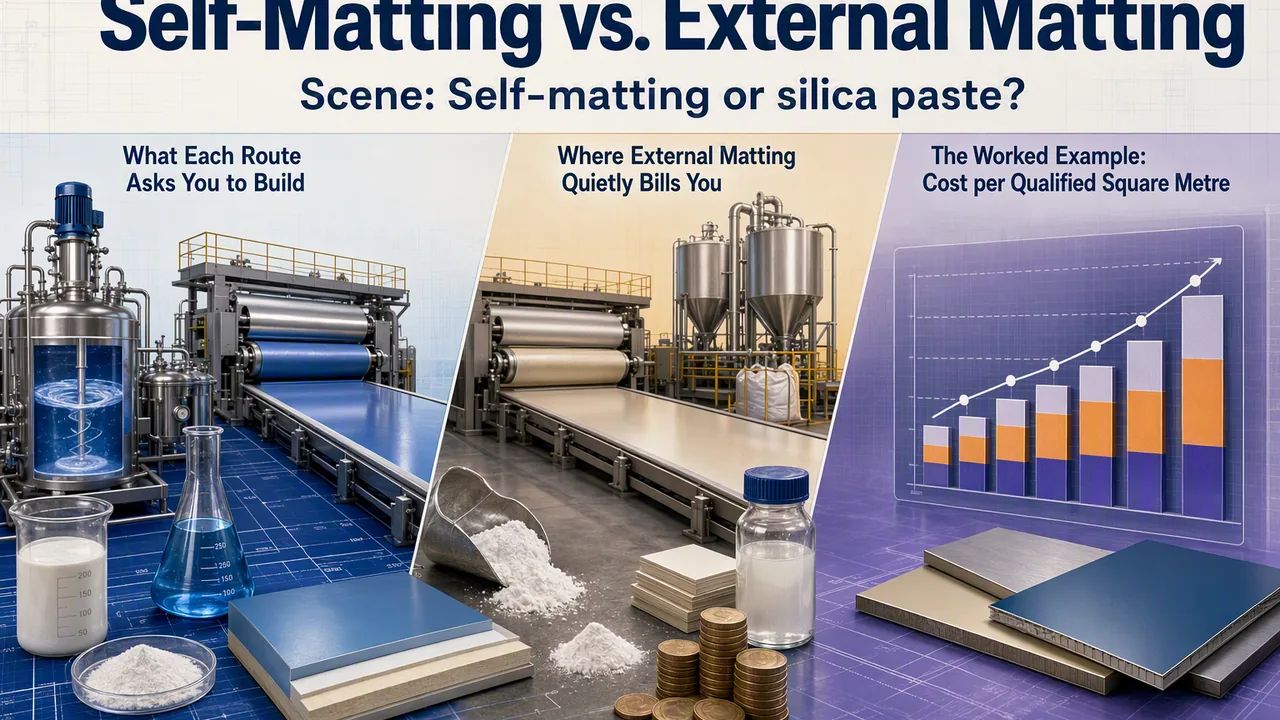
What Each Route Asks You to Build
With external matting you buy two things and manage two chemistries: a clear binder plus a silica or polyamide concentrate that has to be high-shear dispersed, held in suspension, and re-tuned every time the gloss drifts out of spec. A self-matting waterborne PU carries the matte inside the particle architecture of the resin itself. Film formation creates the micro-rough surface, and the coating kitchen gets one drum, one neutralisation step, one let-down.
The mechanism behind the effect, meaning why loose silica blooms and how a self-matting film sidesteps that failure mode, is covered in our piece on self-matting PU versus silica blooming. Here we assume the mechanism and count the money.
Worth costing before you pick a side: the QC loop that comes with the paste. Gloss on an external-matting batch is a process result, so every batch gets a draw-down and a gloss reading before it leaves the kitchen, and the reading needs an operator who knows what they are looking at. The single-component route skips most of that ritual. If the incoming resin lot is right, the draw-down is right.
Where External Matting Quietly Bills You
The visible invoice line is small. The rest of the cost arrives as operating expense:
- Dispersion labour and power. Twenty to forty minutes of high-shear per batch for a properly wetted paste, and an under-dispersed batch shows up later as roughness you can feel with a thumb.
- Settling and lot-to-lot scatter. Matte packages settle, and the 60° gloss measured per ISO 2813 walks from drum to drum. Re-tint batches follow.
- Hand-feel debt. Silica gives a dry, sometimes sandy touch that topcoat lines pay back with a softener addition or a sanding pass.
- Defect exposure. Blooming on black, screen blinding, filter change-outs, and the customer claim you cannot invoice but can feel.
- Inventory sprawl. Binder, paste, dispersant, anti-settling agent. Four SKUs where the self-matting route carries one or two.
None of that counts the training bill. Topping a one-drum let-down to spec is work any operator can do; dialling in a paste dispersion is work for one trained pair of hands per shift, and on a three-shift line that person is the bottleneck.
The Worked Example: Cost per Qualified Square Metre
The honest denominator is not the kilo of coating. It is the square metre that ships without a defect note. Below is the model we run with customers, expressed as an index where the external baseline batch costs 100. The assumptions are ours, not universal. Swap in your own line data at step five below.
| Cost item | External matting route | Self-matting route | Why it moves |
|---|---|---|---|
| Raw material per kg solids | 100 | 118 | Matte resin carries a premium over clear binder plus cheap paste |
| Dispersion labour and power | 12 | 0 | High-shear let-down disappears with a drop-in resin |
| Inventory SKUs and handling losses | 6 | 2 | One drum replaces paste, dispersant and anti-settling |
| Gloss re-tint and off-spec batches | 9 | 3 | Gloss is set by grade choice, not by dispersion quality |
| Softener and hand-feel corrections | 7 | 0 | The touch comes built in rather than bolted on |
| Blooming defects and returns | 8 | 4 | No free particles to migrate on dark shades |
| Model total per qualified m² | 142 | 127 | Roughly ten percent cheaper on the finished square |
Material price is the only row where the paste wins, and by a wide margin. A factory with excellent dispersion discipline, low reject rates and a tolerant hand-feel spec shrinks every other row, and the self-matting advantage with it. What we keep seeing instead is formulators buying the cheap raw material and paying for it in re-tint batches.
A couple of things never fit into the table cleanly. Aqueous matte pastes are alkaline, and in a cold store they can thicken a let-down batch over weeks; some systems gel outright. If your kitchen turns stock weekly that is a non-issue. If a tint base can sit for a quarter, it is a slow fuse on the paste side of the ledger.
Which Self-Matting Grade Earns Its Premium
Five anionic aliphatic grades sit on our shelf, and we shortlist them by hand feel and bake resistance first, gloss target second:
| Grade | Hand and haze | Solids | Viscosity, 25°C | Where it goes |
|---|---|---|---|---|
| YT-X51 | Oily-smooth, full hand; excellent black haze | 30 ± 1% | 100–300 mPa·s | Silicone-modified polyester grade for solvent-free, microfiber and PU leather topcoats; survives 240 °C bake |
| YT-X81 | Matting with black haze, no silicone modification | 30 ± 1% | 100–300 mPa·s | Pick where the finishing kitchen forbids silicone; same 240 °C bake tolerance |
| YT-X65 | Soft velvet touch; best black haze of the five | 30 ± 2% | 500–1000 mPa·s | PVC and cast leather topcoats where feel sells the article |
| YT-X06 | Dry, smooth hand with a whitening matte film | 30 ± 2% | 500–1000 mPa·s | PVC artificial leather, calendered leather and paper coatings |
| YT-X61 | Dry-skin feel, large particle matte | 30 ± 2% | 500–1000 mPa·s | Waterborne PU skin-feel top finishing on PVC and calendered goods |
Full parameters for the starter grade are in the YT-X51 technical data sheet, and the grades sit inside our wider waterborne polyurethane dispersion range. The synthetic leather applications page shows the basecoat and topcoat pairs we build around them.
Where the Silica Camp Keeps Its Points
We will say the quiet part out loud: self-matting will not take a dark topcoat below roughly three gloss units at 60°. If your spec is true dead-matt, external matting still owns that floor, and a big high-shear disperser is already paid for in many kitchens. The compromise we actually recommend is the hybrid. Build most of the gloss drop with a self-matting resin such as YT-X81, then trim in a fraction of the original paste. Half the loading keeps the defect exposure low while the matte stays deep enough to pass.
Run This Comparison on Your Own Line
- Pick one reference article: a pigmented black PU topcoat at your normal service gloss.
- Prepare 500 g lab batches, one external-route control and three self-matting grades at equal solids; stir and filter through 150 mesh instead of dispersing.
- Measure 60° gloss, black haze, and a blind hand-feel score from two operators who do not know which is which.
- Hold one week at 40 °C and one freeze-thaw cycle, then re-measure gloss. Paste-filled batches drift more.
- Line-coat a drum each and price the run per qualified square metre, with re-tint time, softener cost, filter changes and rejects in the box.
If the model above matches what your own numbers show, ask our application lab for a trial panel cut to your gloss and hand-feel target, and run it against your current recipe before anybody changes a price list.