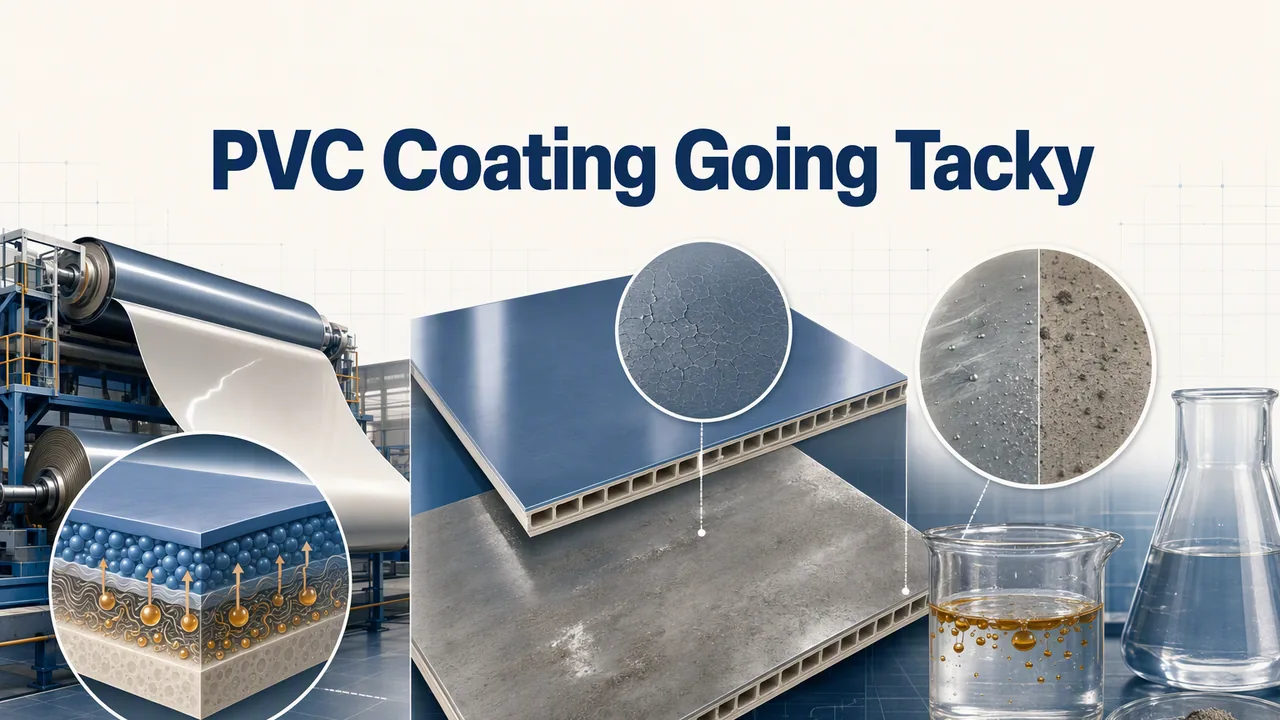
A batch of coated PVC film goes to a distributor in July and comes back in September with the finish tacky to the touch and a grey halo of dust along every fold line. Nobody re-coated it; it sat in a hot container. The topcoat datasheet promised anti-soiling, and the datasheet is not what changed. What you are looking at is plasticizer: the thirty to forty parts per hundred of phthalate or DOTP dissolved in the PVC underneath have been walking outward through your coating the whole time, and the film is now a plasticizer-rich gel rather than a topcoat. Migration is the most common late failure on plasticized PVC, and it is fixable once you stop treating the surface as the problem. Five things decide the result: how the plasticizer moves, what your coating chemistry lets it do, how dense and how crosslinked the film is, how the coat was applied, and what you insist on before you ship.
How plasticizer gets into a topcoat in the first place
Rigid PVC is hard because its chains sit close and barely move. Soft PVC is the same polymer with a heavy dose of plasticizer dissolved between those chains, pushing them apart so the sheet bends. That dose is dissolved, not bonded. Nothing holds the plasticizer in place except compatibility and viscosity, and any material laid over the surface with an appetite for it will start to drink. A coating film is exactly that: a sink at the boundary of a reservoir.
What happens next is the failure you can feel. Plasticizer that diffuses into a polyurethane or acrylic film is itself a plasticizer for that film: it drops the glass transition, softens the modulus, and turns a finish that was hard and slick into one that is tacky and grabby. Tacky picks up dust; dust darkens the surface and scratches it when wiped. A coating that passed every initial pull test has failed by changing what it is made of, not by detaching. And heat is the accelerator, in both directions: it speeds the diffusion through the PVC and it softens the film you are trying to keep dense.
Why a conventional topcoat loses this fight
Four things make an ordinary coat fail early, and every late-migration complaint we have chased had at least one of them:
- A solvent-borne coat, or a strong-solvent clean-down. Solvents swell the PVC surface and pull plasticizer toward it while the wet film is still open; the coat dries already carrying a load. A waterborne coat cannot do this, which is part of why the conversion is genuinely better here, not only greener.
- A soft, compatible acrylic. A plasticizer likes a compatible polymer, and many acrylic topcoats are chemically hospitable to phthalates. The film does not resist the plasticizer; it dissolves it, happily.
- An uncrosslinked one-component film. Even a good polyurethane leaves chain ends and free volume that small molecules crawl through. Un-crosslinked, the film is a slow leak.
- Too little film. Diffusion is a lag problem: a thicker coat delays the arrival of plasticizer at the surface roughly in proportion to the square of its thickness. Delays. The economics of that only work for so long.
Reading the failure: is it migration or is it dirt?
These look identical on a returns pallet, and they are not the same complaint. Migration is a chemistry change inside your film; surface soiling is a dirt problem on a film that is still sound. A quick triage from our own returns table:
| Symptom | Points to | Confirm it with |
|---|---|---|
| Tacky before it is dirty, worse after warm storage | Plasticizer migration | Press clean PET film onto the sample at 70 °C overnight; a migrated plasticizer will visibly soften and dull the PET |
| Gloss loss and a bloomed sheen at the fold lines | Migration plus bloom of additives | Wipe with a dry cloth: bloom wipes away, a softened film does not |
| Dirt held in the texture, surface itself hard | Soiling, anti-soiling additive failure | Wash and re-measure; tack has not come back |
| Fails where the coat was thin or squeegeed | Film build, not chemistry | Coat a thick panel of the same recipe; the failure does not appear |
One more tell: migration failures arrive late and look random across a shipment, because they track the temperature history of each carton. A soiling failure is uniform from day one.
What actually resists migration, and which grades
You want a film the plasticizer hates: chemically inhospitable, dense, and tied together. Three levers, roughly in that order.
Adhesion first, because nothing else matters if the coat lifts. For direct-to-PVC work we start with YT-6128, an anionic dispersion built for grip to plasticized PVC and PET: 35 ± 1% solids, modulus 6.0–7.0 MPa against a tensile of 20–30 MPa and elongation at break of at least 400%, and water absorption of only 3–5% over 24 hours. Low water absorption is a fair proxy for the property that matters here: how little of anything the film lets in and holds.
Then backbone chemistry. Polycarbonate-based polyurethanes resist being swollen better than polyester types, which is the same reason they pass alcohol-wipe tests. That is the family our YT-5140 and YT-5137 sit in, both specified for high alcohol-wipe, water and solvent resistance; 5140 runs 40 ± 1% solids with a tensile of at least 40 MPa and elongation above 700%, 5137 is the softer, higher-gloss sibling at 37 ± 1% solids. If you are deciding between them, the choice is hardness versus flow, not resistance: the polycarbonate backbone is doing the protective work in both. A standard acrylic, by contrast, is often one of the compatible sinks described above; we like acrylics for a great many jobs, but a plasticized PVC article in a hot climate is not the place to test that.
And then the lever that changes the answer most: crosslinking. Tying the film into a network removes the free volume the plasticizer crawls through, and it is the difference between slowing migration and largely stopping it at practical coat weights. A blocked aliphatic or an aziridine from our crosslinker range dosed into a polycarbonate topcoat is the combination we reach for when a customer has already been burned; the reactivity, pot life and handling trade-offs of the two families are laid out in our aziridine versus isocyanate piece.
Be clear about the limits. No topcoat is an infinite barrier, and a film on a substrate loaded with a high-migration plasticizer only buys time. The other half of the fix is off your coating line: lower-migrating plasticizers, and enough of them bound in the PVC by formulation and age-out before coating. If you have already moved to DOTP and the article still blooms, the coating is your lever. Test data for the grades above is on the YT-5140 TDS, and the rest of the PVC-coating range, including the flexible grades for inks, sits on the PVC coatings application page.
Screen for migration before you ship, not after: hold a coated panel against a soft PVC sheet at 70 °C for three days and measure the change in tack, gloss and rub resistance. If a batch is failing and you cannot tell whether the film or the substrate is at fault, send us the plasticizer loading and the storage history and we will read it with you at the application lab.
Frequently asked questions
My PVC topcoat went tacky a month after production. Is the coating defective?
Probably not. A month of warm storage is exactly the timeline migration runs on: the coating was fine the day it cured, and plasticizer has since been diffusing into it and lowering its softening point. Confirm with the PET-film press at 70 °C before you blame the batch. The durable fix is a denser, crosslinked topcoat on a well-aged substrate, starting from a grade with real PVC grip such as YT-6128.
Does a crosslinker actually stop plasticizer migration?
It is the strongest coating-side lever you have, because it removes the pathways rather than just lengthening them. A polycarbonate topcoat such as YT-5140 reacted with a crosslinker survives far longer against the same substrate film than the same coat uncrosslinked. It slows migration dramatically, not infinitely: give a hot enough article enough years and molecules still move.
Will a thicker coat fix it?
For a while, expensively. Diffusion time scales badly with thickness, so a heavier coat buys months rather than years, costs solids and money, and cracks at the fold when it is too thick. Take the density and the crosslink and leave the build where the coating was designed to work.