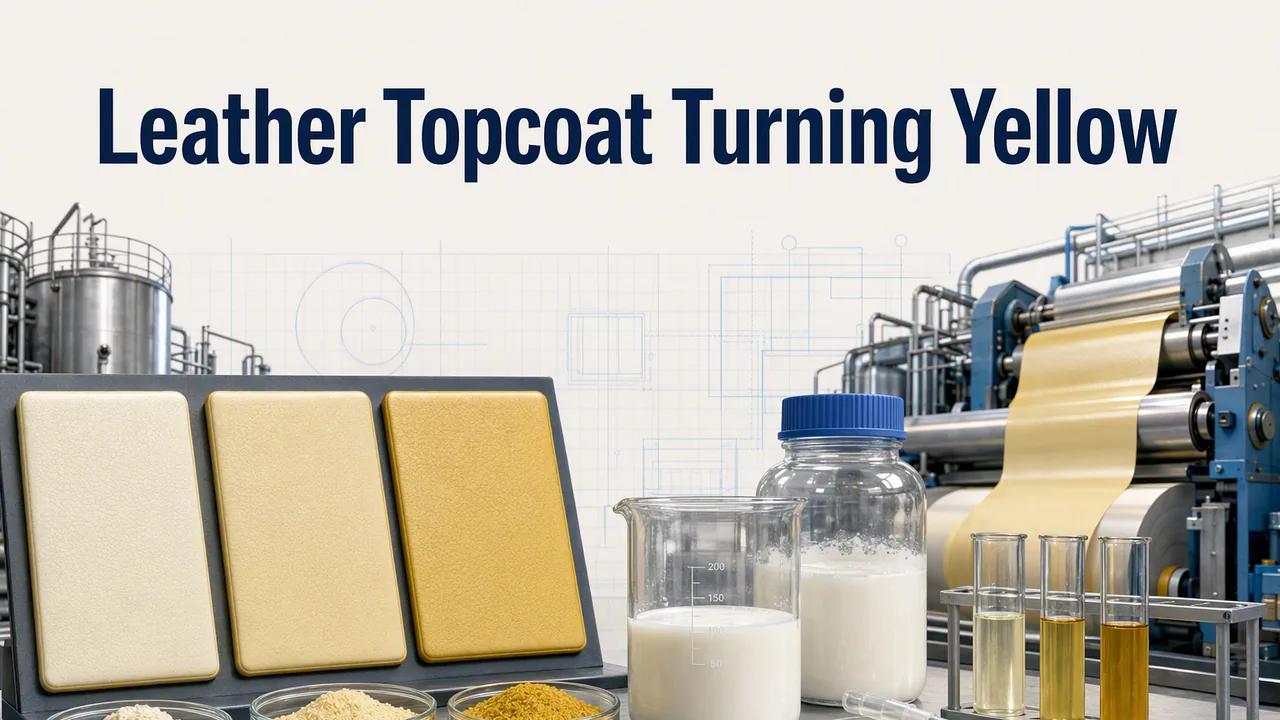
The email carried one colorimeter screenshot. Off-white nappa for a handbag program, three weeks in a brand QC lab, and the b-value had walked from +0.4 to +3.1. The brand blamed the pigment paste. The converter blamed the oven. The binder supplier blamed storage conditions. We have sat in enough of those three-way calls to start where the chemistry is: in most waterborne leather topcoats, yellowing is a binder decision that was made months earlier, and the finish just executed it.
Here is how we work through leather topcoat yellowing: what actually turns cream inside a white finish, how to tell binder yellowing from additive yellowing before you burn a production run, and when the move from aromatic to aliphatic waterborne PU earns back its price difference.
Three different yellows hiding behind one symptom
The famous one is photo-yellowing. If the dispersion was built from aromatic isocyanates, TDI or MDI, the urethane backbone carries benzene rings into your film for the life of the product. UV exposure oxidises the groups linking those rings into quinoid chromophores, and quinoids are intensely colored. A few parts per million of reaction product is enough to shift a white film visibly. This is not a surface defect you can wash off; it is the binder's own skeleton absorbing light.
Heat yellowing is a different clock. Dry-process lines bake at 160–200 °C, and above roughly 180 °C even some aliphatic systems start to brown through amine oxidation and residual catalyst chemistry. A finish that survives the light box but browns in the lamination press has this problem, not the first one.
The one almost nobody suspects is gas-phase staining. Phenolic antioxidants, the BHT family, are in your pigment dispersant, your slip additive, sometimes the paper core your leather ships on. They react with nitrogen oxides in warehouse and transport air and turn yellow-brown without any light at all. That is why a roll yellows on the inside of the tube and looks fine on the outside, and why an unboxing QC pass means nothing.
Triage before you swap a binder
Run the three paths apart and you know within two weeks which one you are paying for.
- Cast films of the suspect finish, about 100 µm wet, dried at your normal line temperature. Split into three sets.
- Set one goes in the xenon weathering box, ISO 105-B02 or AATCC 16 conditions. Set two gets your worst real bake profile, say 200 °C for three minutes. Set three gets wrapped in kraft paper at 50 °C for 48 hours, which is the NOx trap.
- Read the numbers on a colorimeter under D65, not on your eyes in the doorway. We judge against ASTM D2244 and track Δb, not ΔE, because yellowing shows in b long before the total error looks alarming.
- Only then change one variable at a time. Same pigment paste, same additive package, swap the binder. If you swap two things, your trial proves nothing and your customer knows it.
A rough rule we use in the lab: Δb above +2 after 24 hours of xenon points at an aromatic backbone. Δb only in the paper-wrap set points at phenolic antioxidants, and the fix is a phosphite swap in the additive package, not a new resin. Δb only in the bake set is a cure temperature or catalyst conversation.
When aromatic is still the honest answer
Not every program needs aliphatic chemistry, and pretending otherwise costs converters margin they do not owe us. For black, brown and deep red bag leather, we happily spec aromatic. YT-2540 at 40 ± 2% solids is one of the cheapest per kilo of solids in our catalog, it disperses pigment powders well, and it ships milky with a blue tint, which in pigmented shades quietly cancels the yellow cast buyers hate. YT-1128 goes further: self-crosslinked, anionic, 27 ± 1% solids, and it reaches wet-heat anti-tack grade 3.5 without a drop of aziridine crosslinker. On dark shoe uppers and garment leather that combination is hard to beat on cost-in-use.
The line is drawn at color, not at price. Pastels, whites, and anything headed for a brand lightfastness protocol belong to the aliphatic side of the table.
Moving to aliphatic without losing the hand
Formulators worry that an aliphatic swap means giving up softness or matting, and with some generic resins they would be right. Our self-matting aliphatic line was built for the synthetic leather topcoat specifically, so the hand survives the chemistry change.
| Grade | Chemistry | Solids | Viscosity (25 °C) | Start with it when |
|---|---|---|---|---|
| YT-X81 | Anionic aliphatic, self-matting, medium-soft | 30 ± 1% | 100–300 mPa·s | The finish sees real bake heat: it holds through 240 °C without yellowing, which covers lamination and dry-process passes |
| YT-X51 | Silicone-modified polyester aliphatic, self-matting | 30 ± 1% | 100–300 mPa·s | You want the 240 °C stability plus an oilier, fuller hand and strong black haze on dark nappa |
| YT-X06 | Anionic aliphatic self-matting | 30 ± 2% | 500–1000 mPa·s | Classic low-gloss topcoat on PVC or transfer leather without matting powder |
| YT-X65 | Anionic aliphatic polyether self-matting | 30 ± 2% | 500–1000 mPa·s | Velvet hand and deep black haze are the selling points of the article |
Two honest caveats. Aliphatic self-matting grades cost meaningfully more per kilo of solids than YT-2540, so we usually blend into the switch, 30% aliphatic in year one if the brand protocol is light, full swap if it is not. And initial adhesion on greasy substrates can come in flatter than an aromatic; a silane primer coat or a small share of adhesion-promoting PUD fixes it. Full parameters for YT-X81 are in its TDS.
Yellowing FAQ
Can UV stabilizers rescue an aromatic binder in a white finish?
They slow the clock, they do not stop it. A HALS plus benzotriazole pair at 0.3–0.8% on binder buys real months on a shaded article, but on a white topcoat the quinoid chemistry keeps ticking underneath, and small molecules migrate out with flexing and cleaning. For a brand lightfastness protocol, stabilize the pigment package and move the backbone to aliphatic.
The finish and the substrate are both waterborne. Which one yellowed?
Peel a strip of the topcoat off and run the two pieces through the xenon box separately. PU leather substrates foamed with aromatic chemistry yellow on their own account, and no topcoat swap will hide it. We have rejected otherwise fine finishing recipes because the foam underneath was the culprit.
Is the 240 °C bake rating on YT-X81 marketing?
It is a cast-film limit from our own oven trials, and it matters because heat browning is the failure mode of dry-process lamination, not daylight. If your line never sees over 150 °C, the cheaper YT-X06 covers the same color story.
Grade pairing against your silane, pigment paste and oven profile is where these swaps succeed or fail; the synthetic leather application guide has the fuller process view, and you can ask our application lab for a starting blend.