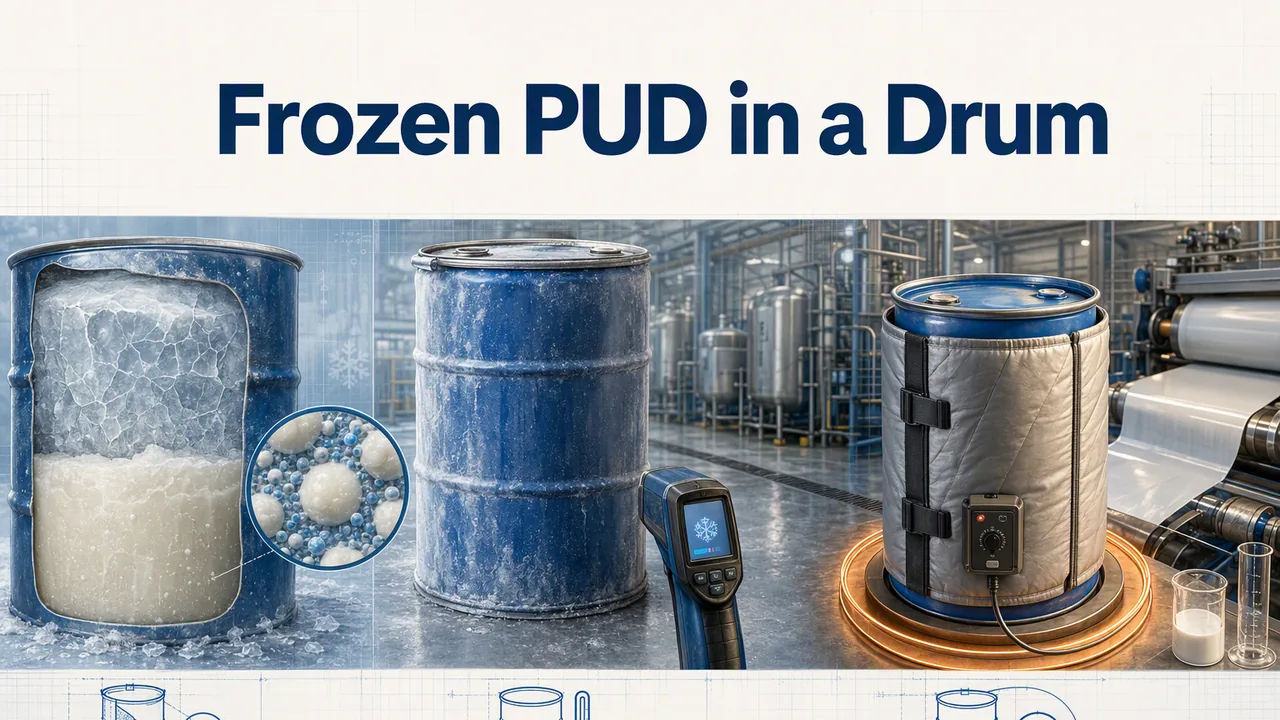
A drum of nonionic PUD came back from a winter shipment with a layer of solid material under the lid, and the first question in the warehouse was whether it could still go into a batch. Sometimes it can. A frozen PUD is not automatically a write-off, but it is not something you thaw overnight and pour either, because freezing either damages the dispersion irreversibly or it does not, and no amount of stirring tells you which until you measure. This is the sequence we use: how to thaw a frozen drum, the six checks that follow, and the point at which the material should be rejected rather than revived.
Waterborne polyurethane dispersions are supplied with a clear storage instruction: keep at 15–30 °C and do not let them freeze. That instruction is preventive, and by the time it matters the freeze has usually already happened: a trailer parked overnight in a hard frost, a warehouse heater that tripped, a drum left on a loading dock over a weekend. The useful question is not whether it should have frozen. It is whether this particular drum still meets specification, and that is a measurement question, not a judgement call.
What freezing actually does to a PUD
A PUD is not a solution; it is polymer particles suspended in water, each particle held apart by a stabilising shell. In an anionic dispersion that shell is electrostatic. In a nonionic waterborne polyurethane dispersion such as YT-101 or YT-102, it is steric: water-soluble chains that keep a cushion of water around each particle. Both mechanisms depend on the water being present and liquid.
When the drum freezes, that changes. Ice forms as pure crystals, excluding the polymer and the stabilising chains, and expands by roughly 9% as it does so. The growing crystals press particles together and strip away the water cushion that was holding them apart. If the particles are pushed into permanent contact they coalesce, and once a film has formed inside the drum there is no stirring, heating or dilution that will take it back to a dispersion. That is the difference between a drum that is merely cold and a drum that is ruined.
Two details shape the practical risk. First, repeated freeze-thaw cycles are more damaging than a single steady freeze, because every thaw re-exposes the particles to the next round of compression; this is the basis of the standard freeze-thaw test for water-borne coatings (ASTM D2243). Second, the damage is not always total. A single mild freeze often produces a rise in viscosity and some coarse particles rather than a solid lump, and that kind of drum is frequently recoverable. For the underlying laboratory method on dispersions and latices, the reference is the freeze-thaw cycle stability test (ISO 1147).
First, confirm the drum really froze
Not every drum that arrives thick has frozen. A dispersion stored at 5–10 °C simply gets more viscous, and its structure is untouched. Freezing starts below 0 °C and leaves physical evidence, so look for it before you do anything else.
Signs of true freezing include a solid or slushy layer that resists a stirring rod, ice crystals or a ring of frost at the surface, a dull thud rather than a liquid slosh when the drum is tilted, and, after thawing, a clear watery layer on top with a denser layer below. A drum that is only cold warms back to 20–25 °C, returns to its normal viscosity, and needs no further test.
Where the history is unknown, ask about the coldest point of the journey rather than the average. A data logger or a min-max thermometer on the shipment settles the question in a way a delivery note never will, and it is worth requesting for any winter consignment of PUD.
Thaw it slowly, or the thaw becomes the problem
How the drum is brought back to temperature matters as much as the freeze itself. Thaw it at room temperature, or in a water bath held at 30–35 °C at most. Do not use a microwave, an open flame or direct steam injection: uneven heating creates hot spots that can shock-coagulate the polymer and turn a salvageable drum into a rejected one.
Leave the drum closed and let it thaw completely; for a 120 kg drum that usually means overnight, and often a full 24 hours. Resist the urge to test early. Measurements taken on a partly frozen, slushy dispersion are meaningless, and a sieve result from a half-thawed drum will condemn material that is actually fine.
Once it is fully liquid, stir it gently. A low-shear paddle at slow speed, or simply rolling the drum on its side, is enough to re-homogenise it. Do not high-shear mix: it entrains air and, more importantly, it can shear-coagulate particles that were already weakened by the freeze, creating the very gels you are trying to rule out.
The six checks, in order
Work through these in sequence and record the numbers against the original batch certificate. Any single failure is a flag; two or more together normally decide the drum’s fate.
| Check | How to run it | Pass looks like | Fail signal |
|---|---|---|---|
| 1. Appearance and odor | Inspect against a light; smell at the lid | Uniform milky white liquid, no separation, neutral or faintly characteristic odor | Clear layer on top, gel, rubbery lumps, sour or ammoniacal odor |
| 2. Sieve | Pour 500 g through a 100–200 mesh screen, rinse and weigh the residue | Little or no residue; only a light film that rinses away | Visible gel grains or a clogged screen |
| 3. Drawdown | Draw a 100 µm wet film on glass, dry and inspect | Smooth, uniform film with no specks | Gels, specks or fish eyes in the dry film |
| 4. pH | Measure at 25 °C and compare with the batch certificate | Within the specified window on the certificate | Drift of more than about 0.5 pH unit, especially with separation |
| 5. Solids | Oven method: 2 g at 105 °C to constant weight, against the nominal value | Matches the nominal value on the certificate | A fall of more than about 1 percentage point |
| 6. Viscosity and dilution | Measure at 25 °C, then dilute 1:1 with water and re-check | Within tolerance; dilutes to a stable, uniform emulsion | Much higher viscosity, or a grainy, unstable mix when diluted |
The sieve and drawdown are the two checks that matter most for a frozen drum. They are the quickest way to see whether coalesced material exists at all, and the drawdown film in particular shows the damage as it will appear in the finished coating. Compare the same defect family in fish eyes in waterborne topcoats, where the cause is foreign contamination rather than the binder itself.
Revive or reject: reading the results
A drum that passes all six checks is usable, and normal practice is to blend it into fresh stock rather than run it alone. A drum that fails one of the hard checks below is not worth the risk, whatever the volume involved.
| Reject the drum | Revive and blend |
|---|---|
| Irreversible gel, or a solid rubbery mass that will not redisperse | Uniform liquid after gentle stirring |
| Heavy sieve residue or a clogged screen | Clean sieve, only a light rinse-out film |
| Gels, specks or fish eyes in the drawdown film | Smooth, uniform drawdown |
| Solids drop of more than 1 point, or pH drift with separation | Solids, pH and viscosity all within tolerance |
| Microbial odor or visible mould | Neutral odor, no growth |
When a drum is salvaged, blend it into a fresh batch at a conservative ratio (10 to 20% is a sensible starting point) and confirm the result in a small trial before it goes near a specification-critical run. Never let revived material carry an order on its own, and never send it into a customer-facing job on the strength of a bench test alone. The honest boundary is simple: the value of one recovered drum never covers the cost of a field failure or a returned shipment. If the material is destined for a warranty application, scrap it and order fresh.
Keeping the next drum from freezing
The cleanest fix is not to thaw a drum in the first place. Store PUD between 15 and 30 °C, keep drums off the loading dock, and rotate stock first-in, first-out so that nothing spends a winter at the back of the warehouse. In cold months, insist on insulated or heated transport, and put a temperature logger on any consignment that has to cross a hard frost.
Shelf life belongs in the same plan. YT-103 carries a 6-month shelf life, while YT-101 and YT-102 are rated at 12 months, so a slow-moving grade with the shorter window has less margin to absorb a winter delay. These nonionic grades are widely used in fiberglass sizing and textile treatment, where a single rejected drum can stall a line, which is exactly why the storage plan deserves as much attention as the formulation. Full storage and handling data for these grades is in the YT-101 technical data sheet.
If a frozen drum is sitting in your warehouse right now, run the six checks before you write it off. And if the drawdown or the sieve leaves you unsure, ask our application lab. Send us the batch number, the storage history and a photo of the drawdown, and we will tell you whether that drum is worth reviving.