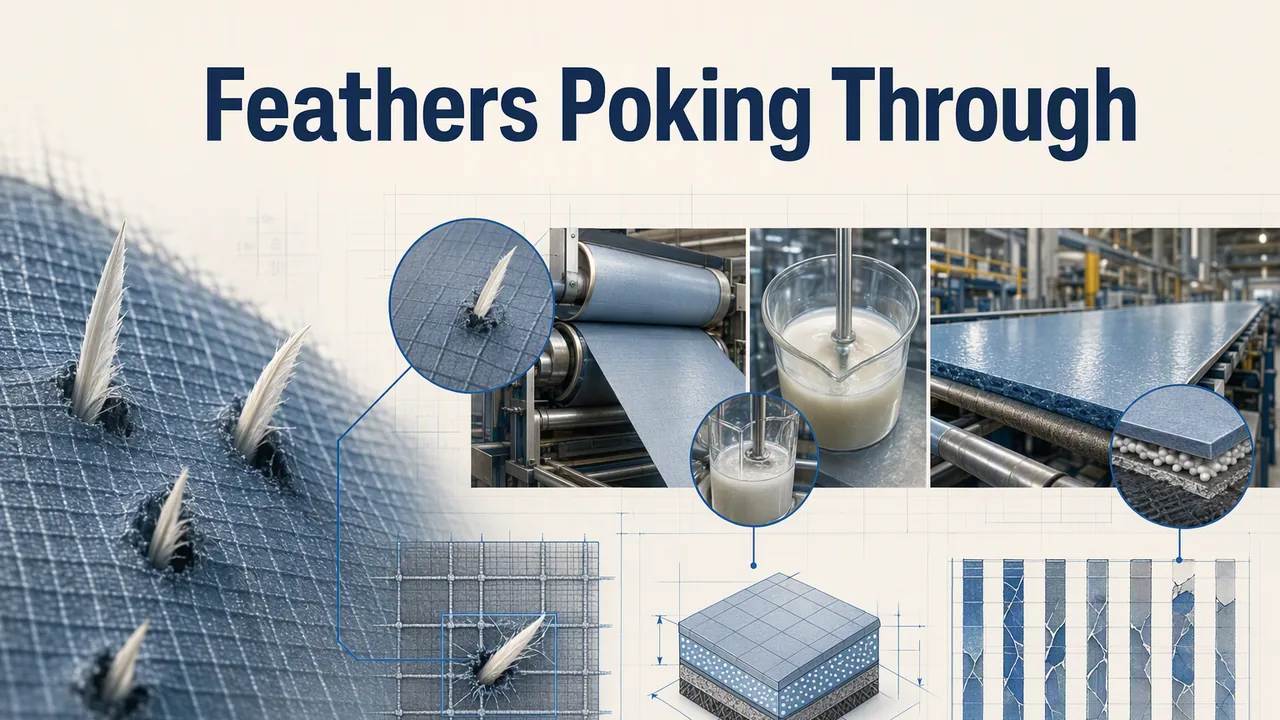
The claim file had three photos and one sentence. An outdoor brand ran a 90/10 goose down program on 20D ripstop nylon, put twenty finished jackets through retail laundering, and quill tips stood out of the shell at the seam allowances and every second yarn crossing. Down retention had fallen from 96% to 93% on the bulk sample. The fabric mill pointed at the down supplier. The down supplier pointed at the coating. Everybody was wrong: the film had passed the fabric-out test. It had not survived being sewn, flexed and washed.
Where the Feather Actually Gets Out
A down-proof coating does not close the fabric like a tarp. It glazes the yarn crossings so the channels between threads get narrower than the largest quill can present itself, and it adds a skin that a puncture has to push through and then hold open. Two things defeat that, and they are physical, not chemical.
First, the needle. A stitch line is a row of forced openings, and every flex cycle of the garment works the needle hole wider. If the coating film is stiff, it cracks around the hole instead of snapping back, and the hole stays open. That is why migration concentrates at seams and never on the flat panel between them.
Second, elasticity mismatch. A quill tip is a wedge that loads in thousands of small cycles, not one big pull. A film with 4 MPa tensile strength and 150% max elongation is tough and still useless here, because it is inelastic. What you need is a coating that stretches with the down pushing into it and recovers before the tip finds a foothold. In our tech-service data the pass-or-fail variable on 15D to 20D shells is elongation, ahead of everything else.
Coverage Math Comes Before Resin Selection
Before any shopping for grades, close the two coverage holes that mimic a bad resin. The first is one-sided coating. A face-side glaze on an open high-count weave still leaves straight channels from the back; down-proof shells want a film on both faces, at modest pick-up rather than a heavy pass on one side. Typical line targets sit in the single-digit to low-teens grams per square meter per face; go there twice and let the crossing geometry do the sealing.
The second is apparent coverage versus real coverage. A viscous mix bridging the tops of a ripstop grid can look continuous at the yarn intersections while leaving voids underneath them. Thinning the emulsion past the point of wetting does not fix it either; the mix floods some crossings and starves others. Check with a light table and a section, not from ten meters on the rolling table.
Reading the Failure Mode, Column by Column
| Symptom | Why | Fix |
|---|---|---|
| Quills only along stitch lines | Needle holes widened by flex; film cracked at the hole | Elasticity first, then seam tape; the panel coating is not the problem |
| Migration at scattered yarn crossings | Void under the crossing despite surface gloss | Two-side coating at lower pick-up; verify on light table |
| White crack lines at folds | Stiff or over-cured film; exceeded recovery strain | Softer high-elongation grade; cut oven temperature |
| Passes fabric-out, fails after washing | Surfactant-plasticized film and enlarged needle holes | Retest after laundering; consider crosslinker below |
| Fuzz on the surface, no down | Yarn slippage and fiber breakage | Weave and finish question, not a coating one |
The Elasticity Window on 15D to 20D Shells
Once coverage is honest, the resin question is mostly a numbers question, and the numbers have to sit in a narrow window. Our down-proof grade YT-206 is built for exactly this lane: a waterborne polyurethane dispersion at 30 ± 1% solids and pH 6.5–7.0 whose film runs a 100% modulus of 1.0–1.5 MPa, 4–5 MPa tensile, and elongation above 1200%. That shape, soft and stretchy rather than strong and springy, is what keeps the needle hole closed through a wear cycle. Adhesion to nylon is the second reason it holds on siliconized ripstop where generic films lift. And because YT-206 is aliphatic, white and pastel shells stay white; we covered why that matters under light in the aromatic versus aliphatic yellowing note, and the same backbone logic applies on a garment rack. Full film properties are on the YT-206 TDS.
The window has two hard edges, and we lose one program a year to each. Below the window, a tacky low-solids film feels great on the hand and pumps air through the crossings; down walks straight out. Above it, a crossloaded or over-cured film passes every dry test and cracks the moment a quilting line flexes cold. If your lab only measures down retention on coated fabric without seams, you are testing the wrong specimen.
Cure, Crosslinker, and the Post-Wash Retest
Coating cured at too high an oven setting embrittles the film, and the damage is invisible until a fold test. Down-proof lines usually run hot-air cure in the 90–110 °C range at the exit frame, one to three minutes depending on pick-up; the right target is the mildest cycle that fully coalesces the film, and that is set on the line by fold and cold-flex, not by the drying lamp.
Wash durability is the other lever. A textile coating that survived 20 home launders is a different product from one that survived 20 launders and still holds quills; the interaction is in the needle holes, where detergent softens the film edge and mechanical agitation works the hole. The laundering sequence itself follows normal ISO 6330 household washing practice, and we retest retention after five cycles, not before. When a program needs a hand-feel-preserving lift in wash fastness, 1–2% of a compatible carbodiimide crosslinker on the mix helps; the trade is a firmer drape and a 24-hour use window on the crosslinked batch, and we would rather flag both to you at trial stage. What a crosslinker does not do is rescue an inelastic film. Post-wash migration on a hard film is still an elasticity problem wearing a washing costume.
For a broader view of what actually drives wash and dry-clean loss in textile films, the earlier wash and dry-clean durability note covers the hydrolysis side that laundering exposes.
Down-Proof Fabric FAQ
Does more coating pickup always mean less feather migration?
No, and past a point it is negative. Enough film to seal the crossings is the goal; a thick stiff glaze cracks along quilting and stitch lines, and every crack is a door. Two thin faces beat one heavy face in our trials, near universally.
Acrylic or polyurethane for a budget down-proof shell?
Acrylic films are cheaper and harder, with elongation typically in the low hundreds of percent. On 20D and heavier with generous seams they can work. On 15D ultralight, cold-weather programs, or anywhere the garment flexes a lot, a high-elongation polyurethane like YT-206 is the only lane that survives a wear cycle, and we stop quoting acrylic for those specs.
Do washes really increase feather loss?
Yes, measurably, mostly through enlarged needle holes and plasticized film edges rather than bulk film loss. Score down retention only after laundering the sewn specimen; a fabric-out pass is a screening result, not a certificate.
If your retention drifts after five washes or migration clusters at seams, send us the shell swatch, the stitch spec and the down mix. We will run the coated-seam specimen and the line of advice will be specific, down to pick-up per face.