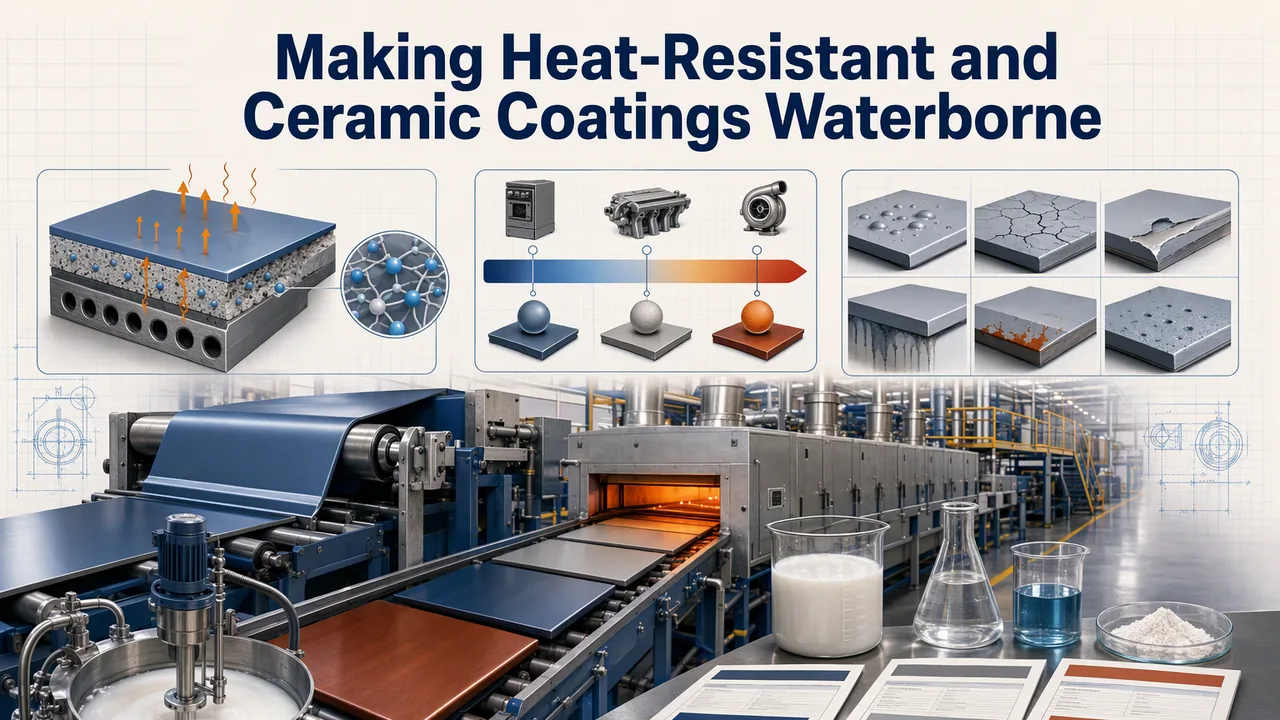
The first line I was asked to convert ran a solvent ethyl silicate primer. It sat in a steel stamping shop: forty parts a rack, one dip, and an oven that spent most of the afternoon pushing ethanol out of a booth. Their permit renewal put a VOC ceiling on the building the following spring. The question arrived in the form these questions usually arrive in: can the same heat resistance run on water?
Twelve months and three rebuilt lines later, I would say this is not a thinner swap. In a heat-resistant or ceramic coating, the binder is a temporary structure. What survives the first firing is the inorganic network it leaves behind. Almost everything that changes during conversion is about how slowly that network gets its water out.
What the Binder Does on the First Firing
Solvent inorganic systems run on hydrolysis at ambient. Alkoxy groups meet moisture in the air and become silanol. They then link into Si-O-Si and release ethanol, and that ethanol is the fraction your scrubber signs for. What remains on the part is silica, plus whatever metal oxides the pigment loading brought along. That is why a correctly cured ethyl silicate primer is comfortable at 400 °C and an epoxy is not.
The waterborne heat-resistant route carries the same oxide backbone in a different vehicle. It is an alkali-stabilised silicate dispersion, and it condenses as the water leaves and the pH relaxes downward. Ours is YT-6033, an inorganic silicate resin at 32 ± 1% solids, pH 9–11, specific gravity 1.208 at 20 °C, rated for roughly 1200 °C in service.
What differs is the drying, and it differs a lot. Water needs more energy to leave a film than ethanol does. Part of it also leaves through the interface with the substrate rather than through the surface, so the flash-off window gets longer. Shop humidity starts to matter in a way it never mattered before. In our lab we have lost more converted lines to that one fact than to anything the inorganic chemistry does.
Picking a Waterborne Grade by Service Temperature, Not Line Speed
Three thresholds decide the formula. Line speed only argues about where they sit.
Under about 120–150 °C continuous, do not buy inorganic chemistry at all. A conventional waterborne polyurethane or acrylic does the job and costs less per kilo. Above that window a PU film does not fail in the furnace. It fails in the first hot summer on a shipping pallet, which is a worse way to find out. For furniture and joinery work in that band we keep our coating grades and their numbers on the wood coating pages.
Ceramic, glass and sanitaryware surfaces are the interesting middle. These coatings never see 200 °C in service, yet they were baked at 200 °C for hardness alone. That is where a single-component air-drying inorganic silicone earns its place. YT-6505 runs 18 ± 1% solids at pH 7–10 and reaches 5H pencil. YT-6508 runs 20 ± 1% solids in the same pH window at 4H–6H, with noticeably more toughness for parts that flex or thermal-cycle. Both bond to metal, glass, ceramic, plastic and wood without a separate primer, and both sets of figures sit in the YT-6505 and YT-6508 TDS sheets.
Above roughly 600 °C, and anywhere a film has to hold water and solvent resistance alongside heat, YT-6033 is the only one of the three grades that still has a coherent film protecting the part.
Be honest about what the conversion buys, because it is not the heat number. On the ceramic side it buys the oven. A coating that reaches its hardness in air does not warp a plastic bezel, does not sit at the end of the line as a bottleneck, and does not burn gas. What it does not buy is speed on a cold morning. YT-6508 hardens without an oven, yes, but the crosslinking continues slowly at room temperature. The 4H–6H figure therefore means whatever your own cure profile delivered. Measure it on your panel before you quote it to a customer, and expect a part packed too early to come back wearing the impression of its own carton. The cost arithmetic we laid out for reducing VOC in industrial coatings carries over to inorganic binders, with the oven rather than the coalescent doing the saving.
Six Ways a Converted Line Fails in Its First Month
Every conversion we have debugged hit some subset of this list. The symptoms read like coating defects. They are water-management defects.
| Symptom on the line | What it is telling you | First move |
|---|---|---|
| Milky haze or blushing right after the first dry | Water closed under the skin because flash-off was too short for the humidity in the plant | Give the part 5–10 minutes of open flash before it sees heat, then re-time the oven. Do not raise the setpoint to chase haze |
| Pinholes along weld seams and inside corner radii | Trapped water walks out through a sintered or profiled steel part after the surface has set | Thinner first coat with a longer flash. On dipped racks, drain and tap before the oven door opens |
| Adhesion excellent on raw glass, gone on a glazed tile | Inorganic films anchor to surface hydroxyls. A glaze or detergent residue has almost none left to grab | Abrade or flame-wet the glaze, then run cross-cut per ISO 2409 before the batch, not after |
| Chalking and powdering at the first heat-up | An organically modified grade pushed past its service limit, or an inorganic film carrying too much organic pigment | Re-read the service temperature against the grade table. Then rebalance pigment loading instead of blaming the binder |
| Flash rust on bare steel within an hour of spraying | pH 9–11 silicate plus water on an unpainted metal surface | Dose a flash-rust inhibitor and get the part into primer within 30 minutes of preparation |
| Viscosity climbing toward gel in a drum or IBC | Buffer amine lost through an open lid or warm storage. pH drift pulls the dispersion down | Sealed dosing, lids on, and stock kept between 5–30 °C, which is the storage window on the YT-6033 TDS |
How We Qualify a Converted Panel
Six checks. We run them on the customer substrate rather than on a clean steel drawdown, because that is where the argument usually dies.
- Pencil hardness per ASTM D3363. Read it at both ends of the cure window the line can actually offer.
- Cross-cut adhesion per ISO 2409 on the real surface. Test its cleaned and its weathered condition separately.
- A furnace cycle with a thermocouple spot-welded to the part, not trusting the setpoint. Ramp to target, hold one hour, cool, then photograph at 200, 400 and 600 °C.
- Damp heat at 40 °C and 90% relative humidity for 240 hours. This is where waterborne conversions fail late, and it is the test most shops skip.
- Gloss at 60° before and after that damp heat. Add a carbon-marker wipe on a glazed ground for any anti-soiling claim you intend to print.
- Three freeze-thaw cycles before you sign for a container. Silicate dispersions are not frost-tolerant, and YT-6033 is one more of them.
Six to eight weeks is a realistic qualification budget for one conversion. The failures come in a pattern worth knowing. In the last five lines we helped convert, the first rejection came from adhesion to a glazed surface or from damp heat. Heat resistance caused none of them.
Grade at a Glance
Three grades, three different jobs. The parameter columns are published figures. The last column is what we actually see them used for.
| Grade | Chemistry | Solids | pH | Hardness / heat | Where it goes |
|---|---|---|---|---|---|
| YT-6033 | Inorganic silicate resin | 32 ± 1% | 9–11 | About 1200 °C in service | Industrial paints on hot parts, floor coatings on hard substrates, art and wood topcoats that need weathering plus heat |
| YT-6505 | Modified inorganic silicone, 1K air-drying | 18 ± 1% | 7–10 | 5H pencil | Sanitaryware, ceramic and glass surfaces, terrazzo and hardened floors where mar and stain resistance decide the sale |
| YT-6508 | Modified inorganic silicone, 1K air-drying | 20 ± 1% | 7–10 | 4H–6H, tougher film | Coating and bonding on ceramic and glass, tunnel panels, parts that flex or cycle in temperature |
Take the boring part if nothing else. The pressure that started the conversion is still there, and the EPA VOC guidance that framed it has not softened since the day you wrote your business case. If your solvent line already hits gloss and adhesion targets, a waterborne inorganic coating will not beat those numbers on the first pass. Decide whether the permit is the real reason before you spend eight weeks finding out. If it is, pick the two hardest panels you own and send them with your oven profile. We will put the waterborne numbers next to the solvent ones on the same substrate.
Questions from the Conversion Trial
Does a waterborne inorganic coating survive the same temperature as the ethyl silicate it replaces?
At temperature, yes. Both end up as an oxide network, and YT-6033 is rated to about 1200 °C. The solvent drum keeps two narrower advantages: flash-off on cold steel, and initial grab on a glazed or barely prepared surface. Neither is a heat argument. Both are fixable with preparation time.
Do I still need the oven?
For the two air-drying grades, no, and the whole business case usually sits there. For the silicate, the water has to be driven out rather than left to drift out. A warm flash does more for it than a longer ambient dwell. How much more is a line trial, and we would rather run it against your panel than guess in an email.
Will it go through my existing spray equipment?
Mostly, with one hard caveat. A pH 9–11 silicate will attack an aluminium wetted path, and it is not kind to carbon steel. Stainless or plastic-lined pumps and fluid paths are the starting point, not an upgrade. Flush with water before the shift ends. The YT-6505 and YT-6508 dispersions run at 18–20% solids, so tip sizes usually transfer from the solvent gun without drama.
Send the substrate, the failed panel and the oven curve. We will run the same six checks and put the results next to your current line: ask our application lab.