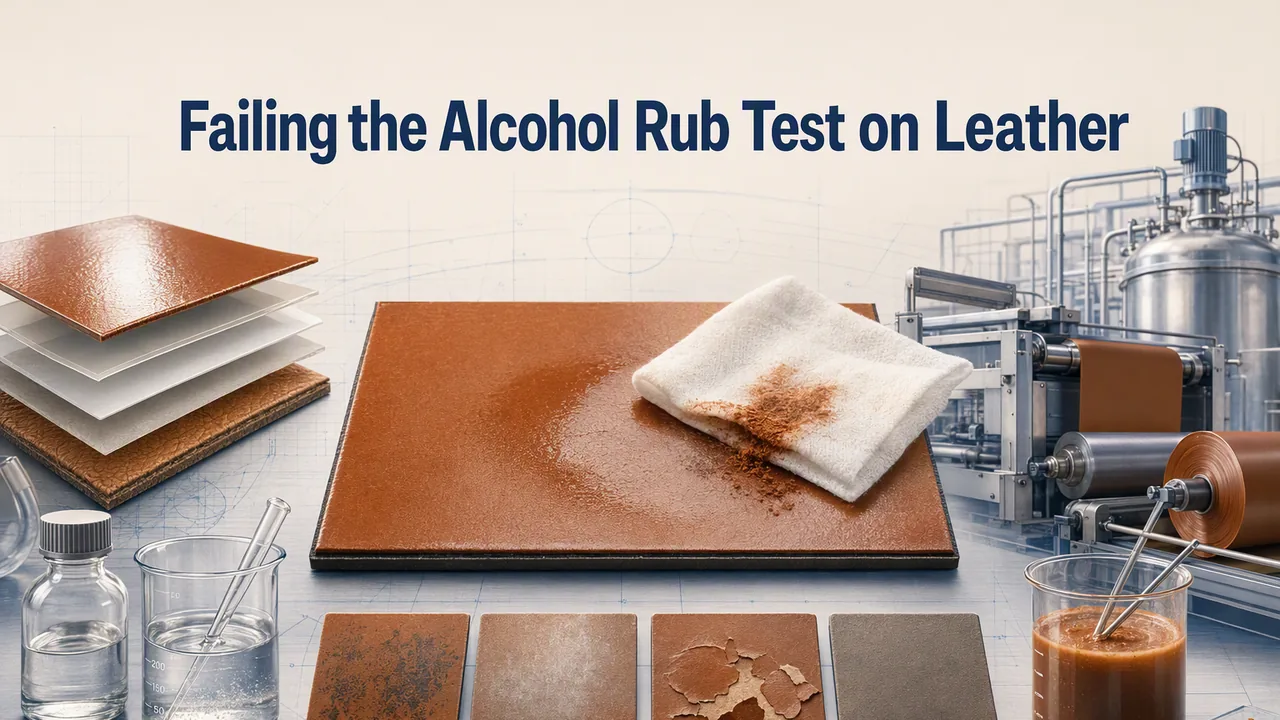
The call came from a motorcycle seat cover supplier in Zhejiang. A European brand had pressed a cotton pad soaked in 50 percent ethanol, under a 500 g weight, against their off-black topcoat and rubbed. Forty double rubs in, the pad came up grey and the 60-degree gloss had halved. The same panels had passed water spotting, cold flex and hydrolysis aging the week before. An alcohol wipe is a different failure mode, and a plain waterborne polyurethane topcoat is not built for it by default.
Why an Alcohol Wipe Beats a Coating That Shrugs Off Water
Water and ethanol attack a film for different reasons. Water sits on a well-formulated topcoat because the surface is set up to shed it. Ethanol has a solubility parameter close enough to the polar segments of a polyurethane that it wets into the film itself, plasticizes it, and knocks the surface Tg down within seconds. What feels like abrasion under the pad is mostly dissolution: softened binder releases pigment particles, and the cotton carries them off.
Hydrophilic content makes it worse. An anionic waterborne polyurethane dispersion carries carboxylate groups along the chain, and those groups hold residual water long after the film feels dry. A swollen, water-plasticized film lets ethanol go deeper and faster. In our lab we look at two variables before blaming the rub machine: how much ionic character the backbone carries, and whether the soft segment is polyether, polyester or polycarbonate. Polyether resists swelling better than polyester, and polycarbonate beats both under a solvent pad, because the backbone is regular, hydrophobic, and has no pendant ester for the ethanol to work into.
Backbone selection decides other failures too. If you have been chasing b-value drift on pale finishes, the aromatic versus aliphatic conversation in our leather topcoat yellowing note is the same chemistry question, scored under a light box instead of a rub pad.
Settle the Test Protocol Before You Blame the Resin
Two factories can run the same formula, report 30 rubs versus 90, and then argue about chemistry. Most of the time they are arguing about protocol. Our wipe rig borrows the geometry of the ASTM D4752 solvent rub method: a cotton pad under 500 g, saturated with the stated ethanol-water mix, figure-eight strokes, one double rub counted per forward-and-back pair. Swap MEK for ethanol and you have the brand wipe spec in all but name.
Three protocol details move the score more than the resin does:
- Test after full cure plus 48 hours of rest. A panel pulled straight from an 80 °C oven can score twice as well as the same panel next month, and nobody wants to hear that during an audit.
- Score color transfer onto the pad and gloss change at 60° as two separate endpoints. A film that loses gloss but does not print the pad is swollen. A film that greys the pad has released pigment, which is the failure the brand actually rejects.
- Test near the real service temperature. Seat surfaces hit 60 °C in a southern summer, and warm ethanol attacks polar segments considerably faster than ethanol at room temperature.
What Each Failure Looks Like, and What Fixes It
| Symptom | Why | Typical fix |
|---|---|---|
| Pad picks up color within 50 rubs | Clear coat too thin or undercured; binder releases pigment | Build film thickness, raise cure, or change backbone |
| Gloss drops, no color transfer | Film swollen but intact, surface micro-roughened | Add crosslinker, cut hydrophilic group content |
| White haze where the pad passed | Residual water and carboxylates redeployed at the surface | Longer flash-off and cure; review neutralizer choice |
| Passes at 24 hours, fails at two weeks | Physical drying counted as cure; slow solvent release | Fix the bake profile before touching the formula |
| Same drum, 30 versus 90 rubs | Protocol drift: pad saturation, stroke rate, endpoint definition | Write the method down, then hold everyone to it |
| Topcoat survives, printed base color bleeds through | Alcohol reached the color layer past a porous topcoat | Denser topcoat, or seal the base first |
The Backbone Does Most of the Work
If the protocol is honest and the panel still greys the pad at 50 double rubs, change resin. On our shelf the grades that clear high alcohol-rub specs without heroics are the polycarbonate-based anionic dispersions YT-5137 and YT-5140. YT-5137 runs at 37 ± 1% solids, a 100% modulus of 2.5–3.5 MPa and elongation above 700%, so it keeps a soft hand and its gloss on supple grain. YT-5140 sits at 40 ± 1% solids and 4–6 MPa modulus for finishes that also take keys, buckles and an occasional ballpoint pen. Both hold pH 6.0–8.0 and stay below 1000 mPa·s at 30 °C, so they spray and roll without a solvent kick. The YT-5137 TDS and the YT-5140 sheet carry the full tables. Synthetic leather finishing is where these wipe specs concentrate, but the substrate is part of the answer too: a softer backbone will not rescue a pigment paste that was never built for wipe duty.
A tough polyether film can still fail this test, which is worth saying out loud in a market full of polyether workhorses. The chain survives the rubbing. The chemistry underneath the pad does not survive the ethanol. We keep polyether resins on programs scored by flex and hydrolysis, and we route wipe specs to polycarbonate instead of arguing with the pad.
The Last 20%: Crosslinker and Oven Discipline
Once the backbone is right, the last stretch of rub resistance is bought with crosslinking. Our YT-G30 carbodiimide is 50 ± 2% solids on a PMA carrier at 80–150 cps, thin enough to disperse without effort, and we typically dose it at 1–3% on the 100%-solids weight of the topcoat. It reacts with carboxyl groups in the chain, which is exactly what makes it waterborne-compatible and also what makes it perishable: carbodiimide hydrolyzes in water, so mixed material that sits overnight is scrap, and a spray tank you cannot empty in one shift is the wrong system for this chemistry. Pot life is the tax you pay for the extra rubs.
The second trap is the oven. Touch-dry is not cured. We set programs around 80–100 °C for 3–5 minutes after a proper flash-off, and we score alcohol rub only on panels that have been through the full cycle. And crosslink density is not free: every point of YT-G30 takes a measurable bite out of elongation, so on winter-rated or deeply embossed article we re-run cold flex and grain-crack before approving anything.
Alcohol Rub Test FAQ
Is isopropanol harder on a topcoat than ethanol?
Slightly milder as a swelling agent, but brands increasingly wipe with 70% IPA because that is the disinfectant that actually reaches the product. Build to the worst case in the customer's own protocol. If they have no protocol, run 50:50 ethanol-water and 70% IPA and quote the lower number.
Can I pass 100 double rubs without a crosslinker?
Yes, on a polycarbonate resin with a proper cure and enough film on the substrate; we see it routinely on coated leather goods. On a polyether without crosslinker, we have not seen a stable pass at 100, and we would not promise one.
Will alcohol resistance hurt low-temperature flexibility?
Only if you buy all of it from crosslink density. Backbone choice costs almost nothing; carbodiimide at 2–3% does cost elongation, so re-run cold flex on any winter spec before you ship.
If your rub scores scatter more than ten double rubs between good and bad batches, send panels and the written protocol to our application lab. We will score backbone and cure content side by side and tell you which one is moving you.