We priced two rheology packages for a 200 L exterior semi-gloss last spring. The cheaper one came in 30 percent under per kilogram. The plant bought it, ran three batches, and read 4 percent off-spec on Stormer consistency before the fourth one passed. That one rework cost more than the thickener saving for the whole year. We keep meeting this trap. Formulators compare HEUR, HASE and cellulosic thickeners on price per kilogram, then discover the bill moved somewhere else in the formula.
Rheology is the cheapest line on the batch sheet and the most expensive one to get wrong.
What each thickener chemistry actually builds
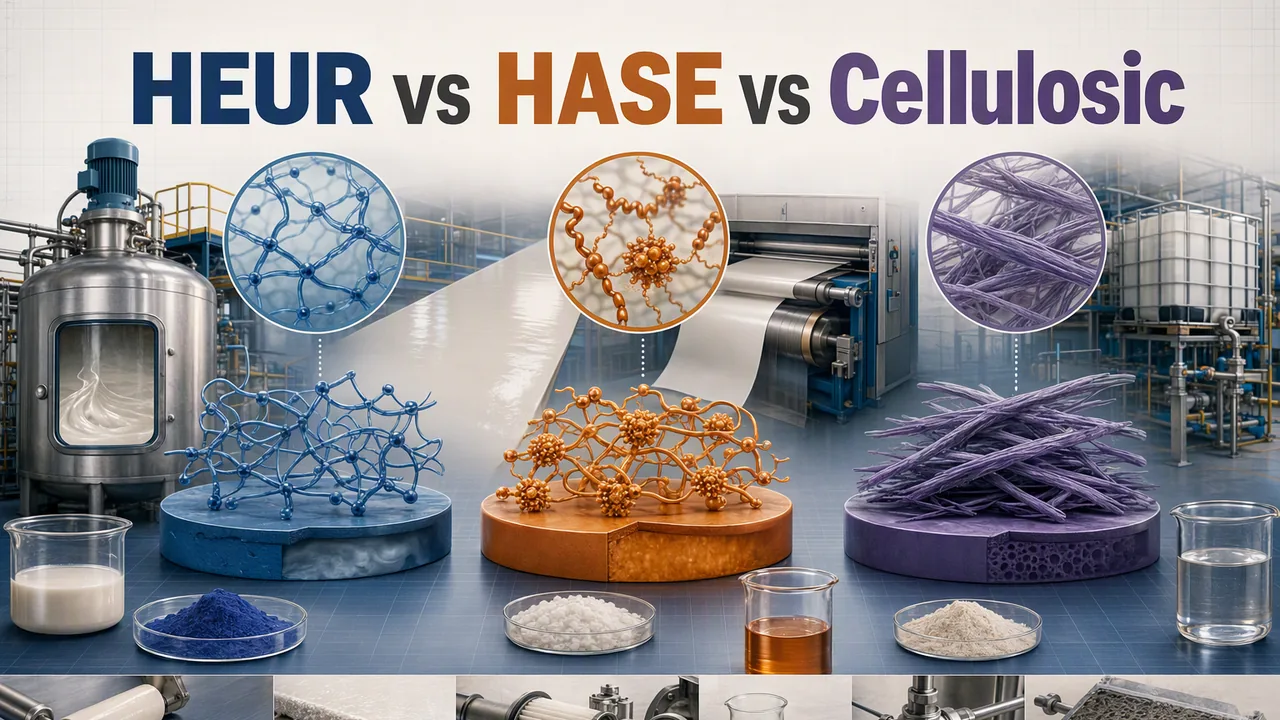
Cellulosics thicken the water. Hydroxyethyl cellulose and carboxymethyl cellulose dissolve into the aqueous phase, entangle, and lock up free volume. You get a strong structure at rest: the paint sits in the can and resists sag on a vertical wall. You also get a wet film that holds water like a sponge. Flash-off slows, early block resistance drops, and the coat underneath stays soft longer than you want. That is the classic HPHV shape, thick at rest and thin under the brush, with a leveling penalty built in.
HASE and HEUR thicken the particles instead of the water. Both are associative. Hydrophobe ends on the chain anchor onto latex and pigment surfaces and bridge between them, so the network sits where the film actually forms.
HASE, the anionic type many suppliers still call HEAA, carries carboxyl groups along the backbone. You neutralise them with AMP-95 or ammonia to uncoil the chain and disperse it. That charge is why HASE loves pigment paste and works well in the mid-shear region during application. It is also why HASE misbehaves when a system drifts. Take pH down toward 6.5 and the carboxyls protonate, the coil shrinks, and viscosity falls off a cliff. Hard water with calcium in it does the same damage from the other direction. Overdosing is worse than underdosing; anionic thickeners peak, then collapse.
HEUR carries no charge, so it needs no neutraliser and no pH window. Our YT-255A, YT-255B, YT-255C, YT-255D and YT-255E all sit at pH 6 to 8 and can enter the grind or the let-down without pre-dilution. YT-330B is the same non-ionic logic at 30 ± 1% solids, with a drum viscosity of 20,000 to 30,000 mPa·s.
Non-ionic is not free of behaviour. Association is temperature dependent. An identical dose reads thinner in a 35 °C plant in July than in a 15 °C store in January. We write that into the QC spec instead of fighting it with a second shot of thickener.
Cellulosic thickener vs associative: split the package by shear
Buyers ask which thickener is best. The better question is which shear region is currently costing you money. A can that separates, a roller that spatters and a pump that cavitates are three different problems, and three different chains solve them.
| Shear region | What the line is doing | Chemistry that wins | Grades we reach for |
|---|---|---|---|
| Low (Brookfield 1 to 20 rpm) | Storage, settling, sag on a vertical panel | Cellulosic HPHV, or a low-shear associative | YT-255E (12W / 299 replacement), YT-255A (105A replacement), YT-155A |
| Medium (brush and roller) | Pick-up, spatter resistance, film build | HASE, or a medium-shear HEUR | YT-255B (8W replacement), YT-330B |
| High (pump, screen, spray) | Line throughput, leveling, gloss | High-shear HEUR | YT-255C (PS166 replacement), YT-255D (2020 replacement) |
Dose windows are narrow for most of our waterborne thickener range. The five HEUR grades above are specified at 0.5 to 2.0 percent of the formula. YT-155A carries a much wider stated window: 0.5 to 20 percent. We use the top of that range only for waterborne adhesives and ink extenders, never for paint.
The hidden line items a per-kilogram quote drops
This is the audit we run when a customer asks us to beat an incumbent rheology package on price. Six questions, in the order they usually bite.
- Price per kilogram of active solids. A 40 percent product at 1.8 times the price of a 30 percent product is not more expensive. Compare YT-255B at 40 percent, YT-330B at 30 ± 1 percent and YT-155A at 30, 40 or 50 percent on the same solids basis, or the quote is meaningless.
- Neutraliser cost and pH control. HASE drags AMP-95 or ammonia at roughly 0.1 to 0.3 percent of the formula, plus a pH check on every batch. HEUR removes that line entirely.
- Biocide loaded for the cellulose. Cellulosics are food. If can stability relies on HEC, part of your preservative package is really a thickener tax. Microbial viscosity loss is common enough that shelf-life viscosity loss is a standing topic in our lab.
- Gloss you have to buy back. The water-holding film cellulosics produce costs measurable 60-degree gloss in a semi-gloss. You recover it with binder, not with the thickener.
- Coat interval and line speed. Slow flash-off pushes the second-coat window on any automated waterborne wood coating line. Two extra minutes per panel is real money at 120 panels an hour.
- Rework. The off-spec batch, the drum pulled back to the blender, the operator adjusting on the fly. This is where cheap packages lose their advantage.
Costing the package per finished litre
Here is a worked example from a current formulation. We use price indexes rather than currency so you can drop in your own supplier numbers. Target: 2,500 mPa·s on a Brookfield RV at 20 rpm, KU around 98, no roller spatter, 60-degree gloss at 70 or better.
Assume active-solids price indexes of 1.0 for a cellulosic, 1.5 for HASE and 2.2 for HEUR. Package A is HEC at 0.30 percent plus a high-shear associative at 0.35 percent, for an index cost of 1.07. Package B is HASE at 0.90 percent plus HEUR at 0.55 percent, for 2.49. Package C, all-associative, runs YT-255A at 0.45 percent with YT-255C at 0.55 percent, for 2.20. On the thickener line alone the cellulosic hybrid wins by a factor of two.
Then add the hidden items. Package A pays a preservative surcharge, gives up gloss and reads worst on spatter. It loses the semi-gloss job despite having the cheapest line item. Package B is the one we avoid in exterior topcoats. You are buying a pH-sensitive ingredient into a product that sits in a metal drum for a year. Package C costs roughly twice as much as A in the tin. It usually lands ahead of B on finished litres, once you stop neutralising and stop chasing gloss.
The ranking flips for high-pigment work. In ink concentrates and colour pastes the picture changes. HASE carries a charge and binds to pigment surface, which makes it the most efficient thickener per unit of solids we have measured. HEUR can float in those same systems. There we let YT-255D handle flow and leveling and leave mid-shear build to the anionic product. Pull the YT-255C technical data sheet and the YT-330B data sheet before you commit a package. Both state solids, pH window and recommended dosage, so you can run this index maths against your own price list.
Questions formulators ask us
Can I replace HEC completely with a HEUR thickener?
Often yes, but not for free. YT-255E gives strong pseudoplasticity at low shear with better pigment wetting and no biocide tax, so can stability survives the switch. What changes is water retention. Cellulosic films hold water longer. Some exterior renders and high-filler systems need that to stay open on the comb and to resist sag on thick applications. In those we keep a small HEC tail rather than pretend one associative does both jobs.
Why does my HASE thickener lose viscosity when I add pigment paste?
Two causes, and they look identical on the viscometer. The paste carries residual surfactant or a buffer that shifts system pH, and the carboxylated chain collapses as pH drops toward its protonation range. The other is ionic strength from hard water or dispersant salts screening the charge. Check pH before you add more thickener. Pushing extra HASE into a collapsed system takes you past the peak and down the far side. That is how a plant doubles its dose and still misses KU.
How do I compare two rheology packages fairly?
Never on one Brookfield reading. Log the curve across the three shear regions. Then measure what the buyer cares about: sag on a drawdown card, spatter on the ICI frame, gloss after cure, and the second-coat interval. Price the passing package per finished litre, including neutraliser, biocide and rework. That is the only comparison we have found that predicts Monday morning on a production line.
Send us your binder, pigment level and target consistency, and we will run the three-way curve on your formula. Then we quote the package on finished litres. Ask our application lab for the rheology audit.